In a horrible incident Pakistan Honor Killing Video Sparks Outrage, 13 Arrested in Balochistan. In yet another chilling case of an alleged “honor killing,” a couple was shot dead in broad daylight in Balochistan, Pakistan, after being accused of having an “illicit” relationship. The brutal murders, captured in a disturbing viral video, have sparked national and international outrage, prompting the arrest of 13 people, including a tribal leader.
The killings underscore the persistence of honor-based violence in Pakistan, a practice deeply rooted in tribal customs, patriarchal control, and weak enforcement of human rights laws. The incident, which occurred in a desert region near Quetta, Balochistan’s capital, has exposed the ongoing clash between modern law and traditional authority in parts of the country.
Pakistan Honor Killing Video Sparks Outrage, 13 Arrested in Balochistan
Viral Video Captures Chilling Execution of Couple
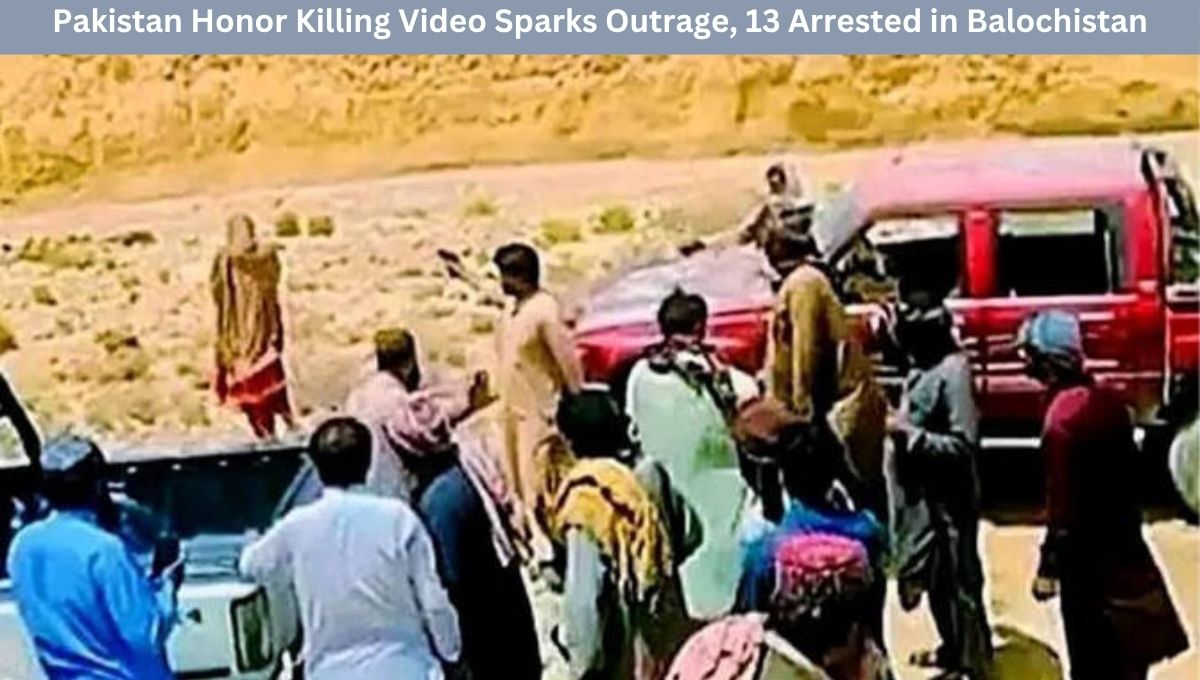
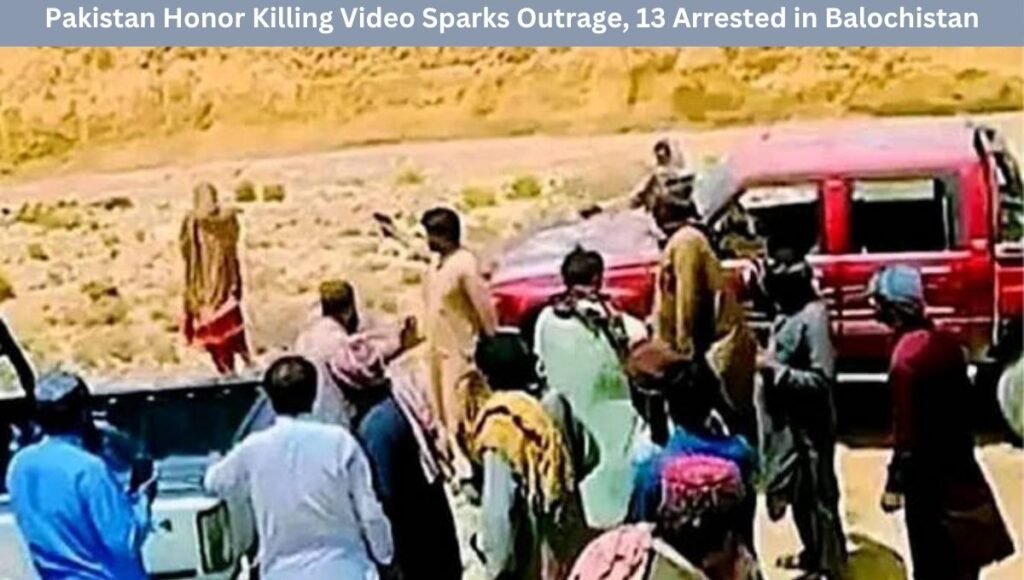
The video, which quickly went viral on social media, shows a group of armed men surrounding a few SUVs in an arid desert area.
A woman, her head covered with a shawl, is seen walking solemnly in front of one of the vehicles while holding a copy of the Quran.
In the Brahvi language, she is heard saying, “You are only allowed to fire at me, nothing else.” The man following her raises a pistol and shoots her at close range.
Shockingly, she remains standing after two shots and collapses only after a third. Another round of gunfire follows, capturing the murder of the man accused of being her partner.
A second video shows their bloodied bodies lying side by side in the sand.
Authorities have confirmed the incident’s authenticity, and Balochistan’s Chief Minister Sarfraz Bugti declared it a “blatant violation of human dignity and social values.”
Victims Identified: Misrepresented as a Married Couple
Initial reports claimed the victims were a couple who had recently married against their families’ wishes. However, Chief Minister Bugti clarified in a press conference that the two were not married to each other.
The slain woman, identified as Bano Bibi, was already married with five children. The man, Ehsan Ullah, was between 45 and 50 years old and also a father of four or five children.
“This was not a case of elopement,” Bugti said, adding that the local tribal court had issued an order to execute them based on an accusation of having an illicit relationship.
Arrests and Government Response
After the video surfaced online, police swung into action. At least 13 suspects, including the tribal leader Sardar Sherbaz Khan, were arrested.
Chief Minister Bugti said he had ordered the Inspector General of Police to arrest all involved within 24 hours. Raids are continuing to apprehend remaining suspects.
A First Information Report (FIR) lists eight named suspects and 15 unidentified individuals, with charges including premeditated murder and conspiracy.
Authorities also suspended the Deputy Superintendent of Police in the area for failing to report the crime when it occurred.
Despite the arrests, Bugti noted with concern that no family member of either victim has come forward to file a complaint. “Not a single person is ready to come forward as a victim,” he said.
Rooted in Patriarchy: The Culture of Honor Killings in Pakistan
So-called honor killings remain disturbingly frequent in Pakistan. In 2024 alone, more than 547 honor killings were reported nationwide, including 32 in Balochistan, according to the Sustainable Social Development Organisation (SSDO).
However, only one case in Balochistan has led to a conviction so far, reflecting a broader issue of impunity.
These killings are often driven by tribal councils or family elders who believe a woman’s behavior has dishonored the family.
Defying marriage traditions, falling in love, seeking divorce, or even speaking out publicly can be grounds for execution in such patriarchal setups.
Human Rights Groups Demand Justice
The Human Rights Commission of Pakistan (HRCP) issued a strong statement condemning the murders and calling them a “tyranny of medieval practices.” Harris Khalique, HRCP’s General Secretary, stated:
“The state, instead of enforcing the rule of law, has historically protected feudal lords and tribal chiefs who perpetuate such practices to retain control over local populations.”
Activists argue that Balochistan’s fragile governance structure characterized by tribal influence and weak civil institutions makes it a hotbed for such violations.
‘Women Are Trapped Between Tribal Violence and State Neglect’
Sammi Deen Baloch, a prominent Baloch women’s rights advocate, issued a scathing criticism of both tribal and state systems, calling the incident just one example of how Baloch women are routinely sacrificed at the altar of power politics.
“Women in Balochistan are murdered for love, disappeared for protest, and buried under layers of tribal authority and state-backed silence,” Baloch said. “These are not isolated tragedies they’re the cost of a system designed to keep women expendable.” She added that the government would have likely ignored the case entirely had the video not gone viral.
Cultural Practices vs Legal Reform: A Legal System in Conflict
Pakistan amended its laws after the 2016 murder of social media star Qandeel Baloch, who was killed by her brother in an “honor killing.”
The legal changes ensured that perpetrators could no longer escape punishment through family pardons. Despite that, the enforcement remains weak.
Experts say that unless Pakistan dismantles parallel systems of tribal justice and empowers civil law enforcement, such crimes will continue unabated.
Silence, Fear, and Underreporting
The current case also highlights a widespread culture of fear and silence. No relative of either victim has approached the police to lodge a formal complaint.
Victims’ families often fear retribution or share the same beliefs that led to the killings.
In many instances, women are denied access to legal support, education, and employment, further marginalizing them and increasing their vulnerability to such crimes.
According to reports, more than a dozen people stood by and watched as the couple was executed. None intervened.
This reflects not only the power of tribal commands but also a collective normalization of honor-based violence in certain rural communities.
One observer noted that the woman held a copy of the Quran and requested to take “seven steps” with the man perhaps symbolizing a makeshift marriage in a desperate bid to protect herself. Yet her plea was ignored.
Media’s Role: From Silence to Exposure
The widespread circulation of the execution video forced authorities to act, suggesting that digital media can play a pivotal role in exposing hidden violence.
Had the video not been shared, this incident might have gone completely unreported just like countless others. However, experts caution that videos alone cannot change systems.
What’s needed is political will, reform of tribal courts, and community education to value human life over outdated notions of honor.
What Comes Next: Justice or Another Forgotten Case?
Chief Minister Bugti has vowed that “no one involved will be spared” and that the law will be enforced. But civil society remains skeptical.
In the absence of witness testimony, community cooperation, and family complaints, legal prosecution may become complicated.
Human rights groups are demanding a federal-level inquiry and protection for anyone willing to testify.
Conclusion: Time to End the Silence
The Balochistan honor killing has once again pulled back the curtain on a dark and brutal reality in parts of Pakistan. Behind the headlines and viral videos lie deeply entrenched systems that devalue women, silence dissent, and prioritize tribal loyalty over justice.
For now, 13 suspects sit behind bars. But the real test for Pakistan is not this single case it is whether the state can finally break the cycle of silence, impunity, and tribal tyranny that fuels honor killings year after year.
If you or someone you know is a victim of honor-based violence in Pakistan, contact the following organizations for help:
- Human Rights Commission of Pakistan (HRCP): www.hrcp-web.org
- Aurat Foundation (Women’s Rights NGO): www.af.org.pk
- Ministry of Human Rights Helpline: 1099
Also Read: Pakistani Actress Humaira Asghar Found Dead Months After Vanishing
Also Read: A couple were accused of having an ‘illicit’ relationship. Their community allegedly shot them dead
Related Posts:
- 7 Key Insights as Daylight Saving Time Ends — What…

- 5 Major Takeaways from the US Supreme Court's…

- Afghanistan–Pakistan War 2025: Inside the 48-Hour Ceasefire

- 7 Shocking Facts About the Jenin Killings After…

- 7 Heartbreaking Facts About Venezuela's Earthquake Disaster

- ICC Issues Arrest Warrants for Taliban Leaders Over…