

A new threat is brewing in the Red Sea as Houthis Threaten U.S. Ships in Red Sea Over Possible Trump Backing of Israel. Yemen’s Iran-backed Houthi rebels have warned they will resume attacks on U.S. ships and warships if the Trump administration formally joins Israel in its military campaign against Iran.
This threat, made public in a video statement by Houthi military spokesperson Brig Gen Yahya Saree, marks a serious escalation and a potential collapse of the May 2025 ceasefire agreement between the U.S. and the Houthis. The ceasefire had successfully halted direct Houthi attacks on American targets in the region.
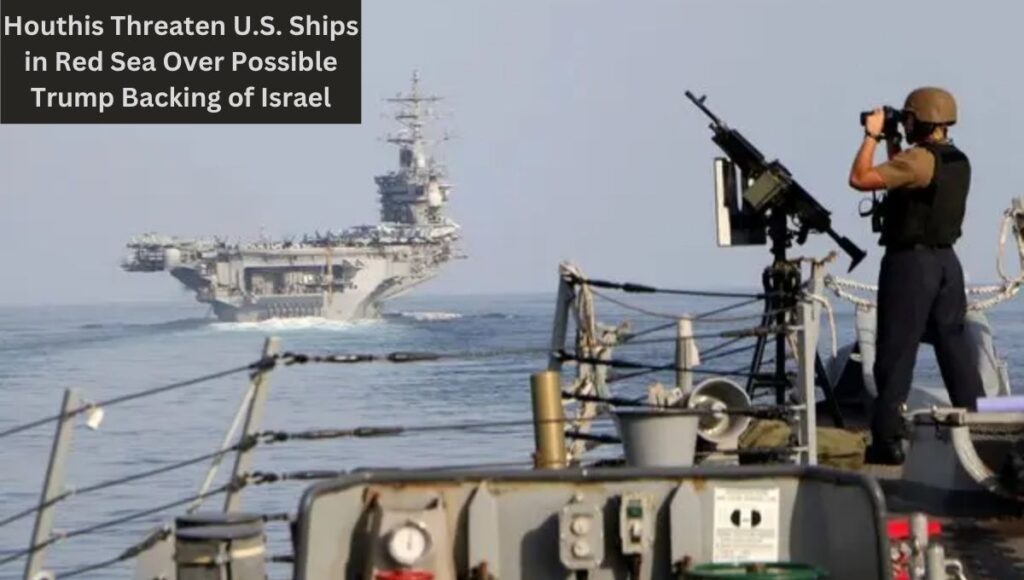
Houthis Threaten U.S. Ships in Red Sea Over Possible Trump Backing of Israel
Red Line Drawn: U.S. Involvement Could Reignite Red Sea Hostilities
“In the event of the American involvement in the attack and aggression against Iran with the Israeli enemy, the armed forces will target its ships and warships in the Red Sea,” said Brig Gen Yahya Saree.
The statement comes amid ongoing Israeli airstrikes under Operation Rising Lion, launched on June 13, 2025, which have targeted Iranian nuclear infrastructure and top military commanders.
Iran has responded with missile attacks on Israel, killing at least 24 civilians, while suffering over 430 deaths and more than 3,500 injuries, according to Iranian sources.
While the U.S. has not formally entered the conflict, President Donald Trump has said he will decide within two weeks whether to support Israel militarily, stressing that diplomacy still has a narrow window.
Background: Houthis and the May Ceasefire with the U.S.
The warning comes just weeks after a ceasefire was brokered between the U.S. and the Houthis in May 2025, aimed at de-escalating maritime hostilities in the Red Sea.
Under the agreement, the Houthis agreed to suspend their drone and missile attacks on U.S. naval vessels and international shipping lanes, in exchange for a pause in American airstrikes.
This truce followed months of confrontations that began after October 7, 2023, when Hamas attacked Israel, triggering a regional crisis.
In response to Israel’s subsequent operation in Gaza, Houthis began targeting Israeli-linked vessels in the Red Sea, later expanding their campaign to include U.S. and allied assets.
Operation Rising Lion: The Spark for Renewed Houthi Threats
Israel’s Operation Rising Lion has dramatically changed the regional landscape. The operation, aimed at halting Iran’s nuclear program, has included strikes on Iran’s nuclear facilities, air defense systems, and top military figures.
One major Israeli success, according to Defense Minister Israel Katz, was the killing of Saeed Izadi, head of the Quds Force’s Palestine Corps, in a strike on Qom. Izadi was reportedly a key figure in Iran’s financial and weapons support for Hamas before the October 2023 attacks.
As the conflict intensifies, Iran has denied that its nuclear program has military objectives, despite Western intelligence agencies warning that Tehran could build a nuclear weapon “within weeks”.
Houthis: Iran’s Last Card in a Broader Proxy Network
The Houthis’ threat is more than just rhetoric. Analysts believe the group may be Iran’s last strategic card to apply pressure on the U.S. and its allies in the event of direct confrontation.
While Iran itself controls the Strait of Hormuz another global oil chokepoint the Houthis have the ability to choke off the Bab al-Mandeb Strait, through which nearly 10% of global oil trade passes.
Disruption here could have major global economic consequences, raising oil prices and impacting international trade.
The Risk of a Wider Conflict in the Middle East
If the Houthis make good on their threat, the U.S. could be drawn into a multi-front conflict supporting Israel in air operations over Iran while defending shipping lanes in the Red Sea. The consequences could be severe:
- Global shipping disruptions
- Spike in oil prices
- Expanded regional war involving Saudi Arabia, Egypt, and the UAE
- Destabilization of Yemen and surrounding waters
Moreover, attacks on shipping could harm U.S. relations with Gulf countries, especially Egypt, which depends heavily on Suez Canal revenues.
Houthi Activities Since the October 2023 Gaza War
Since October 2023, the Houthis have shown themselves to be one of Iran’s most active regional proxies. Initially claiming to attack only Israeli-linked ships, they soon broadened their targets to include U.S., UK, and commercial vessels.
This prompted a U.S.-led coalition bombing campaign in early 2024. The Houthis temporarily paused operations during the Gaza ceasefire but resumed attacks after March 1, 2025, when the ceasefire collapsed.
Trump’s Decision Looms: A Test of Patience and Strategy
President Donald Trump has deliberately delayed a decision on whether the U.S. will enter the Israel-Iran conflict militarily. Speaking Friday, he emphasized that the nuclear threat from Iran was “weeks, maybe months” away, and that “there’s still time for people to come to their senses.”
National Intelligence Director Tulsi Gabbard stated that Iran has the capability to build a nuclear bomb quickly, further intensifying pressure on the White House.
International Reactions and Diplomatic Balancing
The Houthis’ threat has sparked concern in global diplomatic circles. If shipping lanes are disrupted, pressure will mount on both Iran and its backers to rein in the Yemen-based militants. Iran, meanwhile, must walk a fine line:
- Maintaining Houthi loyalty
- Avoiding alienation from Gulf states like Saudi Arabia and the UAE
- Preventing international backlash that could tip neutral countries toward supporting Israel or the U.S.
So far, Iran has not publicly endorsed the Houthis’ threat, suggesting that Tehran is cautious about opening a second naval front.
Conclusion: Red Sea Becomes a Strategic Flashpoint Again
The latest Houthi warning brings maritime security in the Red Sea back into sharp focus. As the Israel-Iran conflict expands, the potential for a broader regional war involving U.S. forces has increased dramatically.
With the Trump administration’s decision pending, the world watches anxiously. If the U.S. enters the conflict, expect the Bab al-Mandeb Strait to become a hot zone, with ripple effects across the Middle East and beyond.
For now, the Houthis have fired a warning shot not with missiles, but with words. Whether that warning escalates into action depends largely on Washington’s next move.
Also Read: Inside Operation Narnia: Why Israel Is Targeting Iranian Nuclear Scientists
Related Posts:
- Yemen War 2025: Israeli Strike Kills Houthi Military…

- 5 Powerful Highlights as Trump Lands Second Nobel…

- Trump’s 2025 Gaza Peace Plan Signing and Historic…

- Trump Threatens Military Action in Nigeria Over…

- Dramatic Moments Behind Trump’s Gaza Peace Push and…

- Yahya Sinwar’s Widow Escapes Gaza, Remarries in…
