
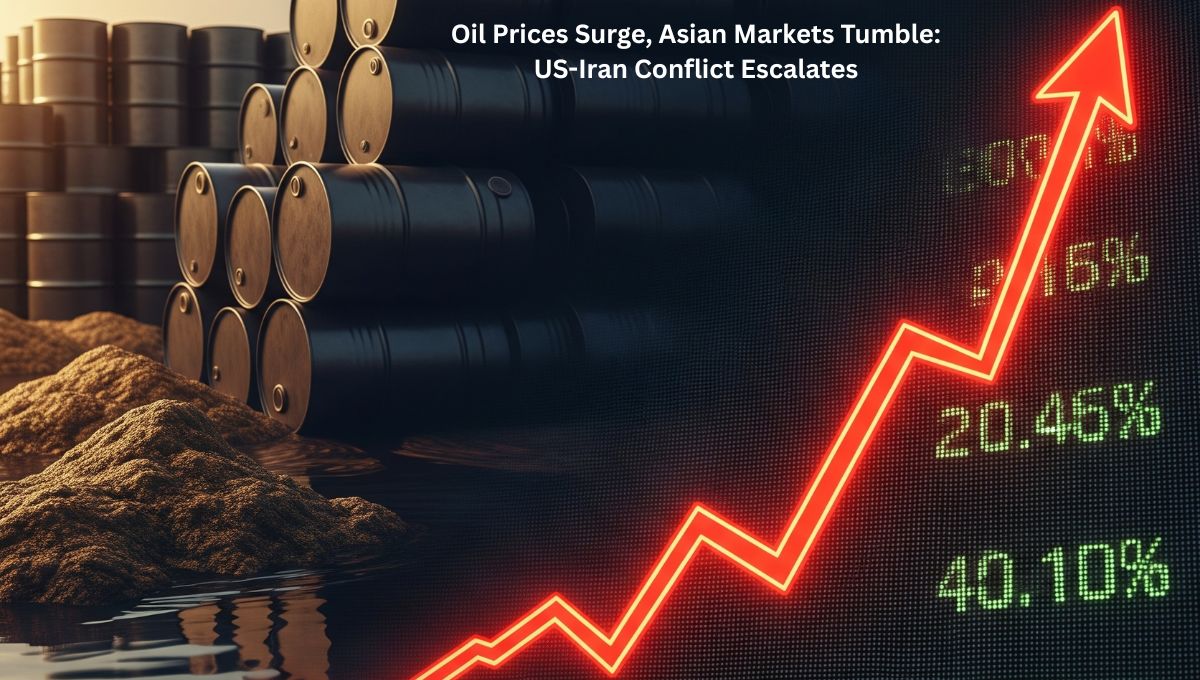
After the Iran’s Nuclear Facilities struck by the US,Oil Prices Surge, Asian Markets Tumble: US-Iran Conflict Escalates. A volatile Monday shook global markets as oil prices surged and Asian stocks dropped sharply, triggered by a major escalation in the Middle East.
Over the weekend, the United States joined Israel in launching airstrikes on Iran’s nuclear facilities a move that has now sparked fears of Iranian retaliation and potential closure of the vital Strait of Hormuz.
The global benchmark Brent crude oil rallied as much as 5.7% to $81.40 per barrel, extending its three-week gain. U.S. crude rose 2.8%, hitting $75.98 per barrel its highest level since January. Market analysts say that if tensions persist or Tehran acts on its threats, oil could surge past $100 per barrel, leading to significant global economic consequences.
Oil Prices Surge, Asian Markets Tumble: US-Iran Conflict Escalates
Strait of Hormuz in Focus as Tehran Mulls Response
The Strait of Hormuz, a narrow but crucial maritime chokepoint, is now at the heart of global concerns. About a quarter of the world’s oil trade and 20% of liquefied natural gas (LNG) flows through this 33-kilometer-wide passage.
Iran has long used the threat of closing the strait as leverage in geopolitical conflicts. This time, that threat appears dangerously real.
Following the U.S. attack on Iran’s key nuclear sites in Fordow, Natanz, and Isfahan, Iranian state-run Press TV reported that parliament had approved a measure to close the Strait. However, implementation requires approval from Supreme Leader Ayatollah Ali Khamenei.
If the strait is blocked, even temporarily, the disruption could send shockwaves through global energy markets, further fueling inflation already straining economies worldwide.
Brent Crude May Hit $100 if Iran Disrupts Shipping
Energy analysts warn that even “selective disruptions” such as missile strikes near tankers or drone harassment of shipping routes could scare off oil carriers. This would be enough to tighten supply and spark a major price rally.
“In a scenario where Iran selectively disrupts shipping through the Strait of Hormuz, we see Brent oil reaching at least $100/bbl,” said Vivek Dhar, commodities analyst at Commonwealth Bank of Australia.
Indeed, past geopolitical disruptions in the region have led to oil price spikes of up to 76%, according to JPMorgan analysts. Even under more optimistic scenarios, oil could see a sustained 30% increase, adding to global inflationary pressures.
Asian Markets Plunge, Global Stocks React Cautiously
While oil surged, Asian stock markets reacted sharply, with investors unnerved by the potential for war in the Middle East. The Tokyo Nikkei index fell 0.6%, Seoul dropped 1.4%, and Sydney slid 0.7%. The MSCI Asia-Pacific index excluding Japan declined 0.5%.
European futures followed suit:
- EUROSTOXX 50 futures down 0.7%
- FTSE 100 futures off 0.5%
- Germany’s DAX futures also dropped 0.7%
US markets remained more stable. S&P 500 futures dipped 0.5% and Nasdaq futures by 0.6%. Despite the tension, investors are not yet in full risk-off mode, with many awaiting Iran’s next move.
Iran May Target Regional Rivals or US Bases
Beyond Hormuz, Iran has multiple paths to escalate. Tehran could attack oil infrastructure in Saudi Arabia, Iraq, or the UAE, all major OPEC members. Already, Riyadh and Baghdad have expressed alarm over the strike on Iran’s nuclear program.
Another possibility: Iran may use proxy forces. The Yemeni Houthi rebels, aligned with Tehran, have already threatened to attack U.S. ships in the Red Sea if Washington continues backing Israeli strikes.
Such moves would deepen the crisis and extend its impact beyond oil, potentially disrupting international trade lanes and stoking regional instability.
Gold Steady, Dollar Rises, Treasuries Remain Calm
In commodities, gold edged down 0.1% to $3,363 an ounce, signaling no mass flight to traditional safe havens yet. Meanwhile, the U.S. dollar gained 0.3% against the yen, rising to 146.48 yen. The euro slipped 0.3% to $1.1481, and the U.S. Dollar Index ticked up 0.17% to 99.078.Bond markets were surprisingly calm.
Yields on 10-year U.S. Treasuries rose 2 basis points to 4.397%, reflecting market uncertainty but not panic. Analysts noted that the absence of a sharp drop in yields or surge in gold suggests that investors are still waiting for more clarity on the situation.
Inflation Fears Rise Amid Tariffs and Oil Shock
This latest oil shock could fuel inflation just as the U.S. economy is already grappling with tariff-driven price increases. Futures for Federal Reserve interest rates slipped slightly, indicating concern that higher energy prices could delay or alter planned rate cuts.
While Fed Governor Christopher Waller recently called for a rate cut as soon as July, most Fed officials remain cautious. Chair Jerome Powell is expected to address these issues during his upcoming testimony before Congress, where Iran’s impact on energy prices and tariffs will be hot topics.
NATO, OPEC+, and Global Leaders React
The crisis is expected to dominate discussions at this week’s NATO leaders’ summit in The Hague, where member states are already planning sharp defense spending increases. Meanwhile, all eyes are on OPEC+, especially as the group holds significant idle capacity that could be activated to stabilize markets if politically feasible.
So far, Kharg Island, Iran’s major oil export hub, has not been targeted. Satellite imagery suggests Tehran is trying to accelerate shipments while it still can. The longer the standoff lasts, the greater the risk that this key infrastructure becomes a target or a casualty of rising conflict.
Israeli Markets Rise on Nuclear Threat Reduction
Interestingly, while most global markets stumbled, Israeli stocks rose. Investors interpreted the U.S. attack as reducing the nuclear threat from Iran, with the Tel Aviv 125 climbing 1.8% to a record 2,919.62 and the TA-35 gaining 1.5% to close at an all-time high.
This divergent reaction highlights how different regions are exposed to, or insulated from, fallout from the U.S.-Iran conflict.
Outlook: High Stakes, High Uncertainty
As of now, the world waits on Tehran’s response. The Iranian government has promised “everlasting consequences,” and the global oil market is already bracing for more volatility.
If Iran does follow through on threats to close the Strait of Hormuz, or if attacks spread to regional rivals, oil prices could spike dramatically. The consequences would ripple across industries, from aviation to agriculture, while central banks would be forced to reconsider their inflation and interest rate strategies.
“This US attack could see a conflagration of the conflict,” said energy strategist Saul Kavonic. “It has fundamentally shifted the trajectory of oil markets.” Whether this marks the start of a wider war or a high-stakes standoff will be determined in the coming days. For now, oil prices surge, markets tremble, and global leaders scramble to respond.
Also Read: Trump Floats $30 Billion Civil Nuclear Deal to Iran Amid Ceasefire
Also Read: Why oil is tumbling and stocks are rising after Iran launched missiles at US bases
Related Posts:
- 7 Powerful Reasons the U.S. Is Letting Countries Buy…
- 7 Explosive Reasons Oil Prices Are Surging as Trump…
- 9 Strategic Reasons the US Allowed India to Buy…

- 7 Shocking Reasons Trump Says Oil Spike Is “Worth…

- 7 Critical Ways Iran’s Yuan Oil Plan Could Shake the…
- 3 Explosive Conditions Iran Sets to End War with US…