71-year-old political agitator George Zinn’s False Confession in Charlie Kirk Assassination: Why He Lied and What Police Revealed. The shocking assassination of conservative activist Charlie Kirk at Utah Valley University has taken another disturbing twist after a 71-year-old man, George Zinn, falsely confessed to the killing. Authorities revealed that Zinn intentionally misled police in the chaotic aftermath, claiming responsibility for the shooting to allow the real suspect, 22-year-old Tyler Robinson, to escape.
What began as an already devastating crime — the targeted shooting of one of America’s most high-profile conservative commentators — quickly spiraled into confusion as Zinn declared himself the gunman. His confession, police say, diverted critical resources at a crucial stage of the investigation and delayed the hunt for the actual shooter.
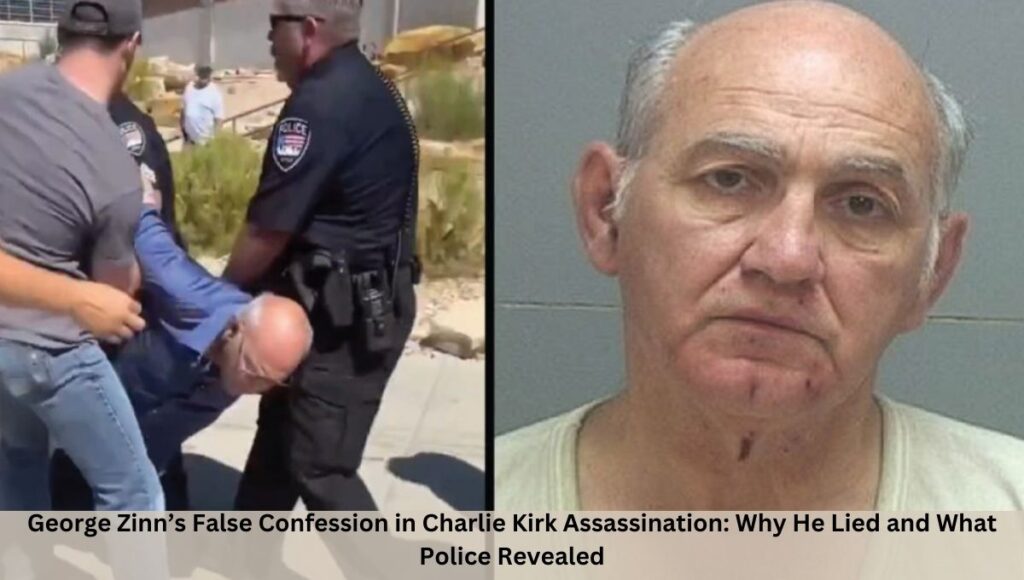
George Zinn’s False Confession in Charlie Kirk Assassination: Why He Lied and What Police Revealed
What George Zinn Told Police After the Shooting
Court documents obtained by Fox 13 and The New York Post outline Zinn’s chilling behavior moments after the attack. Witnesses say he shouted:
“I shot him, now shoot me.”
Police immediately detained Zinn, leading him away in handcuffs as onlookers screamed at him, believing he was the assassin. Officers pressed him for details, including where the weapon was located. Zinn allegedly refused, responding, “I am not going to tell you.”
Once in custody, however, he admitted he had not pulled the trigger. Instead, he told investigators he had lied to “draw attention from the real shooter” and even described himself as wanting to be a “martyr for the person who was shot.”
According to Utah County Sheriff Michael Smith, Zinn deliberately obstructed law enforcement, distracting them at the exact moment when time was most critical.
Police Reaction: “Obstruction of Justice at a Crucial Moment”
Authorities emphasized that Zinn’s actions were not a mere stunt. Sheriff Smith confirmed that the false confession directly hampered the immediate response to Kirk’s assassination:
- Officers lost precious minutes focusing on Zinn rather than pursuing leads on the real suspect.
- Social media was flooded with Zinn’s image, wrongly branding him as Kirk’s killer before police clarified his role.
- Investigators described his behavior as a deliberate attempt to let the true gunman escape.
“By yelling that he was the shooter, Zinn obstructed law enforcement from focusing on the actual suspect,” Smith said.
Who Is George Zinn? A Political “Gadfly” with a Troubled Past
Locals in Salt Lake City are familiar with George Zinn, often labeling him a political “gadfly.” Known for showing up at rallies, demonstrations, and public forums, Zinn frequently disrupted events and was ejected by organizers for unruly conduct.
His record stretches back years:
- In 2013, he was arrested and jailed for a year after threatening to bomb the Salt Lake City Marathon, an offense committed days after the Boston Marathon bombing.
- Prosecutors described him as a man prone to odd and disruptive behavior, though until now, his actions had mostly been considered nuisance-level disturbances.
- Salt Lake County District Attorney Sim Gill, who has dealt with Zinn before, described him as “odd” but more of a public agitator than a serious threat.
Despite this reputation, his decision to insert himself into the Kirk murder investigation escalated his behavior from disturbance to criminal obstruction.
No Connection Between Zinn and Suspected Gunman Tyler Robinson
One lingering question has been whether George Zinn had any ties to Tyler Robinson, the 22-year-old now charged with Kirk’s assassination. Authorities have been clear: there is no evidence of collaboration.
- Robinson was turned in by his own father after the shooting.
- Investigators are probing whether Robinson had any support network, but Zinn is not part of it.
- Robinson himself reportedly texted his roommate during the chaos, acknowledging Zinn’s false confession by writing that police had “grabbed some crazy old dude.”
The false confession appears to have been a solo act of disruption, not part of a coordinated plot.
The Real Suspect: Tyler Robinson
While Zinn sat in custody, the real manhunt continued. Robinson was captured about 33 hours after the shooting. According to the FBI and Utah prosecutors:
- Robinson allegedly used a Mauser bolt-action rifle.
- DNA evidence linked him to the weapon, which was found alongside bullet casings and a screwdriver.
- Prosecutors have charged him with seven counts, including aggravated murder, obstruction of justice for disposing of evidence, and witness tampering for urging a roommate to delete incriminating texts.
- The state has announced it will seek the death penalty.
Charlie Kirk’s Assassination: A “Dark Moment for America”
Charlie Kirk, only 31, was one of the most prominent conservative activists in the U.S. and a close ally of former President Donald Trump. Known for his fiery commentary on gender, race, and gun rights, he built a national following through his organization, Turning Point USA, and media appearances.
Kirk was speaking at Utah Valley University when the shooting occurred, addressing thousands of students. He was struck in the neck and died despite immediate emergency response.
President Trump mourned Kirk, calling him “a patriot” and declaring his killing a “dark moment for America.”
George Zinn Faces Additional Charges Beyond False Confession
While Zinn initially faced charges of obstruction of justice, investigators uncovered even more disturbing evidence. According to the Utah Department of Public Safety:
- Zinn admitted to possessing and viewing child sexual abuse material.
- Authorities found more than 20 illegal images on his phone, which he acknowledged gave him gratification.
- He allegedly described a preference for victims as young as 5 to 12 years old.
- Prosecutors now plan to pursue four felony counts of sexual exploitation of a minor alongside obstruction.
A judge has ordered that Zinn be held without bail, describing him as a “substantial danger to the community.”
Also Read: George Zinn, Seen In Handcuffs After Charlie Kirk Shooting, Faces Child Porn Charges
Community Reaction and Fallout
Zinn’s bizarre false confession drew outrage both locally and nationally. For hours after the shooting, his image circulated widely online, with thousands convinced he had been Kirk’s assassin.
The truth — that he had lied to protect the real gunman — only deepened anger. Many accused him of seeking notoriety at the expense of justice, while others pointed to his long history of instability.
Event organizers in Salt Lake City, long familiar with Zinn, described his presence as disruptive but never anticipated his actions would play into a national tragedy.
A Pattern of Dangerous Behavior
Looking back at Zinn’s record, investigators and prosecutors see a troubling pattern:
- Threatening high-profile events, such as the marathon incident.
- Inserting himself into political rallies and public discussions.
- Now, deliberately misleading police in a murder investigation.
Though once dismissed as a nuisance, Zinn’s actions in the Kirk case demonstrate how individuals with a history of erratic conduct can escalate into serious obstruction of justice.
What Happens Next for George Zinn
Zinn remains in custody at the Utah County Jail. Formal charges include:
- Obstruction of justice (for the false confession).
- Sexual exploitation of a minor (for the possession of child sexual abuse material).
It is unclear whether he has secured legal representation. Given his age and the severity of charges, legal experts suggest he could face decades in prison if convicted.
A Case That Shook the Nation
The assassination of Charlie Kirk has already been described as one of the most consequential political killings in recent U.S. history. The fact that a false confession briefly derailed the investigation only compounds the sense of shock.
For supporters of Kirk, the tragedy is immeasurable. For investigators, the case highlights how chaos, misinformation, and disruptive actors can complicate justice at critical moments. As prosecutors prepare to seek the death penalty against Tyler Robinson, and as George Zinn faces his own slate of charges, the case continues to expose dark undercurrents of political violence and personal instability in America.