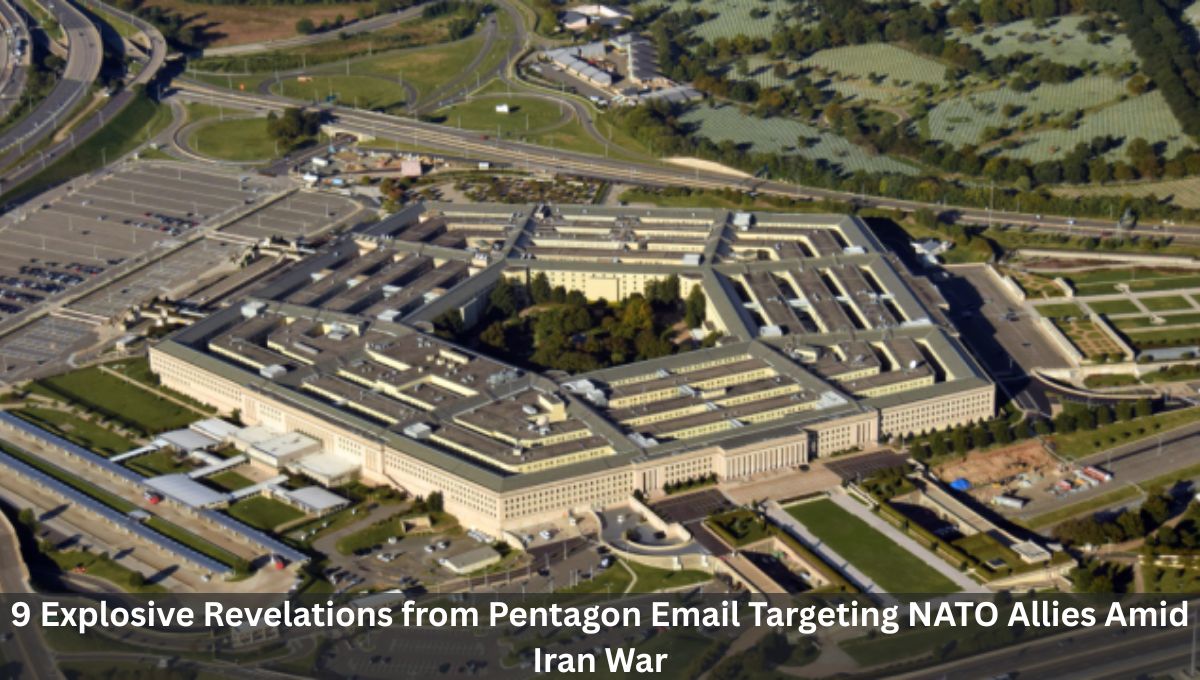
9 Explosive Revelations from Pentagon Email Targeting NATO Allies Amid Iran War fallout. The global geopolitical landscape is witnessing a sharp turn as an internal communication within the United States Department of Defense signals potential punitive measures against key NATO allies.
The reported email, circulating at senior levels in the Pentagon, outlines options targeting nations perceived as “uncooperative” during the ongoing Iran conflict.
At the center of this controversy are proposals that include suspending Spain from NATO and reassessing Washington’s diplomatic stance on Britain’s claim over the Falkland Islands.
These developments come amid escalating tensions tied to the US-led operations against Iran, raising serious questions about the cohesion and future of the alliance.
9 Explosive Revelations from Pentagon Email Targeting NATO Allies Amid Iran War
Growing Rift Within NATO
The North Atlantic alliance, long considered the backbone of Western military cooperation, is facing one of its most significant internal strains in decades.
The reported Pentagon email reflects frustration within Washington over what it sees as insufficient support from European allies during the Iran conflict.
According to officials cited in reports, access, basing, and overflight rights (ABO) were viewed as the minimum expectation for NATO members.
However, several countries reportedly fell short of these expectations, prompting discussions about consequences.
This tension is not merely operational—it strikes at the philosophical core of NATO: mutual defense and shared responsibility.
Donald Trump’s Hardline Stance on Allies
US President Donald Trump has been vocal in criticizing NATO allies for what he describes as a lack of commitment.
His frustration has been particularly evident regarding the failure of European nations to contribute naval forces to reopen the strategically vital Strait of Hormuz.
Trump has repeatedly emphasized that alliances should function as “two-way streets,” suggesting that the US may rethink its commitments if partners fail to reciprocate.
His rhetoric has included calling NATO a “paper tiger” without American leadership.
This evolving stance represents a departure from traditional US foreign policy, which historically emphasized alliance stability even during disagreements.
Spain in the Crosshairs
One of the most striking proposals in the Pentagon email is the potential suspension of Spain from NATO.
While such a move would be largely symbolic—given the lack of formal mechanisms for suspension—it carries significant political weight.
Why Spain?
Spain’s refusal to grant US forces access to its bases and airspace for operations against Iran has drawn sharp criticism.
Key US military installations in Spain, such as Naval Station Rota and Morón Air Base, are critical for operations in Europe and the Middle East.
Spanish Prime Minister Pedro Sánchez has defended his country’s stance, emphasizing adherence to international law and rejecting decisions based on informal communications.
Despite the tension, Spain maintains that it remains a “reliable” NATO member fulfilling its obligations.
The Falkland Islands Issue Resurfaces
Another controversial aspect of the email involves reconsidering US diplomatic support for the United Kingdom’s claim over the Falkland Islands.
Historical Context
The Falklands dispute dates back centuries but gained global attention during the Falklands War between the UK and Argentina.
Britain has maintained control over the islands since 1833, with a brief interruption during the 1982 conflict.
The United States has historically maintained a neutral stance on sovereignty while recognizing British administration.
Why This Matters Now
The suggestion to review US support is widely seen as a pressure tactic aimed at the UK.
Britain’s limited involvement in the Iran conflict—particularly its reluctance to fully back US military operations—has reportedly contributed to this consideration.
UK Prime Minister Keir Starmer has reaffirmed that sovereignty over the Falklands is non-negotiable, emphasizing the principle of self-determination for island residents.
Anglo-American Relations Under Strain
The reported proposals have triggered a strong reaction in London, highlighting growing friction between two historically close allies.
Public statements from UK officials stress that their position on the Falklands remains unchanged.
However, the tone of recent exchanges suggests a cooling of what has long been considered a “special relationship.”
This strain is particularly notable given the historical cooperation between the US and UK during conflicts, including intelligence sharing during the Falklands War.
Broader Implications for NATO
The potential actions outlined in the Pentagon email could have far-reaching consequences for NATO’s unity and effectiveness.
Key Concerns:
- Erosion of Trust: Allies may question US commitment to collective defense.
- Fragmentation Risk: Diverging national interests could weaken coordinated responses.
- Strategic Realignment: European nations may seek greater autonomy in defense policies.
Analysts warn that even discussing such measures could undermine confidence within the alliance, regardless of whether they are implemented.
The Iran Conflict as a Catalyst
The underlying driver of these tensions is the ongoing confrontation between the US and Iran.
The conflict has not only destabilized the Middle East but also exposed fault lines within Western alliances.
European nations have largely taken a cautious approach, balancing concerns about escalation with commitments to international law.
This contrasts with Washington’s more aggressive posture, creating friction over strategy and priorities.
At the heart of the dispute is a long-standing debate: Are NATO allies contributing enough?
US officials argue that Europe has relied too heavily on American military power, particularly in high-risk conflicts.
The Pentagon email’s emphasis on ABO rights as a baseline expectation underscores this frustration.
European leaders, however, counter that involvement in conflicts must align with legal frameworks and national interests—not just alliance obligations.
Can NATO Suspend a Member?
Interestingly, NATO’s founding treaty does not include provisions for suspending a member state. This raises questions about the feasibility of the proposals mentioned in the email.
Experts suggest that while formal suspension may not be possible, political sidelining—such as limiting influence within NATO structures—could be used as an alternative.
Global Reactions and Diplomatic Fallout
The revelations have prompted responses across Europe:
- Germany has dismissed the idea of Spain’s suspension as unrealistic.
- Italy has emphasized the need for unity within NATO.
- Argentina has renewed its claims over the Falklands, viewing the situation as an opportunity.
These reactions highlight how internal NATO tensions can quickly ripple across the global diplomatic landscape.
Strategic Stakes: Strait of Hormuz
A critical element in this broader conflict is the Strait of Hormuz, a chokepoint for global oil supplies. Control over this passage has become a central issue in the US-Iran confrontation.
Trump’s call for NATO allies to deploy naval forces underscores the strategic importance of keeping this route open.
However, reluctance from European nations reflects concerns about being drawn into a wider war.
What Happens Next?
Despite the dramatic nature of the proposals, several factors suggest that immediate drastic changes are unlikely:
- Strong institutional resistance within NATO
- Deep-rooted military and intelligence cooperation
- Political risks of alienating key allies
However, the mere existence of such discussions signals a shift in how the US views its alliances.
Conclusion: A Defining Moment for NATO
The leaked Pentagon email is more than a policy discussion—it is a reflection of changing dynamics in global power structures.
As the US recalibrates its expectations from allies, NATO faces a critical test of unity.
Whether this leads to meaningful reform or deeper divisions remains uncertain. What is clear is that the Iran conflict has become a catalyst for broader geopolitical realignment.
For global audiences, this moment underscores a key reality:
alliances are evolving, and the balance of power is increasingly shaped by shifting national priorities rather than longstanding commitments.
Also Read: 10 Explosive Insights into Trump’s NATO “Naughty List” Amid Iran War
Also Read: Pentagon Email Flags Plan To Target ‘Uncooperative’ Allies, Suspend Spain From NATO
Related Posts:
- 3 Explosive Conditions Iran Sets to End War with US…

- Spain's Ceuta Crisis: 7 Alarming Facts Behind…

- 10 Powerful Revelations from the Trump–Putin Call on…

- 9 Explosive Reasons the UK Blocked Trump from Using…

- 10 Explosive Warnings as Donald Trump Calls Iran…

- 10 Explosive Signals: Trump Rates Iran War “15/10”…