
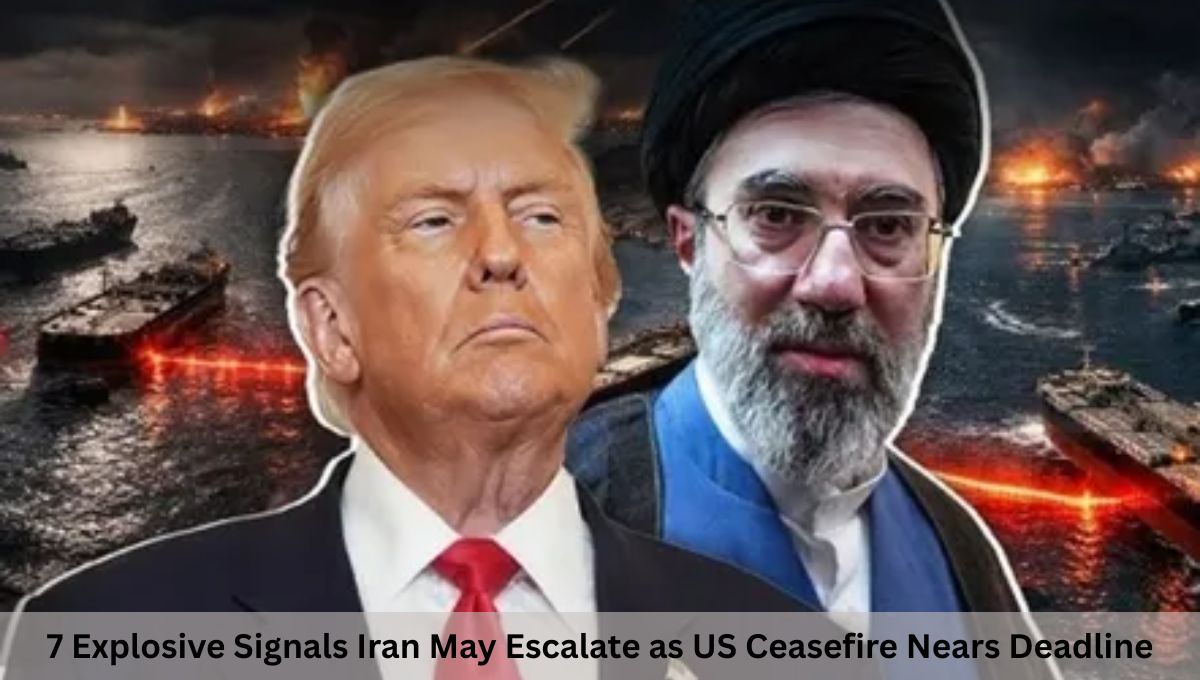
7 Explosive Signals Iran May Escalate as US Ceasefire Nears Deadline, raising fears of renewed conflict. Tensions between Iran and the United States have reached a critical point as a fragile two-week ceasefire approaches its expiration. With both sides exchanging sharp rhetoric and signaling conflicting intentions, fears of renewed conflict are intensifying across global political and economic landscapes.
Thank you for reading this post, don't forget to subscribe!Iran’s Parliament Speaker Mohammad Baqer Ghalibaf has issued one of the strongest warnings yet, declaring that Tehran has prepared to unveil “new cards on the battlefield” if hostilities resume.
His remarks underscore a broader shift in Iran’s posture—from cautious diplomacy to conditional engagement backed by potential escalation.
At the same time, US President Donald Trump has maintained a hardline stance, warning that failure to reach a breakthrough could trigger significant military consequences.
This combination of brinkmanship and uncertainty has placed global markets and diplomatic efforts on edge.
7 Explosive Signals Iran May Escalate as US Ceasefire Nears Deadline
Iran Rejects Negotiations Under Pressure
Iran’s leadership has repeatedly emphasized that it will not engage in negotiations conducted under coercion.
Ghalibaf accused Washington of attempting to transform diplomatic talks into what he described as a “table of surrender.”
According to his statements, the United States is leveraging military threats and economic pressure to force concessions.
Tehran has rejected this approach outright, insisting that any meaningful dialogue must be based on mutual respect and adherence to commitments.
This stance reflects a deeply rooted mistrust that has defined US-Iran relations for decades.
Iranian officials argue that Washington’s recent actions—including alleged ceasefire violations and threats against commercial shipping—have further eroded confidence in the diplomatic process.
‘New Cards on the Battlefield’: What It Means
Ghalibaf’s reference to “new cards on the battlefield” has drawn significant attention from analysts and policymakers.
While the exact nature of these measures remains undisclosed, the phrase suggests a combination of military, strategic, and possibly asymmetric responses.
Iran has historically relied on unconventional tactics to counter stronger adversaries.
These include proxy networks, maritime disruptions, cyber operations, and targeted regional influence campaigns.
The warning indicates that Tehran may be preparing to expand or intensify such measures if negotiations collapse.
The ambiguity surrounding these “new cards” is itself strategic, serving as both a deterrent and a signal of readiness.
By keeping details vague, Iran maintains flexibility while increasing pressure on its adversaries.
Uncertainty Over Islamabad Talks
Diplomatic efforts have centered on a proposed round of talks in Islamabad, with Pakistan playing a mediating role. However, uncertainty looms over whether Iran will participate.
While Pakistani officials have expressed optimism about securing Iran’s attendance, Tehran has not confirmed its involvement.
Iranian authorities have stated that they are “reviewing all aspects” before making a final decision.
This hesitation reflects broader concerns about the credibility of the negotiation process.
Iranian officials have cited inconsistent US positions and alleged violations of the ceasefire as key reasons for their cautious approach.
Pakistan’s Mediation Role
Pakistan has emerged as a critical intermediary in the current crisis, facilitating communication between Washington and Tehran.
Its diplomatic outreach has helped keep channels open despite escalating tensions.
Iran has acknowledged Pakistan’s “good offices and mediation,” signaling appreciation for its efforts.
However, mediation alone may not be sufficient to bridge the deep divide between the two sides.
The success of these talks depends not only on logistical coordination but also on rebuilding trust—an element that remains in short supply.
US Signals Hardline Approach
President Donald Trump has made it clear that the United States is prepared to escalate if negotiations fail.
He has indicated that the ceasefire is unlikely to be extended without tangible progress, setting a firm deadline for diplomatic breakthroughs.
His statements have included stark warnings about potential military action, reinforcing the perception that Washington is using pressure tactics to force a favorable outcome.
At the same time, US officials have signaled willingness to proceed with talks regardless of Iran’s participation, suggesting a dual-track strategy of diplomacy and coercion.
Strait of Hormuz crisis and Global Energy Impact
One of the most critical dimensions of the crisis is the situation in the Strait of Hormuz, a vital artery for global energy supplies.
The waterway handles a significant portion of the world’s oil and liquefied natural gas shipments.
Recent tensions have disrupted shipping routes, with reports of vessels being stranded or requiring special authorization to transit.
Iran has indicated that continued US pressure could lead to further restrictions or even closure of the strait.
Such a scenario would have profound implications for global energy markets, potentially driving up oil prices and exacerbating economic instability worldwide.
Deep-Rooted Mistrust Between Tehran and Washington
The current standoff is rooted in decades of mistrust between Iran and the United States.
Iranian leaders have consistently pointed to past agreements that they believe were not honored by Washington.
Recent developments have only reinforced these perceptions.
Iranian officials have accused the US of sending contradictory signals—engaging in diplomacy while simultaneously escalating pressure.
This lack of trust complicates efforts to reach a sustainable agreement, as both sides remain skeptical of each other’s intentions.
Iran’s Strategic Messaging and Military Readiness
Iran’s leadership has emphasized that its armed forces remain fully prepared for any scenario.
Ghalibaf has stated that the country stands firm and is ready to respond if conflict resumes.
This messaging serves multiple purposes: deterring potential aggression, reassuring domestic audiences, and signaling resolve to international observers.
It also highlights Iran’s reliance on strategy and planning rather than sheer military power.
Officials have argued that effective design and execution can offset disparities in resources and capabilities.
The Role of Asymmetric Warfare
Iran’s approach to conflict has long been characterized by asymmetric warfare.
This strategy allows it to counter more powerful adversaries by exploiting vulnerabilities and leveraging unconventional tactics.
Ghalibaf has emphasized that while the United States may possess greater military resources, strategic missteps can undermine those advantages.
This perspective reinforces Iran’s confidence in its ability to navigate the current crisis, even under significant pressure.
Conflicting Narratives on Ceasefire Violations
Both Iran and the United States have accused each other of violating the ceasefire.
Tehran has cited threats against commercial vessels and continued blockade measures as evidence of US non-compliance.
Washington, on the other hand, has justified its actions as necessary to enforce security and maintain leverage in negotiations.
These conflicting narratives further complicate the situation, making it difficult to establish a shared understanding of the facts.
Potential Scenarios Moving Forward
As the ceasefire deadline approaches, several scenarios are possible:
1. Renewed Conflict
If talks fail and tensions escalate, the region could see a return to active hostilities. This would likely involve not only Iran and the United States but also regional actors.
2. Extension of Ceasefire
A last-minute diplomatic breakthrough could lead to an extension of the ceasefire, providing more time for negotiations.
3. Stalemate with Continued Tensions
Both sides may avoid outright conflict while maintaining pressure, resulting in a prolonged period of instability.
Global Implications
The outcome of the current crisis will have far-reaching consequences beyond the Middle East. Energy markets, international trade, and geopolitical alliances are all at stake.
Countries dependent on oil imports are particularly vulnerable to disruptions in the Strait of Hormuz. At the same time, shifts in US-Iran relations could reshape global power dynamics.
Conclusion
The standoff between Iran and the United States represents a complex interplay of diplomacy, strategy, and power.
With the ceasefire deadline fast approaching, the risk of escalation remains high.
Iran’s warning of “new cards on the battlefield” signals a readiness to shift tactics if necessary, while the United States continues to apply pressure in pursuit of its objectives.
Whether these dynamics lead to renewed conflict or a breakthrough in negotiations will depend on the ability of both sides to navigate deep-seated mistrust and competing priorities.
For now, the world watches closely as events unfold, aware that the stakes extend far beyond the immediate region.
Also Read: 9 Shocking Developments as Pakistan Guarantees US–Iran Ceasefire Till April 21
Also Read: Pakistan presses ahead with preparations for Iran-US talks even with Tehran’s participation unclear
Related Posts:
- 3 Explosive Conditions Iran Sets to End War with US…
- 9 Explosive Claims as Trump Says US Winning Iran War

- 7 Powerful Facts About Ayatollah Ali Khamenei’s…
- 10 Explosive Warnings as Donald Trump Calls Iran…
- 7 Powerful Insights on Ghalibaf as Trump’s Iran Deal Partner
- 11 Explosive Warnings as Trump Vows to ‘Knock the…
