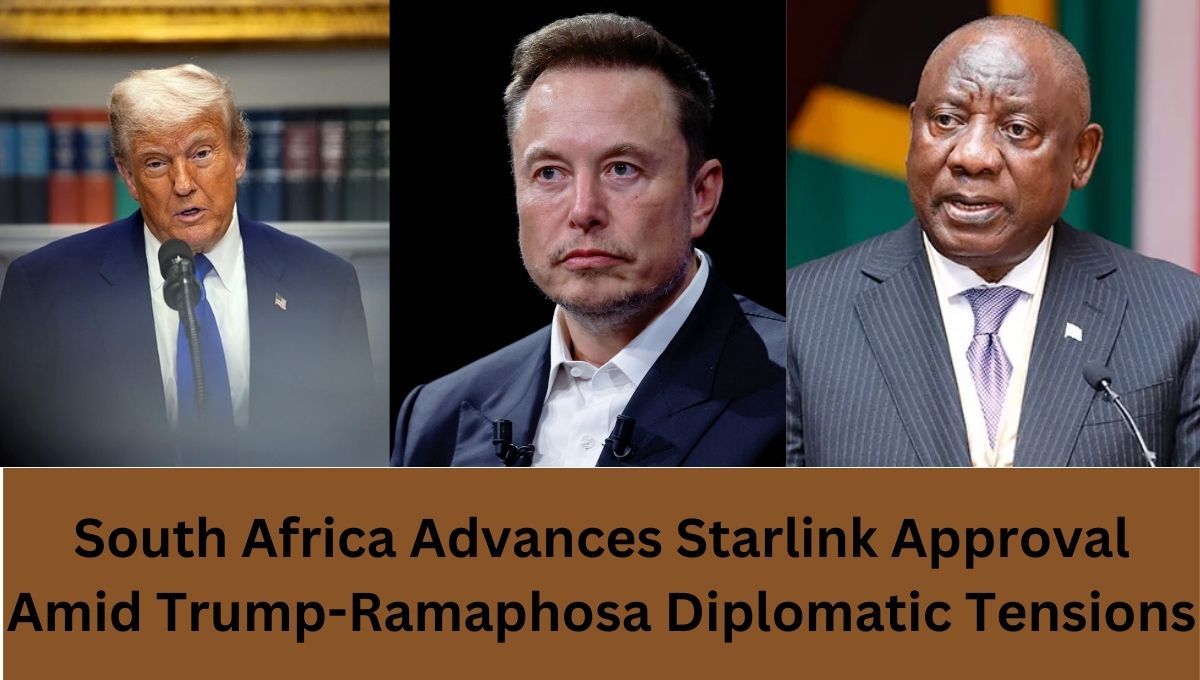
Moving forward with a pivotal policy review South Africa Advances Starlink Approval Amid Trump-Ramaphosa Diplomatic Tensions. South Africa enabled Elon Musk’s satellite internet provider, Starlink, to operate in the country without complying with the traditional Black ownership mandates. This regulatory adjustment, known as the “equity equivalent,” seeks to modernize telecom laws while addressing historical inequalities. This article explores the background of South Africa’s ownership laws, the recent diplomatic tensions during President Cyril Ramaphosa’s Washington visit, and what the potential Starlink approval means for South Africa’s digital future.
South Africa Advances Starlink Approval Amid Trump-Ramaphosa Diplomatic Tensions
Background: South Africa’s Ownership Laws and Starlink’s Challenges
South Africa’s laws currently require foreign companies to share ownership with historically disadvantaged groups, mainly Black South Africans, as a legacy of apartheid-era policies.
This framework aims to correct long-standing economic disparities by ensuring greater inclusion in business ownership. Elon Musk, South African-born and the world’s richest person, publicly criticized these ownership requirements.
He claimed that these laws prevented Starlink from operating in South Africa, stating, “Starlink is not allowed to operate in South Africa because I’m not black.”
Musk’s comments sparked debates around regulatory fairness and balancing racial equity goals with the need to attract advanced technology investments.
The Equity Equivalent: A New Regulatory Approach
The proposed “equity equivalent” model would allow satellite companies like Starlink to meet local ownership obligations by investing directly in disadvantaged communities rather than ceding company shares.
This approach, already applied in industries such as automobile manufacturing, aims to both preserve social justice objectives and promote foreign investment.
Communications Minister Solly Malatsi highlighted that this shift is intended to expand digital infrastructure and improve internet access key drivers of opportunity in education, healthcare, and business.
“Digital infrastructure opens a world of opportunity,” a spokesperson said, emphasizing that the policy change is about progress, not special treatment.
Starlink’s Potential to Bridge South Africa’s Digital Divide
Starlink’s satellite internet service promises high-speed connectivity, especially crucial for rural and underserved regions of South Africa where traditional infrastructure is limited.
Access to reliable internet could revolutionize education, healthcare services, and economic participation for millions of South Africans.
Musk and his company argue that providing this technology benefits disadvantaged communities more significantly than ownership stakes might.
Still, the policy review faces scrutiny from political groups such as the Economic Freedom Fighters (EFF), who accuse Musk of manipulating misinformation, including the false narrative of white genocide, to sway policies in his favor.
Diplomatic Context: Ramaphosa’s White House Meeting with Trump
The Starlink policy review coincides with a high-profile and tense Oval Office meeting between South African President Cyril Ramaphosa and former U.S. President Donald Trump.
During the meeting, Trump confronted Ramaphosa with debunked claims about white farmers being persecuted in South Africa, straining diplomatic ties between the two countries.
Despite the confrontation, Ramaphosa maintained composure, deflecting unsubstantiated accusations and fostering dialogue with U.S. business leaders present.
The meeting underscored complex diplomatic and political dynamics but also signaled South Africa’s strategic push to engage with U.S. stakeholders, including Musk representatives.
Diverse Opinions Within South Africa on Starlink and Telecom Policy
Not all South African leaders view Starlink as the sole solution for the country’s telecom needs. MP Khusela Sangoni Diko stressed that multiple satellite providers are prepared to comply with existing ownership laws, suggesting a more diversified approach to expanding internet access.
Meanwhile, prominent business figures like Johann Rupert expressed optimism about South Africa’s stability and potential, emphasizing that challenges can be overcome through collaboration and innovation.
The Future of Telecommunications: Public Commentary and Regulatory Steps
South Africa’s Independent Communications Authority (ICASA) has opened a 30-day public comment period for the equity equivalent proposal.
Following this, ICASA will determine whether to approve the policy, which would pave the way for Starlink and similar providers to enter the market.
Approval could mark a landmark moment in the country’s telecommunications sector, balancing equity goals with the urgent need for improved digital connectivity.
South Africa’s potential approval of Starlink amid ongoing political tensions highlights the delicate balance between embracing technological innovation and upholding social justice principles.
With the digital divide still wide in many regions, satellite internet could provide critical access that fosters economic empowerment.
At the same time, South Africa must carefully navigate complex domestic and international political pressures.
The evolving dialogue between South Africa, the U.S., and tech companies like SpaceX reflects the growing interconnection of business, politics, and social equity in the digital age.
Also Read: 9 Explosive Moments: Benin Coup Attempt Shakes West Africa
Also Read: The Trump Administration Leaned on African Countries. The Goal: Get Business for Elon Musk.
Related Posts:
- Elon Musk Forms ‘America Party’ After Breaking with…

- Elon Musk Unfollows Trump Allies After Yaccarino’s…

- Trump and Elon Musk Reunite at Charlie Kirk Memorial…

- 7 Stunning Signs Trump and Musk Are Repairing Their…

- Elon Musk’s Viral Oval Office Video Sparks Drug Use…

- Elon Musk’s ‘America Party’ Gains 40% Support in New…