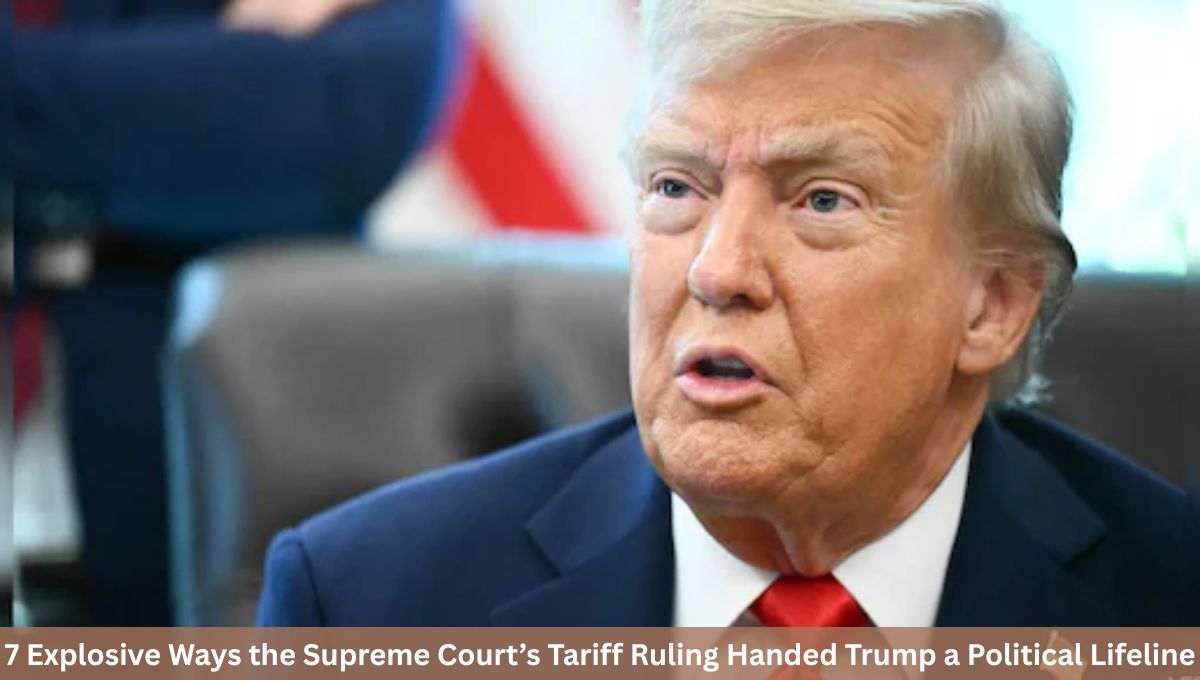
7 Explosive Ways the Supreme Court’s Tariff Ruling Handed Trump a Political Lifeline and the GOP relief from global trade fallout. When the U.S. Supreme Court struck down President Donald Trump’s sweeping global tariffs, the ruling was widely framed as one of the most consequential legal defeats of his second term.
Yet politically, the decision may turn out to be something very different:
a gift.
By curbing Trump’s most economically disruptive trade weapon, the court may have shielded him — and the Republican Party — from escalating political damage at a precarious moment marked by slowing growth, weak job creation, stubborn inflation, and looming midterm elections.
This is not merely a legal story. It is a political, economic, and geopolitical inflection point — with implications stretching from Washington to New Delhi.
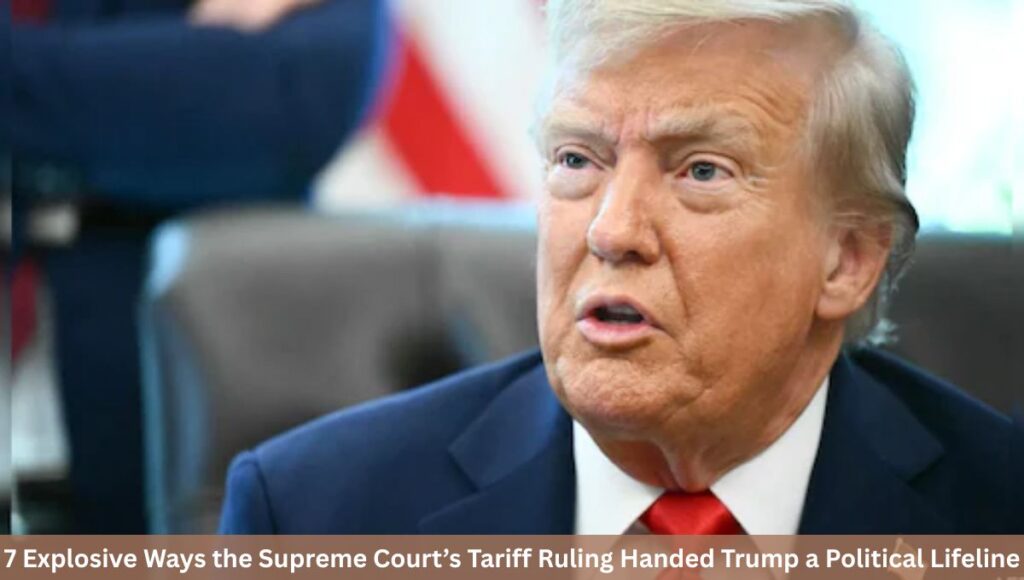
7 Explosive Ways the Supreme Court’s Tariff Ruling Handed Trump a Political Lifeline
1. A Landmark Ruling That Slammed the Brakes on Trump’s Tariff Power
In a 6–3 decision, the Supreme Court ruled that Trump overstepped his authority by imposing sweeping global tariffs under the International Emergency Economic Powers Act (IEEPA).
Chief Justice John Roberts, writing for the majority, left little room for ambiguity:
The power to “regulate importation” does not include the power to impose tariffs.
The ruling categorically rejected the administration’s argument that emergency economic powers could be stretched to cover broad, long-term taxation of imports — a power the Constitution clearly reserves for Congress.
Notably, the majority included conservative justices appointed by Trump himself, reinforcing that this was not an ideological ruling, but a constitutional one.
2. Why This Defeat May Quietly Help Trump Politically
At first glance, losing a signature economic policy appears disastrous. In reality, tariffs had become one of Trump’s most politically toxic initiatives.
Since announcing global tariffs last year:
- Trump’s net economic approval fell sharply
- Polling showed 62% of Americans opposed the tariffs
- Even one-quarter of Republican-leaning voters disapproved
By striking down the tariffs, the Supreme Court effectively removed a self-inflicted political wound — one that Trump had voluntarily embraced despite repeated economic warnings.
The ruling gives Trump something invaluable:
someone else to blame.
3. A GOP Relieved to Be Saved from Itself
Publicly, few Republicans rushed to celebrate the ruling. Privately, relief was palpable.
For months, GOP lawmakers had tolerated tariffs that directly contradicted decades of Republican orthodoxy on free markets and free trade. Many held their noses, fearing backlash from Trump’s base.
The court’s decision changed the equation:
- It curbed Trump’s unilateral authority
- It reduced near-term economic pain
- It gave Republicans political cover to pivot away from tariffs
Crucially, Congress never mustered a veto-proof majority to block Trump’s emergency tariffs. The court did what lawmakers could not — or would not — do themselves.
4. Trump’s Counterattack: Section 122 and Its Hard Limits
Within hours of the ruling, Trump announced a new plan: a 10% global tariff, quickly raised to 15%, imposed under Trade Act of 1974 Section 122.
Trump claimed this path was “even stronger.”
It isn’t.
What Section 122 Allows
- Maximum tariff: 15%
- Maximum duration: 150 days
- Congressional approval required for extension
- Intended for balance-of-payments crises, not general trade wars
Unlike IEEPA, Section 122 cannot support indefinite, flexible, or punitive tariff campaigns. Foreign governments know this — and it sharply reduces Trump’s leverage in negotiations.
Even Roberts explicitly rebutted claims that alternative statutes offered unlimited authority.
5. The Economy: Why Timing Matters
The ruling landed on a brutal economic backdrop.
Just 90 minutes earlier, the Bureau of Economic Analysis reported:
- GDP growth of 1.4% annualized
- Second-worst growth year since 2016
- One of the weakest job-creation years in decades
While tariffs were not the sole cause, they amplified uncertainty, raised costs, and gave voters a clear villain for economic pain.
From a political standpoint, tariffs had become an anchor dragging down both Trump and down-ballot Republicans.
6. What the Ruling Means for India and Global Trade
For India, the implications are nuanced but significant.
India’s Tariff Journey Under Trump
- Initial reciprocal tariffs: 25%
- Raised to 50% over Russian oil imports
- Reduced to 18% after interim trade framework
- Supreme Court ruling implied rollback to ~3.5%
- New global tariff sets effective rate at ~18.5%
In practical terms, the new 15% global tariff produces only marginal change for India — but massive uncertainty for exporters, investors, and supply chains.
White House officials have acknowledged that existing trade agreements may receive temporary relief — but nothing is guaranteed.
Globally, the ruling signals a return to process-driven trade policy, reducing the risk of sudden, unilateral tariff shocks.
7. The Supreme Court Reasserts Itself — After a Year of Deference
Perhaps the most consequential aspect of the ruling is institutional.
For much of Trump’s second term, the Supreme Court repeatedly sided with him on emergency requests involving immigration, federal agencies, military policy, and deportations.
This case was different.
After full briefing and argument, the court drew a firm constitutional line — reminding both the president and Congress that taxation without representation is not optional.
Legal scholars widely see the decision as a warning:
On core questions of statutory authority, the court will not provide blanket legal cover.
The $133 Billion Question: Refunds and Fallout
One major issue remains unresolved — refunds.
U.S. Customs has already collected an estimated $133 billion under tariffs now deemed unlawful. Importers are lining up for repayment, while courts brace for years of litigation.
Consumers, however, are unlikely to see direct relief. Any refunds will almost certainly go to corporations, not households that paid higher prices.
Conclusion: A Setback That May Shape Trump’s Next Move
The Supreme Court’s tariff ruling is undeniably a legal loss for Donald Trump. But politically, it may spare him — and the GOP — from deeper economic and electoral harm.
Trump now faces a choice:
- Escalate under constrained authority
- Or quietly pivot away from a policy that polls badly and damages growth
If he keeps pushing, he risks squandering a rare moment where an institutional defeat doubles as political protection. In politics, not every loss is truly a loss. And not every gift is recognised before it’s gone.
Also Read: 7 Explosive Claims: Trump’s $600 Billion Tariff Windfall Shakes Markets
Also Read: Tariff ruling: Meet the Trump-appointed Supreme Court judges who went against him