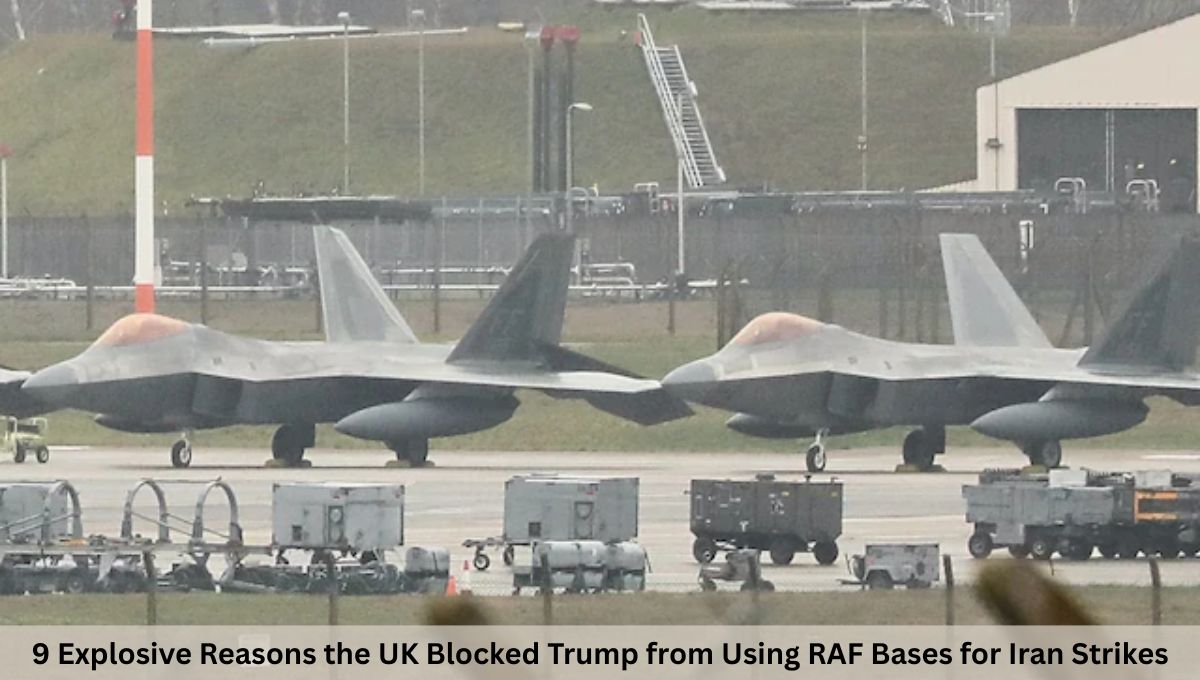
9 Explosive Reasons the UK Blocked Trump from Using RAF Bases for Iran Strikes amid Chagos deal tensions.
The United Kingdom has taken one of its most consequential foreign-policy decisions in years:
refusing to allow the United States to use British-controlled airbases for potential military strikes against Iran.
The reported decision — first revealed by the BBC, Bloomberg, The Times, and The Guardian — comes as Washington rapidly expands its military presence around Iran, raising fears of a major regional conflict. It has also triggered a sharp public backlash from Donald Trump, deepening tensions with the government of Keir Starmer.
At the center of the dispute are two strategically vital locations:
- RAF Fairford, home to US heavy bombers in Europe
- Diego Garcia, a joint UK-US base in the Indian Ocean
The decision has implications far beyond Britain and Iran.
It affects:
- US war planning in the Middle East
- The future of the Chagos Islands sovereignty deal
- NATO alliance cohesion
- Global oil markets and shipping lanes
- The credibility of international law on pre-emptive war
This article breaks down why Britain said no, why Trump reacted so strongly, and what this means for a world already on edge.
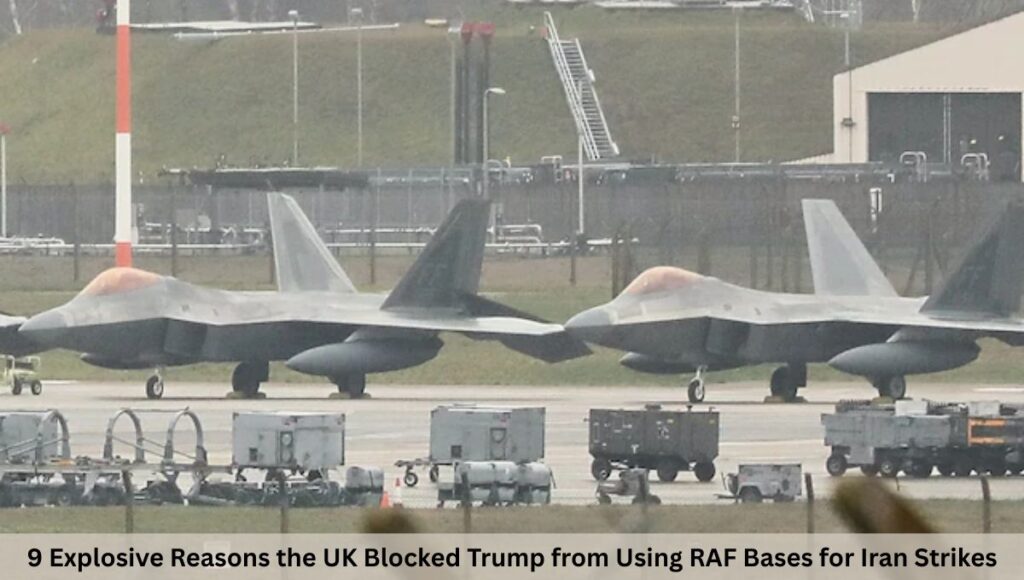
9 Explosive Reasons the UK Blocked Trump from Using RAF Bases for Iran Strikes
1. What the UK Actually Blocked — and Why It Matters
Contrary to some early interpretations, the UK has not severed military cooperation with the US. Instead, it has refused to grant explicit approval for American forces to launch offensive strikes on Iran from British-controlled territory.
Bases Involved
- RAF Fairford (England):
- The only forward operating location for US strategic bombers in Europe
- Regularly hosts B-1, B-2, and B-52 bombers
- Diego Garcia (Chagos Islands):
- A critical hub for long-range operations across the Middle East and Indo-Pacific
- Previously used for operations in Iraq, Afghanistan, and against ISIS
Under long-standing bilateral agreements, any combat operation launched from UK territory requires UK government approval. This is not symbolic — it is legally binding.
Britain has not granted that approval.
2. International Law: The Core of Britain’s Resistance
At the heart of London’s decision lies international law, specifically the UK’s post-2001 legal doctrine on the use of force.
Britain’s Legal Position
The UK holds that:
- Military force is lawful only in self-defence against an imminent or actual attack, or
- When explicitly authorised by the **United Nations Security Council
A pre-emptive strike on Iran, absent clear evidence of imminent attack, would likely fall outside these bounds.
Under international law, a state can be held legally responsible if it:
- Knowingly assists another state
- In carrying out an unlawful military action
British officials fear that approving US strikes could expose the UK to:
- Legal liability
- Diplomatic backlash
- Retaliatory attacks
This is why Britain previously declined direct participation in US strikes on Iranian targets, limiting its role to defensive measures.
3. Why Trump Is Furious
President Trump has responded with unusually direct and public criticism of Britain.
Posting on Truth Social, he warned that:
“The United States may need access to Diego Garcia and the Airfield located in Fairford in order to eradicate a potential attack by a highly unstable and dangerous Regime.”
Trump argues that:
- Iran poses a direct threat to Western allies
- Pre-emptive action could be justified as collective self-defence
- Restricting US military options weakens deterrence
But his anger appears to extend beyond military logistics.
4. The Chagos Islands Deal: The Hidden Fault Line
The standoff over Iran strikes has become entangled with a separate — and deeply sensitive — issue:
Britain’s agreement to transfer sovereignty of the Chagos Islands to Mauritius.
Key Elements of the Deal
- UK would cede sovereignty to Mauritius
- Britain would lease back Diego Garcia for 99 years
- Estimated cost: £35 billion
- Mauritius would have no role in base operations
The UK government argues this is the only way to secure the base’s long-term future, following adverse international court rulings questioning Britain’s legal claim.
5. Why the US Is Nervous About Chagos
Washington sees Diego Garcia as:
- Essential for Middle East air campaigns
- Vital to Indo-Pacific deterrence against China
- One of the most secure overseas bases in the US arsenal
Trump has repeatedly warned Britain not to “give away” Diego Garcia, calling the lease arrangement:
- “A big mistake”
- “An act of GREAT STUPIDITY”
Although the US State Department has formally endorsed the deal, Trump’s latest remarks suggest the issue has become personal and political.
Several UK officials believe Trump’s renewed opposition to the Chagos deal is retaliation for Britain’s refusal to approve Iran strikes.
6. Why RAF Fairford Is So Important to Any Iran Campaign
From a military standpoint, RAF Fairford is a prize asset.
Strategic Advantages
- Significantly closer to Iran than US mainland bases
- Allows higher sortie rates
- Reduces strain on aircraft and crews
- Enables sustained bombing campaigns
Distance comparison:
- RAF Fairford → Iran: ~2,500 miles
- Diego Garcia → Iran: ~2,300 miles
- Whiteman AFB (Missouri) → Iran: ~6,500 miles
Without access to Fairford or Diego Garcia, US bombers must fly longer, riskier missions, limiting operational tempo.
7. Why No B-2 Bombers Have Moved — Yet
Observers have noted the absence of US strategic bombers at Diego Garcia during the current crisis.
Last year, six B-2 Spirit stealth bombers deployed there in a show of force against Iran and later struck Houthi targets in Yemen.
This time, despite a massive buildup of fighters, tankers, and surveillance aircraft, no bombers have forward-deployed.
Many analysts believe Britain’s refusal to grant approval is a key reason.
8. Britain’s Longstanding Caution on Pre-Emptive War
The UK’s stance reflects historical experience.
Iraq War Lessons
In 2003, legal controversies over Iraq deeply damaged trust in government intelligence and decision-making.
Since then:
- Legal advice has been more conservative
- Ministers are wary of being drawn into US-led wars
- Parliamentary scrutiny has increased
Starmer’s government appears determined not to repeat past mistakes, particularly without UN backing.
9. What This Means for the US–UK Alliance
Despite heated rhetoric, officials on both sides insist the alliance remains strong.
However, this episode exposes real limits to the “special relationship”:
- Britain will not automatically back US military action
- Legal constraints can override alliance loyalty
- Domestic politics now shape strategic decisions
As one former UK official put it:
“This is not anti-Americanism. It’s legal realism.”
10. Iran, Geneva, and the Diplomatic Clock
The dispute unfolds as the US and Iran engage in high-stakes nuclear talks in Geneva.
Trump has issued ultimatums, warning of severe consequences if Tehran does not curb its nuclear programme.
Britain officially supports diplomacy, stating:
- “There is a political process ongoing between the US and Iran, which the UK supports.”
- “Iran must never be allowed to develop a nuclear weapon.”
London fears that authorising pre-emptive strikes could collapse talks entirely.
11. The Global Fallout: Oil, Shipping, and Escalation Risks
Any strike on Iran risks:
- Iranian retaliation against regional bases
- Attacks on shipping in the Strait of Hormuz
- Sharp spikes in global oil prices
Roughly one-third of global seaborne oil passes through Hormuz.
Even limited conflict could:
- Trigger inflation worldwide
- Hit energy-importing economies
- Destabilise fragile Middle Eastern states
12. Domestic Politics in Britain: A Deal in Jeopardy
The Chagos legislation has stalled in Parliament.
If it is not passed before the end of the current session:
- The bill may lapse
- The deal could unravel
- Britain could face renewed legal challenges
Opposition figures have already declared the deal “dead in the water” without US support.
13. Can Trump Force Britain’s Hand?
In practical terms, no.
Under UK law:
- The government controls base usage
- Parliament can scrutinise decisions
- Courts can review legality
But Trump can:
- Apply political pressure
- Undermine diplomatic trust
- Complicate future cooperation
Whether this dispute escalates or fades may depend on:
- Progress in Iran talks
- Trump’s domestic political calculations
- The fate of the Chagos deal
Conclusion: A Rare Line Britain Will Not Cross
Britain’s refusal to allow US strikes on Iran from its territory marks a clear red line.
It reflects:
- Legal caution
- Strategic calculation
- Political memory
For Trump, it is an unacceptable constraint on American power. For Starmer, it is a necessary defence of law and sovereignty.
As the US military buildup continues and diplomacy hangs by a thread, one thing is clear:
The UK has decided that alliance loyalty does not mean automatic participation in war — and that decision could reshape transatlantic relations for years to come.
Also Read: 7 Explosive Signals the US–Iran War Could Begin Within Days
Also Read: U.K. Denying U.S. Use Of Key Bases Would Impact Bombers’ Role In Iran Air Campaign