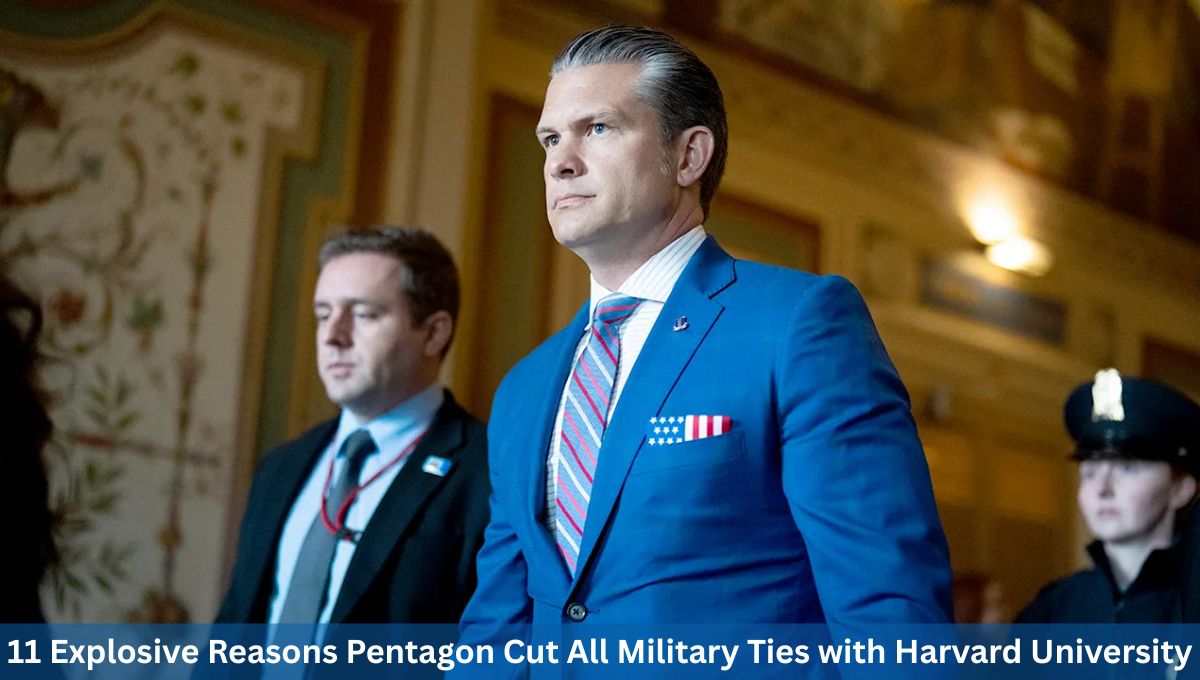
11 Explosive Reasons Pentagon Cut All Military Ties with Harvard University, calling It “Woke” and unfit to train US military leaders.The United States Pentagon has formally announced it will end all academic ties with Harvard University, marking one of the most dramatic ruptures between the US military establishment and an elite civilian institution in modern American history.
The decision, announced by Secretary of War Pete Hegseth, will terminate all professional military education (PME), fellowships, and certificate programmes conducted in partnership with Harvard beginning in the 2026–2027 academic year. Military personnel already enrolled will be allowed to complete their studies, but no new participants will be admitted.
The move comes amid a broader campaign by President Donald Trump’s administration to pressure top US universities over alleged ideological bias, campus protests, diversity policies, and foreign research links. Harvard has emerged as the administration’s most prominent target.
Below is a comprehensive, global-audience explainer of what happened, why it matters, and what it signals for the future of US civil-military relations and higher education.
11 Explosive Reasons Pentagon Cut All Military Ties with Harvard University
1. Pentagon Announces End to Harvard Military Programs
In a formal statement and a post on X (formerly Twitter), Secretary Pete Hegseth confirmed that the Pentagon—using his preferred term, the “War Department”—would sever all academic relations with Harvard.
“Starting now and beginning in the 2026–27 school year, I am discontinuing all graduate-level Professional Military Education, all fellowships and certificate programs between Harvard University and the War Department,” Hegseth said.
The announcement covers:
- Graduate-level PME courses
- Military fellowships
- Executive and certificate programmes
The Pentagon stressed that officers currently studying at Harvard would be allowed to finish their courses.
2. ‘Harvard Is Woke’: Hegseth’s Blunt Justification
Hegseth offered an unusually ideological explanation for the decision, repeatedly describing Harvard as “woke” and incompatible with military values.
“Harvard is woke. The War Department is not,” he wrote.
He argued that Harvard no longer meets the needs of the US military or contributes to combat readiness.
“For too long, this department has sent our best and brightest officers to Harvard, hoping the university would better understand and appreciate our warrior class,” he said. “Instead, too many of our officers came back looking too much like Harvard — heads full of globalist and radical ideologies that do not improve our fighting ranks.”
The language marked a sharp departure from the traditionally technocratic tone of Pentagon education policy.
3. A Break With a Long and Historic Relationship
The decision ends a relationship that stretches back to the founding of the United States.
Hegseth himself highlighted Harvard’s deep historical ties to the US military:
- In 1775, George Washington took command of the Continental Army in Harvard Yard
- Harvard buildings were used as military barracks during the Revolutionary War
- Through the Korean War, military service was common among Harvard students
- Harvard has produced more Medal of Honor recipients than any other civilian university
Despite this history, Hegseth said the relationship had fundamentally changed.
“Harvard today is no longer a welcoming institution to military personnel or the right place to develop future leaders,” he said.
4. Allegations of Foreign Influence and Security Concerns
One of the Pentagon’s most serious accusations concerned Harvard’s research partnerships.
“Campus research programs have partnered with the Chinese Communist Party,” Hegseth said.
While no specific projects were named in the announcement, the allegation reflects broader US government concerns about:
- Technology transfer
- National security risks
- Academic collaboration with foreign powers, particularly China
These concerns have been a recurring theme in Trump-era policy toward universities.
5. Campus Culture and Protest Politics Cited
Hegseth also criticised what he described as Harvard’s campus environment.
He accused university leadership of:
- Encouraging a culture that “celebrated Hamas”
- Allowing attacks on Jewish students
- Failing to curb antisemitism during pro-Palestinian protests
- Continuing race-based policies allegedly in violation of US Supreme Court rulings
“University leadership encouraged a campus environment that celebrated Hamas, allowed attacks on Jews, and still promotes discrimination based on race,” he said.
Harvard has previously said it condemns all forms of discrimination and has acknowledged that both Jewish and Muslim students experienced harassment following the outbreak of the Gaza war in 2023.
6. Part of a Wider Trump Administration Crackdown
The Pentagon’s decision is not an isolated move. It fits into a broader confrontation between the Trump administration and elite universities.
Key elements of that campaign include:
- Attempts to cut or freeze billions of dollars in federal funding
- Legal complaints alleging antisemitism on campuses
- Pressure to dismantle diversity, equity and inclusion (DEI) programmes
- Efforts to restrict foreign student enrolment
Harvard has sued the federal government over funding freezes and has resisted several administration demands.
President Trump recently said his administration would seek $1 billion in damages from Harvard as part of ongoing disputes.
7. Review of Other Ivy League Universities Looms
Hegseth made clear that Harvard may not be the last institution affected.
“We will evaluate all existing graduate programs for active-duty service members at all Ivy League universities and other civilian universities,” he said.
The Pentagon will assess whether such programmes provide:
- Cost-effective education
- Strategic value
- Measurable leadership benefits
Public universities and military-run graduate institutions may increasingly replace elite private schools in officer education.
8. Shift Toward ‘Warrior Culture’ and Lethality
The Pentagon framed the decision as part of a refocus on combat readiness.
“Our focus is developing warriors, increasing lethality and re-establishing deterrence,” Hegseth said.
He argued that expensive elite universities no longer justify their cost to taxpayers.
“That no longer includes spending billions of dollars on expensive universities that actively undercut our mission and undercut our country.”
Supporters of the move say it restores military priorities; critics warn it risks narrowing strategic thinking.
9. Hegseth’s Own Ivy League Background Raises Eyebrows
The announcement drew attention because Hegseth himself is an Ivy League graduate.
- Bachelor’s degree from Princeton University
- Master’s degree from Harvard Kennedy School
In 2022, while working as a Fox News commentator, Hegseth publicly returned his Harvard diploma on air, writing “Return to Sender” on it while criticising the university’s politics.
That clip has since resurfaced on Pentagon-linked social media accounts, underscoring the ideological nature of the break.
10. Concerns Over Academic Freedom and Free Speech
Rights advocates and academic groups have raised alarms about the government’s actions.
Critics argue that:
- Cutting ties over ideology threatens academic freedom
- Universities should remain independent from political pressure
- Military leaders benefit from exposure to civilian perspectives
Some analysts warn the move could isolate senior military leadership from broader global, economic and diplomatic thinking.
11. What This Means for the Future of Military Education
The Pentagon’s decision signals a potential transformation in how US officers are educated.
Likely consequences
- Greater reliance on war colleges and military academies
- Increased use of public universities
- Reduced interaction between elite academia and the armed forces
- A sharper ideological divide between universities and the military
For decades, Harvard and similar institutions were seen as incubators for strategic thinkers. That assumption is now being openly challenged.
Harvard’s Response
Harvard University did not immediately comment on the Pentagon’s announcement.
A university spokesperson directed media to a public page outlining Harvard’s historical role in US military traditions, stating that the institution has played a “significant role” in America’s military history since its founding.
The university has previously rejected claims that it promotes extremism or discrimination and has defended its campus policies as consistent with US law.
Global Implications
For international audiences, the episode highlights:
- Rising politicisation of higher education in the US
- Deepening ideological divides within American institutions
- Shifts in US civil-military relations
- Broader debates over nationalism, globalism and academic independence
Foreign universities and governments are closely watching how US academic partnerships evolve under these pressures.
Conclusion: A Symbolic and Strategic Break
The Pentagon’s decision to cut ties with Harvard is more than an administrative change. It represents a symbolic break between the US military and elite academia, driven by ideological conflict as much as policy evaluation.
Whether this shift strengthens military effectiveness or narrows strategic vision remains contested. What is clear is that the relationship between America’s armed forces and its most prestigious universities has entered a new, uncertain phase.
As the 2026–27 academic year approaches, the long-standing bridge between the barracks and the ivory tower appears, at least for now, firmly burned.
Also Read: ‘Harvard is woke, we’re not’: Hegseth says Pentagon will sever all academic ties with Harvard
Related Posts:
- 3 Explosive Conditions Iran Sets to End War with US…

- 5 Major Takeaways from the US Supreme Court's…

- 7 Explosive Signals as Hegseth Warns Iran and Trump…
- 10 Shocking Details as UK Train Stabbing Leaves 10 Injured

- Trump Unveils Sweeping AI Plan to Eliminate “Woke”…
- 10 Explosive Warnings as Donald Trump Calls Iran…