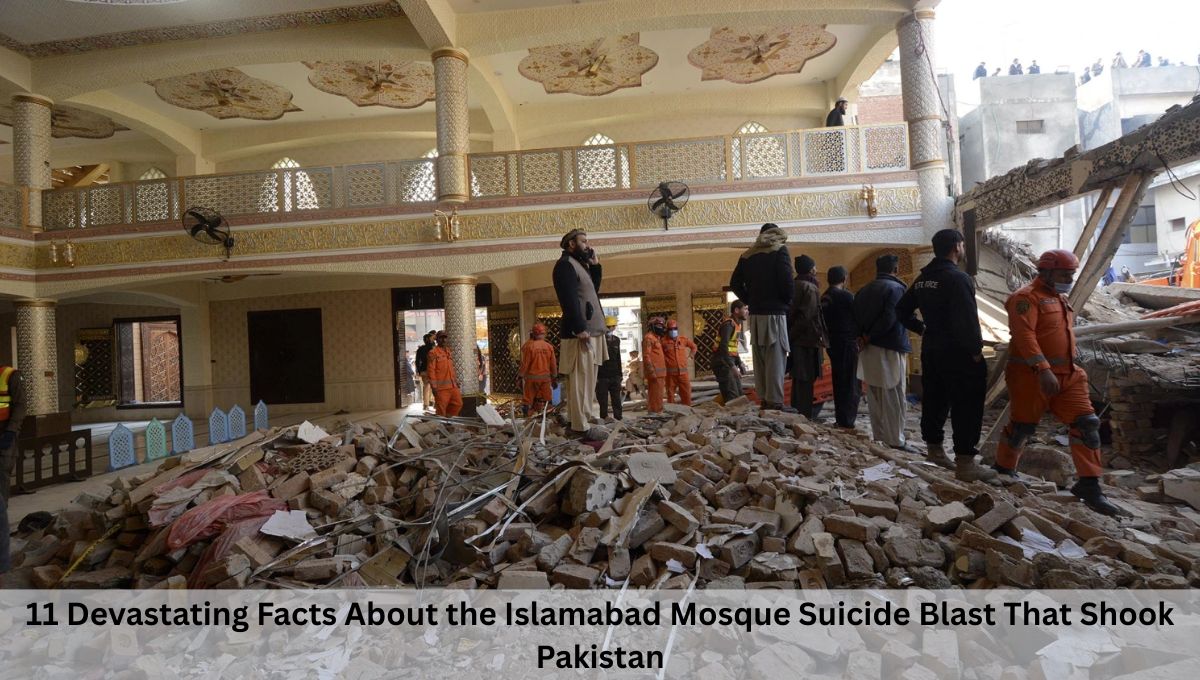
11 Devastating Facts About the Islamabad Mosque Suicide Blast That Shook Pakistan, leaving 31 dead and over 170 injured. At least 31 people were killed and more than 170 wounded when a suicide bomber struck a Shi’ite mosque in Islamabad during Friday prayers, marking one of the deadliest attacks in Pakistan’s capital in more than a decade.
The assault, later claimed by the Islamic State (IS) group, has sent shockwaves across Pakistan and drawn condemnation from around the world.
The bombing targeted the Khadija Tul Kubra Imambargah in the Tarlai Kalan area, a semi-urban neighborhood on the outskirts of Islamabad. What unfolded within seconds turned a sacred space into a scene of devastation, bloodshed, and grief.
Below is a comprehensive, on-the-ground account of what happened, why it matters, and how it is reshaping Pakistan’s security and political discourse.
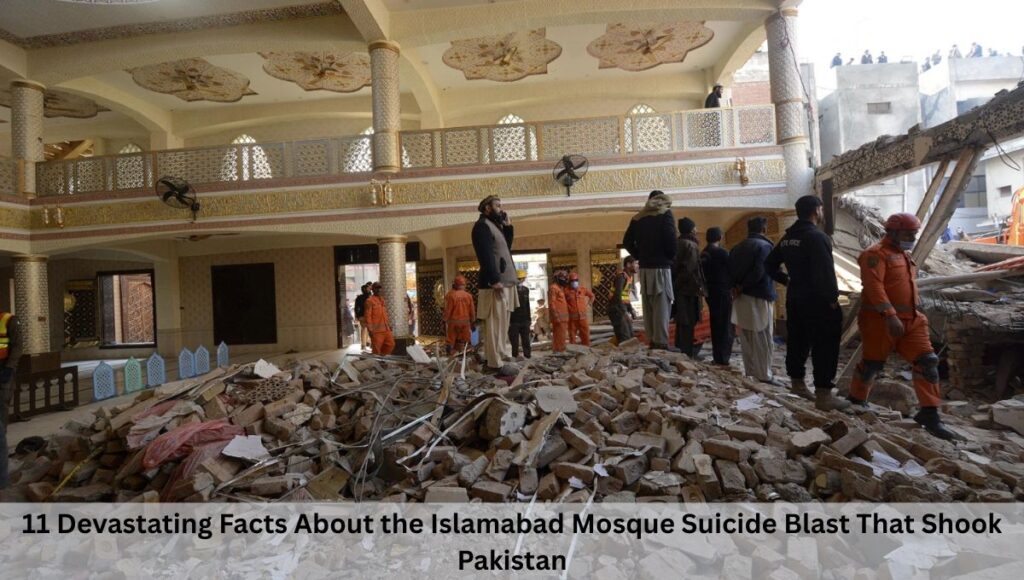
11 Devastating Facts About the Islamabad Mosque Suicide Blast That Shook Pakistan
1. The Attack Struck During Friday Prayers
The suicide bombing occurred shortly after Friday prayers began, a time when mosques are typically packed with worshippers.
According to police and eyewitness accounts, between 600 and 700 people were inside or around the mosque complex when the attacker arrived.
Friday prayers are among the most sacred communal rituals in Islam, making the timing of the attack particularly devastating.
Survivors described hearing gunshots first, followed by a massive explosion that tore through the prayer hall and courtyard.
“There was smoke, screaming, and blood everywhere,” said one survivor at Islamabad’s Pakistan Institute of Medical Sciences (PIMS) hospital.
2. Security Guards Tried to Stop the Bomber
Pakistan’s Defence Minister Khawaja Asif confirmed that mosque security guards intercepted the attacker at the entrance.
When challenged, the bomber allegedly opened fire on the guards, injuring security personnel.
Conflicting accounts exist about how far the attacker advanced:
- Police sources say the bomber was stopped at the gate and detonated his explosives there.
- Eyewitnesses claim he managed to run 15–20 metres inside the compound before blowing himself up among worshippers.
What is clear is that the guards’ intervention likely prevented even greater casualties.
3. At Least 31 Killed, Death Toll May Rise
As of official confirmation:
- 31 people were killed
- 169–170 people were injured
- Dozens remain in critical condition
Medical officials warned that the death toll could still rise due to the severity of injuries, including shrapnel wounds, internal bleeding, and burns.
Children were among the injured, and hospitals across Islamabad and neighboring Rawalpindi were placed under emergency protocols.
4. Hospitals Overwhelmed by the Scale of Injuries
Scenes at Islamabad’s largest public hospital were harrowing.
Journalists and medical staff reported:
- Victims arriving on stretchers, motorcycles, and private cars
- One injured person transported in the boot of a car
- Families screaming and searching for loved ones in crowded corridors
Emergency wards were quickly overwhelmed, forcing authorities to shift patients to multiple hospitals to cope with the influx.
5. Islamic State Claimed Responsibility
On Friday evening, the Islamic State (IS) group claimed responsibility for the attack via its Telegram channel.
The group released:
- A photograph allegedly showing the attacker holding a gun
- A statement boasting about the assault and warning of more attacks
IS and its regional affiliate Islamic State Khorasan Province (ISKP) have a history of targeting Shi’ite Muslims, whom they consider heretics.
6. Shi’ite Minority Once Again Targeted
Shi’ite Muslims make up around 10–15% of Pakistan’s population, but they have long been targets of sectarian violence.
This attack fits a broader pattern:
- Mosques and imambargahs targeted
- Attacks timed during religious gatherings
- High civilian casualties intended to inflame sectarian tensions
Pakistani Shi’ite leader Raja Abbas Nasir called the bombing:
“A grave failure in protecting human lives and a serious indictment of the authorities.”
7. Islamabad Rarely Sees Attacks of This Scale
Islamabad is one of the most heavily guarded cities in Pakistan, home to:
- Foreign embassies
- Government institutions
- Military and intelligence headquarters
The last major suicide bombing of similar scale occurred in 2008, when a truck bomb destroyed the Marriott Hotel, killing at least 63 people.
Security analysts describe the latest attack as a major intelligence and security breach.
8. Political Leaders Condemn the ‘Crime Against Humanity’
Condemnation poured in from across Pakistan’s political spectrum.
- Prime Minister Shehbaz Sharif expressed “deep grief”
- President Asif Ali Zardari called it a “crime against humanity”
- Deputy PM Ishaq Dar said targeting worshippers violated Islamic principles
Opposition leaders, including Bilawal Bhutto Zardari, described the bombing as an attack on Pakistan’s conscience, unity, and values.
9. Pakistan Blames External Actors, India Responds Sharply
Defence Minister Khawaja Asif alleged the attacker had travelled to and from Afghanistan and went further by accusing India of sponsoring the attack, without presenting evidence.
India swiftly rejected the claims.
In a strongly worded statement, India’s Ministry of External Affairs said Pakistan was:
“Deluding itself by blaming others for its home-grown ills.”
The exchange has added diplomatic tension to an already volatile regional situation.
10. International Condemnation and Solidarity
Global leaders and diplomatic missions condemned the attack:
- United Kingdom: Ambassador Jane Marriott called it “abhorrent”
- European Union: Condemned terrorism and offered condolences
- United States Embassy: Said attacks on places of worship are unacceptable
- Afghanistan: Denied any role and condemned the violence
The attack has reinforced concerns about regional militancy spilling across borders.
11. Pakistan Faces a Resurgent Wave of Militancy
The Islamabad bombing comes amid a broader rise in militant violence across Pakistan:
- Deadly attacks in Balochistan
- Frequent clashes with Tehreek-e-Taliban Pakistan (TTP) in Khyber Pakhtunkhwa
- Increased ISKP activity targeting minorities
Security experts warn that militant groups are attempting to destabilize urban centers, not just border regions.
Eyewitness Accounts: ‘Blood Everywhere’
Survivors described chaos and horror inside the mosque.
“We heard gunfire, then a blast that threw people across the hall,” said Sarfraz Shah, who lost his brother in the attack. “When the smoke cleared, there was blood everywhere.”
Another worshipper recalled counting nearly 30 bodies before fleeing to help the wounded.
Media Silence Controversy Inside Pakistan
Local journalists accused national TV channels of downplaying the death toll and continuing entertainment programming hours after the blast.
Veteran journalist Ihtisham Ul Haq called it:
“Cruel, shameful, and deeply insensitive.”
The criticism has reignited debate about media responsibility during national tragedies.
Why This Attack Matters Beyond Pakistan
The Islamabad mosque bombing is not just a national tragedy—it carries global implications:
- Highlights the ongoing threat of Islamic State affiliates
- Exposes vulnerabilities even in heavily guarded capitals
- Risks inflaming sectarian tensions across South Asia
- Complicates already strained Pakistan–India–Afghanistan relations
For global audiences, the attack underscores how religious extremism continues to target civilians worldwide, regardless of borders or security measures.
What Happens Next
Authorities have launched a full-scale investigation, reviewing:
- CCTV footage
- Intelligence failures
- Possible militant networks involved
Security across Islamabad has been tightened further, with additional checkpoints and patrols deployed.
Yet for families of the victims, justice and accountability remain uncertain.
Conclusion: A Nation in Mourning
As Pakistan buries its dead, the Islamabad mosque blast stands as a grim reminder of the human cost of extremism.
Worshippers seeking peace were met with violence, and a city long considered secure was forced to confront its vulnerabilities.
The coming weeks will test Pakistan’s ability to:
- Protect religious minorities
- Counter militant networks
- Heal sectarian wounds
- Restore public confidence in security institutions
For now, the nation mourns—and the world watches.
Also Read: 12 Killed in Powerful Islamabad Court Blast Amid Rising Pakistan-Afghan Tensions
Also Read: Deadly Islamabad bombing sharpens focus on cross-border attacks in Pakistan
Related Posts:
- 5 Major Takeaways from the US Supreme Court's…

- 7 Heartbreaking Facts About Venezuela's Earthquake Disaster
- Afghanistan–Pakistan War 2025: Inside the 48-Hour Ceasefire

- 7 Powerful Facts About Ayatollah Ali Khamenei’s…
- Swat Suicide Bombing: 14 Killed in Devastating…
- 11 Explosive Revelations From Ted Cruz’s Leaked…