9 Explosive Signals as U.S.–Iran Tensions Near a Breaking Point amid U.S. military build-up. U.S.–Iran tensions have entered a dangerous new phase, marked by an unusually blunt warning from President Donald Trump and an unmistakable surge of American military power toward Iran’s doorstep.
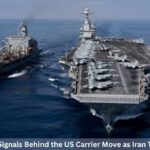
In a series of social media posts and public remarks this week, Trump declared that a “massive armada” led by the USS Abraham Lincoln aircraft carrier was moving rapidly toward Iran, warning Tehran that it must agree to a nuclear deal or face military consequences “far worse” than last year’s U.S. strikes on Iranian nuclear facilities.
Iran, for its part, has responded with defiance. Senior officials insist the country is ready for negotiations only on “equal footing” and without coercion, while simultaneously warning that any U.S. attack would be met with retaliation “like never before.”
The confrontation comes against the backdrop of Iran’s bloodiest domestic unrest in decades, unresolved disputes over Tehran’s nuclear programme, and a U.S. president who appears increasingly willing to use military force as leverage.
9 Explosive Signals as U.S.–Iran Tensions Near a Breaking Point
Trump’s ‘Armada’ Warning and the Nuclear Ultimatum
President Trump’s language has been striking even by his own standards.
“A massive Armada is heading to Iran,” he wrote on Truth Social, describing a naval force larger than the one previously deployed before the U.S. seized Venezuelan President Nicolás Maduro in a surprise military operation earlier this month.
According to Trump, the fleet is “ready, willing, and able to rapidly fulfil its mission, with speed and violence, if necessary.”
The central demand is clear:
Iran must return to negotiations and accept a deal that permanently prevents it from acquiring nuclear weapons.
“Time is running out; it is truly of the essence,” Trump warned. “The next attack will be far worse! Don’t make that happen again.”
The Shadow of ‘Operation Midnight Hammer’
Trump’s threat is not hypothetical.
In June 2025, during the 12-day Iran–Israel war, the United States launched its first-ever direct strikes on Iranian soil.
The operation, codenamed Operation Midnight Hammer, targeted three of Iran’s most sensitive nuclear sites: Fordo, Natanz, and Isfahan.
What Happened in June 2025
- Seven B-2 stealth bombers dropped Massive Ordnance Penetrator (MOP) bunker-buster bombs on the underground Fordo enrichment facility
- Natanz was also hit with MOPs
- Isfahan was struck by more than two dozen Tomahawk cruise missiles fired from a U.S. submarine
- A total of 125 aircraft participated in the mission
U.S. officials said the strikes severely degraded Iran’s nuclear capabilities. Trump later claimed the programme had been “obliterated.”
Iran disputes that assessment, insisting that key materials were moved before the attack and that its nuclear expertise remains intact.
Why the USS Abraham Lincoln Matters
At the centre of the current escalation is the USS Abraham Lincoln Carrier Strike Group, one of the most powerful naval formations in the world.
Capabilities of the Carrier Group
- 6,000–7,000 personnel
- Around 65 fighter aircraft, including F/A-18E Super Hornets
- Multiple Arleigh Burke-class guided-missile destroyers, capable of launching Tomahawk missiles
- Advanced missile defence, radar, and surveillance systems
The carrier effectively serves as a mobile airbase, capable of sustaining high-intensity combat operations for extended periods.
Military analysts note that the deployment significantly expands Trump’s military options, from limited punitive strikes to a broader campaign designed to coerce Tehran.
A Region Saturated With U.S. Power
The naval deployment is only part of the picture.
Open-source intelligence and satellite imagery show a substantial increase in U.S. air and naval activity across the Middle East and Indian Ocean.
Recent U.S. Military Movements
- Fighter jets deployed to Jordan’s Muwaffaq Air Base
- Increased aircraft traffic to bases in Qatar and Diego Garcia
- Surveillance drones and P-8 Poseidon aircraft operating near Iranian airspace
- Guided-missile destroyers docked in Bahrain
- Preparations to deploy additional Patriot and THAAD missile defence systems
According to analysts, this level of activity goes beyond routine deterrence and suggests contingency planning for potential conflict.
Iran’s Response: ‘Fingers on the Trigger’
Iranian officials have answered Trump’s threats with equally stark language.
Foreign Minister Abbas Araghchi said Iran’s armed forces are fully prepared to respond “immediately and powerfully” to any aggression by land, sea, or air.
“Iran has always welcomed a fair and equitable nuclear deal,” Araghchi said. “But such a deal must be free from coercion, threats, and intimidation.”
Iran’s mission to the United Nations went further, warning that if attacked, Tehran would retaliate “like never before.”
The Protests That Changed the Equation
The current standoff cannot be separated from Iran’s domestic crisis.
Protests erupted in late December following a sharp collapse of the Iranian rial, quickly evolving into a nationwide challenge to the legitimacy of the clerical leadership.
The Crackdown
- Thousands of protesters reportedly killed
- Tens of thousands detained
- Internet shutdowns lasting weeks
- Security forces accused of mass executions
Iran denies the scale of the violence reported by Western human rights organisations, but even official figures acknowledge significant casualties.
Trump seized on the unrest, urging protesters to “seize their institutions” and repeatedly warning Tehran against executing demonstrators.
Human Rights as a Pretext for Intervention?
Some analysts believe Trump briefly considered military action framed as protection for Iranian civilians.
However, as the protests were eventually crushed, Trump’s rhetoric shifted back toward Iran’s nuclear programme — a familiar and more internationally defensible justification for potential strikes.
Critics warn that using airpower to inspire regime change is fraught with risks.
“Airstrikes alone cannot topple the Islamic Republic,” one senior Israeli official has said.
“Without boots on the ground, the regime will survive — possibly more repressive than before.”
Why Washington Thinks Iran Is Weak
U.S. intelligence assessments reportedly suggest Iran is in one of its weakest positions in decades.
Factors include:
- Severe economic collapse
- Loss of senior military leaders in Israeli strikes
- Widespread public anger
- Ongoing sanctions pressure
Secretary of State Marco Rubio told lawmakers that the Iranian regime is “probably weaker than it’s ever been.”
But history suggests that pressure alone rarely produces capitulation — and often strengthens hardliners.
Iran’s Nuclear Red Lines
Despite U.S. pressure, Tehran has been consistent on one point: it will not accept a permanent ban on uranium enrichment.
Under the 2015 nuclear deal, Iran was allowed limited enrichment for civilian purposes. Trump abandoned that agreement in 2018, calling it “decaying and rotten,” and reinstated crippling sanctions.
Since then, Iran has steadily expanded its enrichment activities and restricted access for UN nuclear inspectors.
Washington now demands:
- A permanent end to uranium enrichment
- Limits on ballistic missile development
- An end to support for regional proxy groups
Iran rejects these terms as an infringement on its sovereignty.
The Risk of Regional Blowback
Any U.S. strike on Iran would not occur in isolation.
Analysts warn Tehran could retaliate by:
- Targeting U.S. bases across the Middle East
- Attacking oil infrastructure
- Blocking shipping through the Strait of Hormuz
- Striking U.S. allies, including Israel
Gulf states hosting American forces have privately and publicly urged restraint, fearing they would be the first targets of Iranian retaliation.
Why Allies Are Nervous
Saudi Arabia, the UAE, and other regional players have ruled out allowing their airspace or territory to be used for a U.S. attack on Iran.
Their concern is not sympathy for Tehran, but fear of chaos.
A fragmented Iran — a nation of over 90 million people — could destabilise the entire Middle East, disrupt global energy markets, and trigger refugee flows on a massive scale.
Regime Change: A Dangerous Illusion
Trump has openly hinted at wanting “new leadership” in Iran.
But experts warn that removing Supreme Leader Ayatollah Ali Khamenei would not guarantee a more moderate outcome.
Power could shift further toward the Islamic Revolutionary Guard Corps (IRGC), entrenching military rule and hard-line policies.
“There is no guarantee that regime change would improve conditions for Iranians,” analysts caution.
“It could make everything worse.”
Why This Moment Feels Different
Despite the risks, U.S.–Iran tensions today feel more volatile than in recent years.
Key differences include:
- Direct U.S. strikes on Iranian soil in 2025
- A massive and visible military build-up
- Iran’s internal instability
- Trump’s demonstrated willingness to act unilaterally
Each side believes it holds leverage — a dangerous dynamic in any confrontation.
Diplomacy Still Exists — Barely
Behind the scenes, messages have reportedly been exchanged through intermediaries, including Omani diplomats.
But there are no active negotiations, no agreed framework, and no trust.
Iran says talks must be genuine. Washington says Tehran already knows the terms.
For now, both appear locked in a high-stakes game of brinkmanship.
Conclusion: A Narrow Path Away From War
U.S.–Iran tensions are approaching a critical threshold.
Trump’s warnings, the arrival of a powerful armada, and Iran’s vows of unprecedented retaliation have created a volatile mix where miscalculation could trigger a wider conflict.
Neither side appears eager for full-scale war. Neither side wants to be seen as backing down.
What happens next may depend less on strategy than on restraint — a quality in dangerously short supply. For now, the armada sails on, the warnings grow louder, and the clock Trump invoked continues to tick.
Also Read: 9 Explosive Warnings as Hezbollah Backs Iran Against Trump Threats
Also Read: How does US military build-up off Iran compare to the June 2025 strikes?