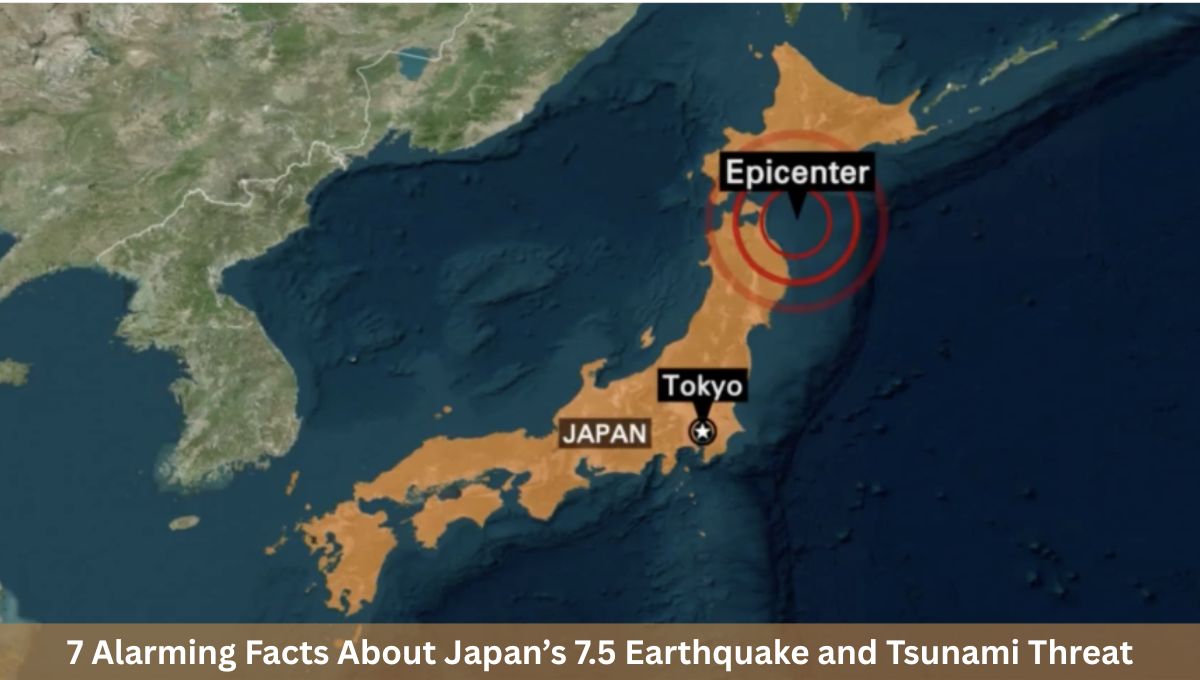
7 Alarming Facts About Japan’s 7.5 Earthquake and Tsunami Threat, raising fears of a potential megaquake along the Pacific Coast. A powerful 7.5-magnitude earthquake rattled northern Japan late Monday night, leaving dozens injured, forcing mass evacuations, and triggering tsunami warnings across parts of the country’s northeastern Pacific coastline.
While the immediate tsunami threat has since been lifted, Japanese authorities are now warning of the heightened risk of strong aftershocks or even a potential “megaquake” in the coming days.
The earthquake, one of the strongest to strike Japan this year, underscores the country’s ongoing vulnerability as one of the most seismically active nations on Earth.
7 Alarming Facts About Japan’s 7.5 Earthquake and Tsunami Threat
A Strong Quake Strikes Offshore Northern Japan
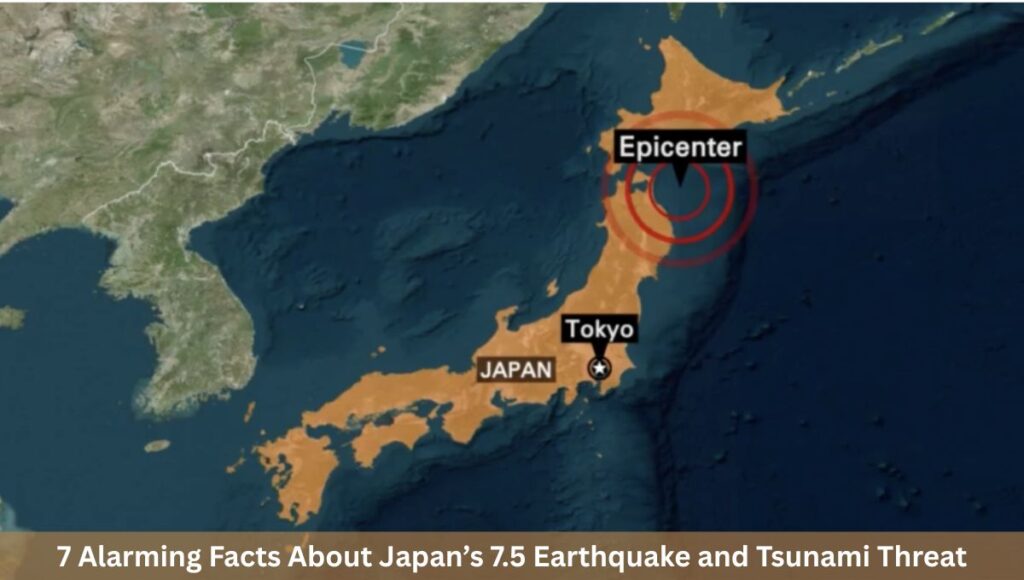
The earthquake struck at 11:15 p.m. local time off the eastern coast of Aomori Prefecture, according to the Japan Meteorological Agency (JMA). The epicentre was located approximately 80 kilometers offshore, at a revised depth of around 54 kilometers beneath the seabed.
The United States Geological Survey (USGS) recorded the quake at a similar magnitude and depth, noting that the tremor lasted more than 30 seconds, a duration long enough to cause widespread panic.
The shaking was so intense that tremors were felt more than 400 miles away in Tokyo, where residents reported buildings swaying and emergency alerts sounding late into the night.
Dozens Injured, Mostly From Falling Objects
Japanese authorities initially reported 23 people injured, but later updates raised the toll to around 30 injured, including at least one person seriously hurt.
According to Japan’s Fire and Disaster Management Agency, most injuries were caused by falling furniture, collapsing items, or people losing their balance during the strong shaking.
Public broadcaster NHK reported:
- Multiple guests injured at a hotel in Hachinohe City
- A man in the Tohoku region hurt after his car fell into a damaged section of road
- Residents injured after tripping or being struck by household objects
Despite the strength of the quake, authorities confirmed there were no immediate fatalities.
Tsunami Warnings Issued Along the Pacific Coast
Shortly after the quake, the Japan Meteorological Agency issued urgent tsunami warnings for parts of Hokkaido, Aomori, and Iwate prefectures, initially estimating possible waves of up to 3 meters (10 feet). Residents in coastal areas were urged to evacuate immediately to higher ground or reinforced evacuation buildings.
Tsunami Waves Observed
Actual tsunami waves were significantly smaller than feared, but still measurable:
- 70 cm at Kuji Port, Iwate
- 50 cm in parts of Hokkaido
- 10–40 cm at several ports in Aomori Prefecture
After several hours, warnings were downgraded to advisories, and by Tuesday morning, all tsunami advisories were fully lifted.
Mass Evacuations and Transport Disruptions
The quake prompted evacuation orders for more than 114,000 residents across multiple prefectures, with temporary shelters opening overnight.
Officials reported:
- Around 480 people sheltered at the Hachinohe air base
- Approximately 800 homes without electricity
- 200 passengers stranded overnight at New Chitose Airport in Hokkaido
Major transportation links were disrupted:
- Tohoku Shinkansen bullet train services suspended between Morioka and Shin-Aomori
- Some expressways temporarily closed due to structural checks
- Local and regional train services halted for inspections
Airlines including All Nippon Airways (ANA) and Japan Airlines resumed normal operations by Tuesday.
Nuclear Facilities Checked After the Quake
Given Japan’s painful history with nuclear disasters, immediate attention focused on the safety of nuclear facilities in the affected region.
Authorities confirmed:
- No abnormalities detected at Fukushima Daiichi or Fukushima Daini
- No issues reported at Onagawa or Higashidōri nuclear power plants
However, Japan Nuclear Fuel Limited reported that over 100 liters of water overflowed from a spent-fuel pool at a nuclear waste reprocessing facility in Rokkasho Village, Aomori Prefecture.
The company stressed that:
- The water remained inside the building
- Cooling systems functioned normally
- No radiation leak or environmental impact was detected
As a precaution, Tokyo Electric Power Company (TEPCO) temporarily halted the discharge of treated Fukushima wastewater into the ocean following the tsunami warning. The International Atomic Energy Agency (IAEA) also confirmed it observed no nuclear safety concerns.
Government Response and Emergency Measures
Prime Minister Sanae Takaichi, elected in October, took to social media and addressed reporters, urging calm but swift action.
“Where a tsunami warning has been issued, please evacuate immediately to safe locations such as high ground or evacuation buildings.”
Her government set up an emergency task force at the prime minister’s crisis management center within minutes of the quake.
The Defense Ministry mobilized 18 helicopters to conduct aerial damage assessments, while local governments worked through the night to check roads, bridges, and coastal infrastructure.
Chief Cabinet Secretary Minoru Kihara emphasized that the government was operating under the principle of “putting human life first.”
Warning of Further Strong Quakes or a ‘Megaquake’
In a rare move, the Japan Meteorological Agency issued a special advisory warning that the likelihood of further strong earthquakes in the offshore region from Hokkaido to Sanriku is now higher than normal.
The JMA placed the probability of a magnitude 8 or stronger quake at around 1%, a low but notable risk given the region’s history. NHK reported that this is the first time since 2022 that Japan has issued this category of alert, often associated with the possibility of a “megaquake.”
While authorities have not recommended preemptive evacuations, residents along Japan’s Pacific coast—from Hokkaido to Chiba Prefecture—have been urged to:
- Review disaster preparedness plans
- Keep emergency supplies ready
- Stay alert to official warnings over the next week
Japan’s Ongoing Earthquake Vulnerability
Japan sits at the heart of the Pacific Ring of Fire, where multiple tectonic plates collide. The country accounts for around 20% of the world’s earthquakes of magnitude 6.0 or higher, despite covering a small fraction of the Earth’s surface.
Memories remain fresh of the March 2011 Tohoku earthquake and tsunami, a 9.0–9.1 magnitude disaster that killed or left missing more than 22,000 people and triggered the Fukushima nuclear meltdown. While this latest quake was far smaller, experts warn it is a reminder that Japan’s seismic threat is ever-present.
What Happens Next
As of Tuesday afternoon, damage assessments were ongoing and most essential services were gradually returning to normal. Authorities remain on high alert for aftershocks, which could continue for days or weeks.
For now, officials say the immediate tsunami threat has passed—but the situation remains fluid. Japan has once again been reminded of its fragile relationship with nature, where seconds matter, preparedness saves lives, and vigilance never truly ends.
Also Read: 6.3-Magnitude Earthquake Devastates Northern Afghanistan
Also Read: Japan Issues First Megaquake Warning After 7.5 Tremor
Related Posts:
- 7 Alarming Facts About Super Typhoon Fung-wong
- 6.1-Magnitude Earthquake Rocks Western Türkiye:…
- Trump’s 20-Point Gaza Peace Plan Gains Urgent Global…

- 6.3-Magnitude Earthquake Devastates Northern Afghanistan

- Massive 8.8 Earthquake Hits Russia’s Kamchatka,…
- Why the Kamchatka 8.8 Earthquake Didn't Turn into a…