9 Explosive Reasons Trump Hit Mexico with a 5% Tariff Over Water, accusing Mexico of violating a 1944 treaty. United States President Donald Trump has once again turned to tariffs as a weapon of diplomacy—this time targeting Mexico over what he calls a long-standing violation of a cross-border water-sharing treaty dating back more than eight decades.
In a late-night message posted on Truth Social, Trump announced he had authorised the immediate imposition of a 5 percent tariff on Mexican imports, accusing Mexico of failing to deliver water owed under the 1944 Water Treaty—a shortfall he says is devastating Texas farmers, crops, and livestock.
The announcement has reignited tensions between the two neighbours, raised questions about the future of US–Mexico trade relations, and exposed deepening strains caused by climate change, drought, agriculture, and geopolitics along the shared border.
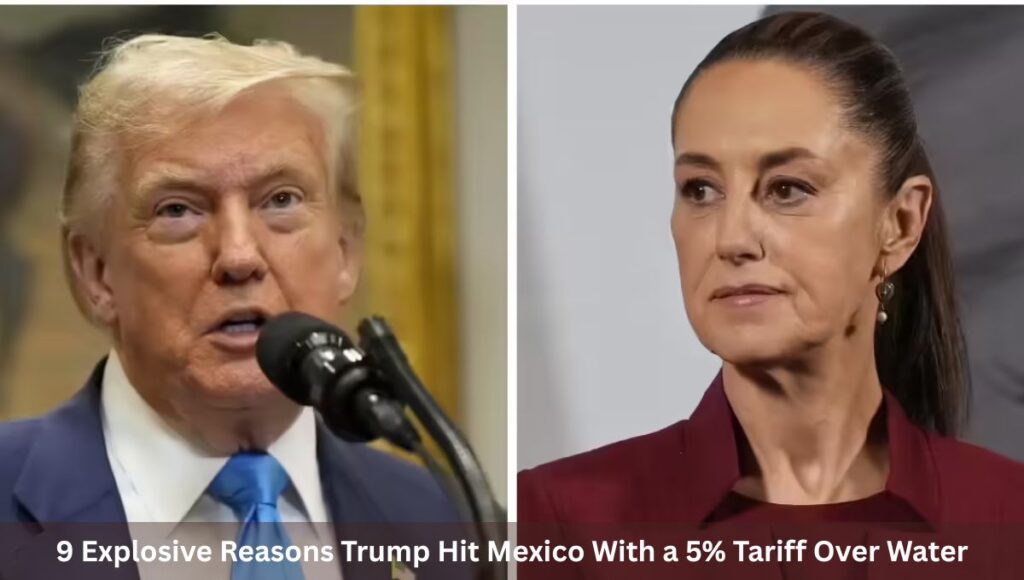
9 Explosive Reasons Trump Hit Mexico With a 5% Tariff Over Water
Trump’s Tariff Announcement: Sudden, Sharp, and Personal
Trump revealed the tariff escalation in characteristically blunt terms on Monday night. “Mexico continues to violate our comprehensive Water Treaty, and this violation is seriously hurting our BEAUTIFUL TEXAS CROPS AND LIVESTOCK,” Trump wrote.
He claimed Mexico owes the United States more than 800,000 acre-feet of water—nearly 987 million cubic metres—for failing to comply with its treaty obligations over the past five years.Trump set a firm demand and deadline, calling on Mexico to release 200,000 acre-feet of water—about 246 million cubic metres—by December 31, warning that economic pressure would intensify if Mexico failed to act.
“As of now, Mexico is not responding, and it is very unfair to our U.S. Farmers,” Trump added.
“That is why I have authorized documentation to impose a 5% Tariff on Mexico if this water isn’t released, IMMEDIATELY.” The tariffs, Trump said, would begin right away, and hinted that further escalation—including higher tariffs or sanctions—remained on the table.
What Is the 1944 Water Treaty?
At the heart of the dispute is the 1944 Treaty on the Utilization of Waters of the Colorado and Tijuana Rivers and of the Rio Grande, signed by the United States and Mexico at the end of World War II.
The agreement governs water-sharing across key cross-border rivers:
Under the Treaty
- The United States must deliver 1.5 million acre-feet of water per year to Mexico from the Colorado River
- Mexico must deliver an average of at least 350,000 acre-feet per year, over five-year cycles, to the US from tributaries feeding the Rio Grande
The treaty allows for flexibility during times of “extraordinary drought,” but it does not clearly define what qualifies—leaving room for disagreement.
Why Texas Farmers Are at the Center of the Dispute
Texas farmers—particularly in the Rio Grande Valley—say water shortages have reached crisis levels.
Agriculture in the region relies heavily on water flowing north from Mexico to:
- Irrigate citrus farms
- Support row crops
- Supply livestock
- Provide drinking water to border communities
Texas lawmakers estimate the water shortage has contributed to more than $1 billion in crop losses in recent years. Texas Governor Greg Abbott has been among the loudest voices pressuring Washington to act.
“Mexico must be held accountable for their continued breaches of our long-standing water agreement,” Abbott said. “Texas farmers are enduring preventable hardship.”
The Texas Commission on Environmental Quality (TCEQ) has repeatedly urged federal intervention, warning that economic losses from delayed water deliveries cannot be recovered.
Mexico’s Drought Crisis: A Country Running Dry
Mexico rejects claims that it has deliberately violated the treaty. President Claudia Sheinbaum has argued that historic drought conditions have made full compliance impossible.
According to the North American Drought Monitor, more than 75 percent of Mexico is currently experiencing moderate to exceptional drought—the highest level recorded since 2011. Sheinbaum said Mexico has delivered water “to the extent that water has been available”, noting the country has endured three consecutive years of drought.
Mexican officials also face intense domestic pressure. Farmers across northern states such as Chihuahua and Baja California depend heavily on US-supplied water and have staged protests against tighter restrictions. Just weeks ago, Mexican farmers drove tractors to blockade Congress, opposing legislation that would further limit water access.
The Growing ‘Water Debt’ Dispute
The United States claims Mexico’s shortfall has accumulated into what officials describe as a growing “water debt.”
The International Boundary and Water Commission (IBWC) estimates Mexico has underdelivered by:
- 73,000 acre-feet over the past five years, according to US calculations
- Other US officials put the figure far higher, citing hundreds of thousands of acre-feet
Mexico counters that treaty obligations operate strictly within five-year cycles, and that the latest deadline runs through October 2025, not 2024 or early 2025. This difference in interpretation has fueled diplomatic friction and legal ambiguity, with no clear enforcement mechanism beyond political pressure.
Trump’s History of Using Tariffs as Leverage
This is not the first time Trump has wielded tariffs to force compliance.
In April, he issued a similar threat:
“We will keep escalating consequences, including TARIFFS and, maybe even SANCTIONS, until Mexico honors the Treaty.”
In March, the Trump administration took an unprecedented step by denying Mexico a special request for additional Colorado River water to supply Tijuana—the first such denial since 1944. The US State Department said the move reflected frustration with Mexico’s repeated water shortfalls.
Trade Stakes: Why a 5% Tariff Matters
Mexico is America’s largest trading partner, sending hundreds of billions of dollars’ worth of goods north each year. A 5 percent tariff, if fully applied, would raise overall duties on Mexican imports to nearly 30 percent.
However:
- Most Mexican goods are currently exempt, provided they comply with the US–Mexico–Canada Agreement (USMCA)
- That agreement is scheduled for a review in July
- The Trump administration has signalled it may allow the deal to expire altogether
If the free trade framework collapses, tariffs could have far-reaching consequences across:
- Manufacturing
- Agriculture
- Automotive supply chains
- Consumer prices
Economists warn that escalating trade disputes could push costs higher for American consumers already grappling with inflation.
Political Fallout and Farm Aid Debate
Trump’s water-tariff threat came the same day he announced $12 billion in new economic assistance for US farmers.
The White House said the aid would:
- Provide one-time payments to row-crop farmers
- Include $1 billion for specialty crops
- Be funded by tariff revenue
But critics have pushed back sharply. Senate Democratic Leader Chuck Schumer argued farmers need stable markets—not bailouts.
“Farmers do not want a handout,” Schumer said. “They want markets. But Donald Trump’s policies have killed the markets our farmers rely on.”
Farmers themselves say aid offers only temporary relief and does not address:
- Rising production costs
- Export uncertainty
- Volatile trade policy
Cross-Border Tensions Extend Beyond Water
The water dispute is unfolding against a backdrop of broader friction.
Trump has:
- Pressured Mexico to crack down on migration
- Demanded tougher action on drug trafficking
- Threatened tariffs tied to border security
Sheinbaum, meanwhile, has warned against US actions that infringe on Mexico’s sovereignty, even as she seeks to keep bilateral relations stable.
Despite attempts at cooperation, Trump recently admitted:
“I am not happy with Mexico.”
A Climate Reality Both Countries Can’t Ignore
When the 1944 treaty was signed, water scarcity was a manageable challenge. In 2025, it is an existential one.
Experts point to:
- Climate change-driven drought
- Growing populations
- Aging water infrastructure
- Increased agricultural demand
All of which are intensifying competition for dwindling water supplies on both sides of the border. What was once a technical treaty issue has become a symbol of climate stress, political leverage, and regional instability.
What Comes Next
It remains unclear whether Mexico will meet Trump’s December 31 deadline, or whether tariffs will escalate further. Negotiations continue behind the scenes, but both countries face strong internal political pressure that limits compromise.
With water growing scarcer and trade relations more fragile, the dispute highlights a troubling reality:
in the 21st century, water may be as powerful—and dangerous—a weapon as tariffs.
Also Read: 7 Key Insights into Trump’s $2,000 Tariff Dividend Promise to Americans