7 Alarming Twists in the Sheikh Hasina–Tulip Siddiq Corruption Verdict, sparking global concern over judicial fairness and political retribution. In a dramatic escalation of Bangladesh’s fast-moving political and legal turmoil, a Dhaka court has sentenced former Prime Minister Sheikh Hasina, her sister Sheikh Rehana, and her niece — British Labour MP Tulip Siddiq — to prison terms over alleged corruption tied to a government land project.
The verdict, delivered in their absence, has triggered widespread international concern, accusations of political retribution, and renewed debate over the credibility of Bangladesh’s legal system under the interim administration. The ruling marks one of the most consequential developments in Bangladesh since Hasina’s ouster in July 2024, when mass protests and a nationwide uprising ended her 15-year rule.
As a series of corruption and human rights cases press forward against members of the former ruling circle, the consequences are rapidly reshaping the country’s political landscape and testing the boundaries of diplomatic relationships with the UK, India, and Western governments.
This article examines the background, the allegations, the court findings, political reactions, and broader implications of the latest verdict involving Sheikh Hasina, Sheikh Rehana, and Tulip Siddiq.
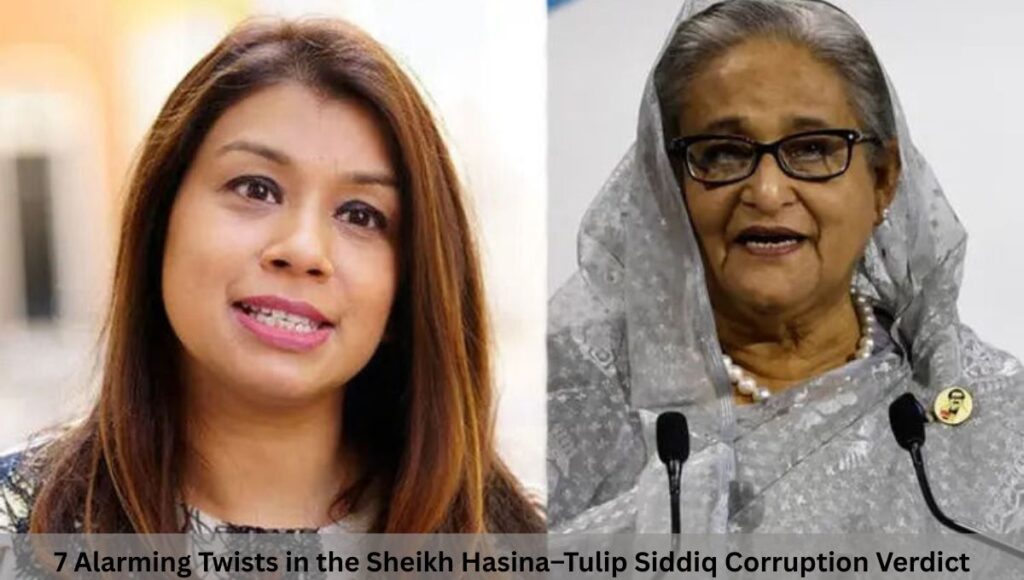
7 Alarming Twists in the Sheikh Hasina–Tulip Siddiq Corruption Verdict
A Landmark Verdict That Reverberated Across Borders
On Monday, Judge Rabiul Alam of Dhaka’s Special Judge’s Court issued a series of prison sentences:
- Sheikh Hasina: 5 years
- Sheikh Rehana: 7 years
- Tulip Siddiq (British MP): 2 years
- Fines: 100,000 Bangladeshi taka (approx. $813) each, with additional jail time for non-payment
The convictions relate to the Purbachal New Town land allocation scheme, a project developed by Rajdhani Unnayan Kartripakkha (Rajuk), the state urban planning authority.
According to the Anti-Corruption Commission (ACC), Hasina abused her authority as prime minister to acquire multiple plots for herself and close relatives, including her niece Tulip Siddiq, her sister Rehana, and Hasina’s children — Saima Wazed and Sajeeb Wazed Joy.
The court ruled that Siddiq exerted influence over her aunt to secure land for her mother, Sheikh Rehana, and her siblings — allegations Siddiq strongly denies.
Why Tulip Siddiq Was on Trial — and Why It Matters in Britain
Tulip Siddiq, who serves as the Labour MP for Hampstead and Highgate, is one of the UK’s most recognisable British-Bangladeshi politicians. Her connection to Sheikh Hasina is well known, but the new criminal proceedings mark the first time in modern British politics that a sitting MP has been sentenced by a foreign court.
Key points:
- Siddiq has not been in Bangladesh for the proceedings.
- She maintains she never received formal charges and was never allowed to respond.
- The Bangladeshi prosecutor argued she was tried as a Bangladeshi citizen despite her lawyers insisting she has no active Bangladeshi passport, no national ID, and no voter registration.
UK Labour officials immediately questioned the legitimacy of the verdict. A party spokesperson said highly regarded legal experts had concluded that Siddiq “has not had access to a fair legal process” and that the party cannot recognise the judgment.
Despite the verdict, Siddiq:
- Is not under investigation by the Labour Party
- Retains the Labour whip
- Faces no disciplinary proceedings
This status reflects the widespread perception among British officials that the charges may be politically motivated.
The Purbachal Land Scam Case Explained
The corruption charges stem from the ACC’s investigation into alleged illegal allotment of land plots in the prestigious Sector 27 diplomatic zone of the Purbachal New Town project.
According to the ACC:
- Six separate cases were filed between January 12–14, 2024.
- Hasina and her associates allegedly obtained six 10-katha plots (7,200 sq ft each).
- These plots were allegedly acquired without eligibility and outside proper procedures.
- Rajuk officials were accused of colluding with Hasina to facilitate the illegal acquisition.
Hasina, Rehana, Siddiq and several others were alleged to have benefited from these irregularities.
Court Findings
The court concluded:
- Hasina used her power to bypass regulations
- Rehana was the “primary participant”
- Tulip Siddiq influenced her aunt to secure land for family members
All three sentences were issued in absentia.
A Growing List of Legal Troubles for Sheikh Hasina
Monday’s ruling is only one of several serious cases currently underway against the former prime minister.
Previous Convictions and Charges Against Hasina
- 21-year prison sentence (issued November 27)
- Three related corruption cases tied to the Purbachal project
- Death sentence (issued November 17)
- Delivered by the International Crimes Tribunal
- Charges: crimes against humanity during anti-government protests that left an estimated 1,400 people dead
- Trial held in absentia
- Multiple ongoing graft trials
- Related to land allotments, embezzlement, and power plant financing
Hasina has denied all allegations, calling the trials politically motivated and the proceedings unconstitutional. She currently lives in exile in India and has not appointed legal counsel for the new cases.
Rehana and the Hasina Family: Widening Legal Exposure
Sheikh Rehana, Hasina’s sister and Tulip Siddiq’s mother, has also been increasingly targeted in the ACC’s sweeping investigations.
In addition to the seven-year term issued Monday, Rehana:
- Was fined
- Had land allotments revoked
- Faces ongoing investigations into alleged embezzlement
- Has been named in cases involving the Russian-funded nuclear power plant deal
Two of Hasina’s children — Sajeeb Wazed Joy and Saima Wazed Putul — were sentenced to five years each in related cases. Bangladeshi authorities estimate that $234 billion was lost through corruption during Hasina’s rule, though these figures are widely disputed and politically contested.
Tulip Siddiq: From Rising UK Political Star to Reluctant Defendant
Tulip Siddiq’s involvement has been one of the most controversial and internationally sensitive elements of the case.
Her Defence
Siddiq has:
- Called the allegations “false, vexatious, and politically motivated.”
- Said the entire process is “flawed and farcical.”
- Accused prosecutors of briefing media without providing evidence to her legal team.
She stated that she would respond to “any credible evidence presented to me” — but insists she was given none.
UK Legal Community Responds
Last week, prominent British legal figures wrote to Bangladesh’s UK mission expressing concern about the fairness of the trial.
Signatories included:
- Former Justice Secretary Sir Robert Buckland
- Former Attorney General Dominic Grieve
- Prominent human rights lawyer Cherie Blair
Their letter described the trial as:
“Artificial, contrived and an unfair way of pursuing a prosecution.”
Was the Trial Politically Motivated?
Supporters of Hasina and members of her Awami League party say yes — unequivocally.
In a statement, the Awami League said the verdict was:
- “Entirely predictable.”
- “Lacking in judicial fairness.”
- “Driven by political opponents.”
Hasina herself accused the judiciary of being controlled by an “unelected government” aligned with her rivals.
Bangladesh’s interim government, led by Nobel laureate Dr Muhammad Yunus, has denied political interference, arguing that the ACC is finally able to prosecute long-standing corruption.
Legal Questions: Can Tulip Siddiq Be Extradited?
Unlikely.
Key Facts:
- The UK does not have an extradition treaty with Bangladesh.
- Bangladesh is classified as a 2B country under UK extradition law.
- This requires clear, credible evidence to justify extradition.
- Human rights concerns can block extradition even if evidence exists.
Given these limitations — and the political nature of the trial — legal experts say Siddiq is highly unlikely ever to face imprisonment in Bangladesh.
Bangladesh has issued an arrest warrant, but Siddiq is not expected to return voluntarily.
The Broader Crisis: Bangladesh’s Political Landscape in Freefall
The legal proceedings come at a time when Bangladesh is engulfed in upheaval:
- Hasina’s 15-year rule collapsed amid massive protests.
- An interim government now oversees the country.
- Dozens of cases have been opened against former ministers, advisers, and bureaucrats.
- The ruling elite of the past decade faces unprecedented scrutiny — and unprecedented retaliation.
Supporters claim this is long-overdue accountability.
Opponents call it political vendetta disguised as justice.
International observers remain divided.
Diplomatic Fallout: UK, India, and Regional Tensions
UK Reaction
Downing Street has been cautious, but several British MPs have demanded:
- A review of Bangladesh’s judicial independence
- Diplomatic pressure to uphold fair trial standards
- Protection for Tulip Siddiq as a British lawmaker
Prime Minister Keir Starmer’s ethics adviser previously found no impropriety in Siddiq’s conduct, but warned her about reputational concerns.
India’s Role
India is hosting Hasina in exile. Bangladesh has officially requested her extradition, though the likelihood of compliance is extremely low.
Conclusion: A Verdict That Raises More Questions Than Answers
The sentencing of Sheikh Hasina, Sheikh Rehana, and Tulip Siddiq is one of the most consequential and contentious legal turning points in Bangladesh’s recent history. It blends allegations of corruption, accusations of political revenge, international legal disputes, and a deeply fractured political climate.
For Bangladesh, the verdict signals:
- A continued purge of the former ruling elite
- A justice system under intense scrutiny
- A political crisis that shows no signs of easing
For the UK, it presents an unprecedented scenario involving a sitting MP entangled in a foreign trial criticised for lacking due process. As Bangladesh’s legal battles intensify, the world continues to watch — not only for justice, but for fairness, stability, and the rule of law at a moment of profound national transformation.
Also Read: Bangladesh Bans Sheikh Hasina’s Awami League Under Anti-Terrorism Act Amid War Crimes Trial
Also Read: Labour MP Tulip Siddiq says corruption verdict against her ‘flawed and farcical’