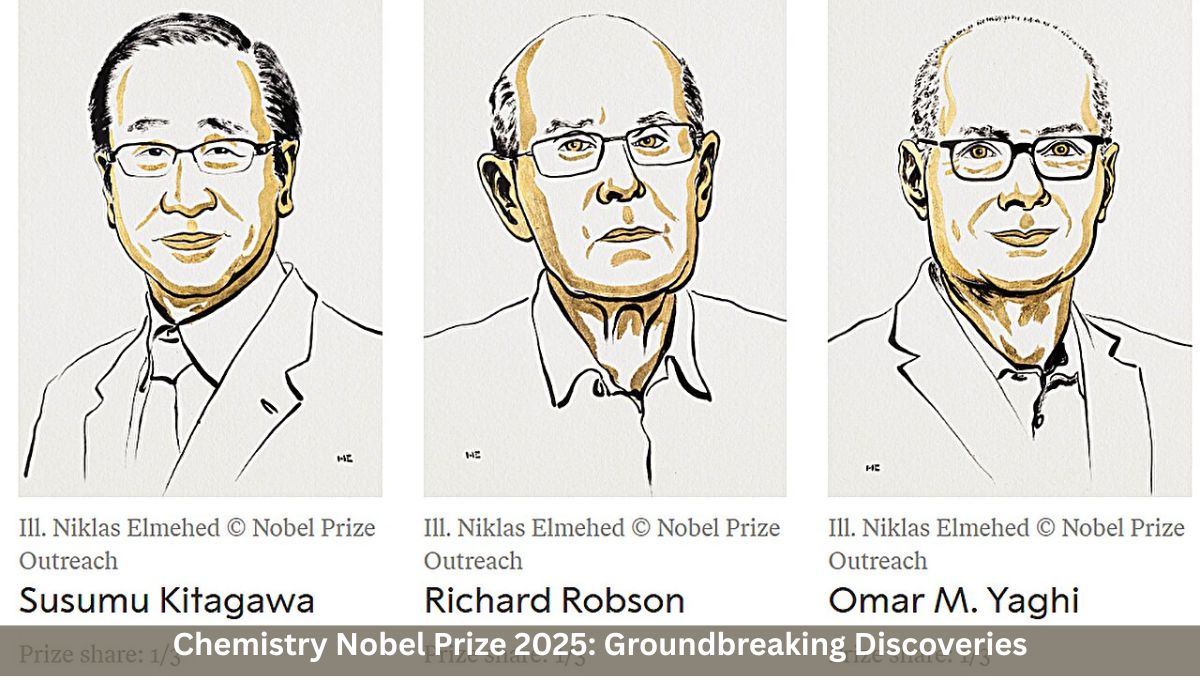
Chemistry Nobel Prize 2025: Groundbreaking Discoveries in metal-organic frameworks. The Royal Swedish Academy of Sciences has awarded the 2025 Nobel Prize in Chemistry to Susumu Kitagawa of Kyoto University, Richard Robson of the University of Melbourne, and Omar M. Yaghi of the University of California, Berkeley, for their pioneering work in the development of metal-organic frameworks (MOFs).
These scientists have created molecular structures with vast internal spaces, allowing gases and other chemicals to flow through them. Such frameworks have wide-ranging applications, including harvesting water from desert air, capturing carbon dioxide, storing toxic gases, and breaking down pharmaceutical traces in the environment. “Metal organic frameworks have enormous potential, bringing previously unforeseen opportunities for custom-made materials with new functions,” said Heiner Linke, chair of the Nobel Committee for Chemistry.
Chemistry Nobel Prize 2025: Groundbreaking Discoveries
The Laureates and Their Contributions
Susumu Kitagawa, 74, is a professor at Kyoto University in Japan, Richard Robson, 88, teaches at the University of Melbourne in Australia, and Omar M. Yaghi, 60, is a professor at the University of California, Berkeley.
The three scientists’ contributions, while developed independently, built upon each other’s breakthroughs to create stable and functional MOFs.
“The new form of molecular architecture can be compared with Hermione Granger’s handbag: small on the outside but very large on the inside,” said Olof Ramstrom of the Nobel Committee for Chemistry.
Kitagawa emphasized that his dream was to capture air and separate its components, including CO2, oxygen, and water, converting these into useful materials using renewable energy.
Omar Yaghi: A Journey from Refugee Camp to Nobel Laureate
Omar M. Yaghi was born to Palestinian refugees in Amman, Jordan, living in a single room shared with his family and livestock. Despite his challenging upbringing, Yaghi developed a passion for chemistry after discovering a book on molecules in the library at age 10.
“Science allows you to do it. Science is the greatest equalising force in the world,” he said.
Yaghi moved to the United States at 15 and went on to earn his PhD in chemistry from the University of Illinois. His research in MOFs, combined with Kitagawa’s and Robson’s work, has made him the first Palestinian scientist to win the Nobel Prize.
What Are Metal-Organic Frameworks (MOFs)?
Metal-organic frameworks are molecular constructions resembling a timber framework of a house, capable of absorbing and storing gases within their cavities. These structures can be flexible, stable, and modifiable, depending on their chemical design.
The potential applications of MOFs are transformative:
- Capturing carbon dioxide from power stations and factories to mitigate climate change.
- Harvesting water from air in arid regions, providing a renewable water source.
- Storing toxic gases safely for industrial or environmental management.
- Breaking down pharmaceutical residues and persistent “forever chemicals” in water.
“A small amount of such material can be almost like Hermione’s handbag in Harry Potter. It can store huge amounts of gas in a tiny volume,” said Heiner Linke.
Richard Robson’s Early Experiments
Robson’s foundational work in the 1980s involved combining copper ions with a four-armed molecule, forming a diamond-like crystal structure filled with cavities. While initially unstable, this experiment paved the way for MOFs.
Robson’s hands-on approach, including drilling holes in wooden balls to simulate atoms and chemical bonds, helped demonstrate the possibility of constructing complex molecular architectures.
“There’s talk about binding CO2 and solving the world’s atmospheric problems, which doesn’t sound realistic to me, but these compounds could do that job on a small scale,” Robson said.
Kitagawa and Yaghi: Stabilizing and Expanding MOFs
Between 1992 and 2003, Kitagawa and Yaghi made critical advances:
- Kitagawa showed that MOFs could be flexible and functional, allowing selective adsorption and release of gases like methane, nitrogen, and oxygen.
- Yaghi developed MOF-5, a stable structure that can withstand high temperatures and store large quantities of molecules in tiny spaces.
MOF-5 even enabled experiments to collect water from desert air, demonstrating the real-world applicability of these frameworks.
“During the night, their MOF material captured water vapor from the air. When dawn came and the sun heated the material, they were able to collect the water,” the Nobel Committee said.
The Global Significance of MOFs
The creation of MOFs represents a paradigm shift in chemistry, opening opportunities for:
- Climate change mitigation through carbon capture and storage.
- Water scarcity solutions in arid regions.
- Environmental cleanup, including degradation of persistent chemicals and pharmaceuticals.
More than 100,000 MOFs have been reported to date, and researchers are exploring commercial scaling and industrial applications.
The Inspiration Behind the Work
Kitagawa’s guiding principle was the concept of “the usefulness of useless”, reflecting the philosophy of Chinese philosopher Zhuangzi. Even seemingly impractical research can lead to revolutionary discoveries.
Yaghi’s journey from a refugee background to a Nobel laureate underscores the democratizing power of science and the global potential of talent when nurtured.
“Smart, talented, and skilled people exist everywhere. That’s why we really should focus on unleashing their potential through providing opportunity,” Yaghi said.
Reactions and Recognition
The Royal Swedish Academy of Sciences highlighted the trio’s achievements as groundbreaking and capable of addressing some of humanity’s most pressing challenges.
- King Abdullah II of Jordan congratulated Yaghi, calling him “Jordan’s pride.”
- Dr. Annette Doherty, president of the Royal Society of Chemistry, praised the award as a recognition of chemistry’s role in solving global problems.
The three scientists will share the prize money of 11 million Swedish kronor (£872,000 / $1 million).
Comparing MOFs to Fictional Technology
The Nobel Committee compared MOFs to Hermione Granger’s handbag in Harry Potter, or Mary Poppins’ enchanted carpet bag: small on the outside but capable of storing vast amounts on the inside.
“They have found ways to create materials, entirely novel materials, with large cavities on their inside which can be seen almost like rooms in a hotel, so that guest molecules can enter and also exit again from the same material,” Heiner Linke said.
This analogy helps convey the transformative potential of MOFs in chemistry, materials science, and environmental engineering.
Historical Context of the Nobel Prize
Alfred Nobel, a chemist and inventor of dynamite, established the Nobel Prizes in 1895. The award ceremony is held on December 10, the anniversary of his death.
In 2024, the Chemistry Nobel went to David Baker, John Jumper, and Demis Hassabis for decoding protein structures with AI. This year, the 2025 prizes have already honored scientists in medicine and physics.
- Medicine (2025): Mary E. Brunkow, Fred Ramsdell, Shimon Sakaguchi – immune system research.
- Physics (2025): John Clarke, Michel H. Devoret, John M. Martinis – quantum mechanics and computing.
Impact and Applications of MOFs
MOFs’ porosity and modular structure allow applications such as:
- Carbon dioxide capture from industrial emissions.
- Water harvesting in deserts and arid zones.
- Removal of persistent environmental pollutants, including PFAS.
- Gas storage for industrial or energy purposes, including hydrogen storage.
- Catalysis and chemical reaction acceleration, including potential uses in nuclear chemistry.
“One gram of a MOF material can have the same surface area inside its pores as a football pitch,” Kim Jelfs, professor at Imperial College London, explained.
Future Prospects
Researchers are exploring mass production of MOFs and scaling up applications for global climate and environmental solutions. While challenges remain, the principles established by Kitagawa, Robson, and Yaghi form the foundation for decades of future innovation.
“Every year we see Nobel Prizes given to chemists who welcome the challenge of finding solutions to the biggest problems our global society faces – better healthcare, environmental protection, clean energy, and secure food and water for everyone,” said Dr. Annette Doherty.
Personal Insights from the Laureates
- Kitagawa: Focused on renewable energy applications and converting captured air components into useful materials.
- Robson: Highlighted the importance of hands-on experimentation and the long journey from concept to application.
- Yaghi: Emphasized the transformative power of science as an equalizer and a path for talent from all backgrounds.
The Legacy of MOFs
MOFs represent a new era in molecular architecture, enabling chemists and engineers to design materials for specific environmental and industrial purposes. The Nobel Prize recognition signals both the scientific importance and the practical potential of these materials in addressing global crises.
Whether it is carbon capture, water scarcity, or pollution mitigation, the discoveries by Kitagawa, Robson, and Yaghi showcase how fundamental chemistry can reshape the world.
Conclusion
The 2025 Nobel Prize in Chemistry celebrates scientific ingenuity, perseverance, and global collaboration. The work of Susumu Kitagawa, Richard Robson, and Omar M. Yaghi on metal-organic frameworks demonstrates the transformative potential of molecular architecture.
From Robson’s initial models in Australia, Kitagawa’s flexible MOFs in Japan, to Yaghi’s industrial-scale applications in the U.S., the trio’s research illustrates how fundamental discoveries in chemistry can address humanity’s biggest challenges, from climate change to water scarcity.
This award not only recognizes scientific achievement but also inspires a new generation of chemists to explore the untapped potential of molecules and materials for a sustainable future.
Also Read: Nobel Prize in literature goes to Hungarian author László Krasznahorkai
Also Read: 7 Groundbreaking Insights: Nobel Prize Winners Reveal Immune System Secrets
Related Posts:
- 5 Amazing Facts About 2025 Nobel Physics Winners
- Nobel Prizes 2025: Major Discoveries in Medicine & Physics
- 7 Groundbreaking Insights: Nobel Prize Winners…

- 7 Stunning Reasons Saudi Arabia’s Desert Saw Snow…

- 7 Heartbreaking Facts About Venezuela's Earthquake Disaster

- From Zebra-Striped Cows to Pizza-Loving Lizards:…