
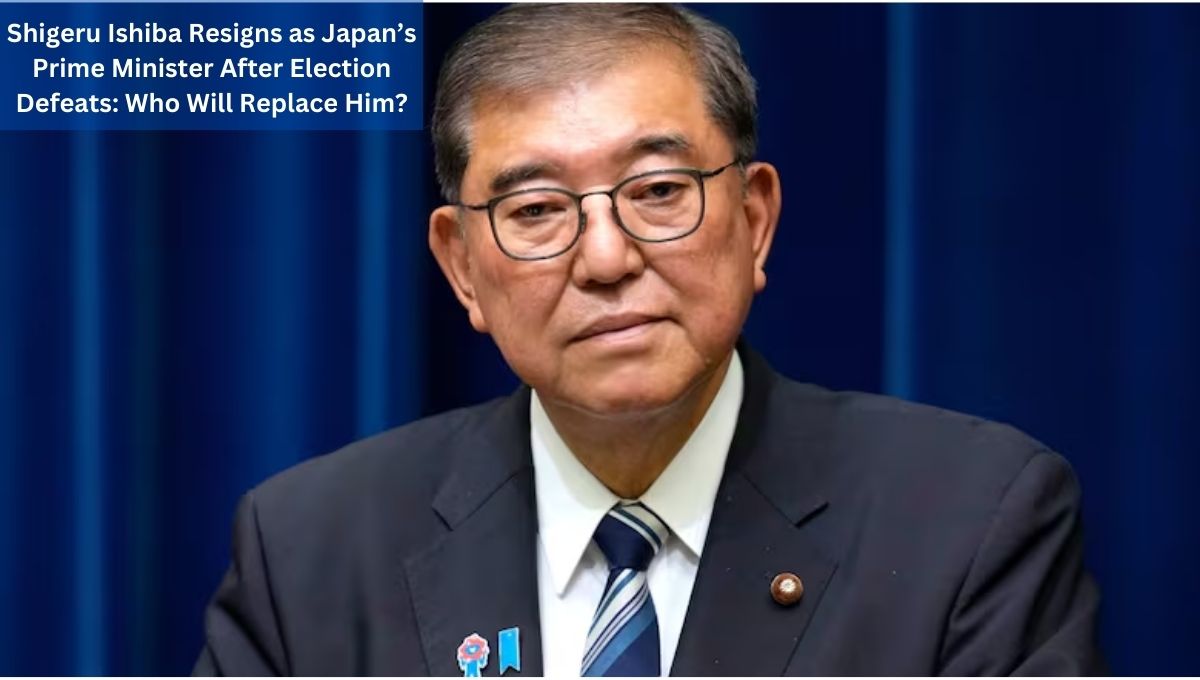
After months of pressure, Shigeru Ishiba Resigns as Japan’s Prime Minister After Election Defeats: Who Will Replace Him? Japanese Prime Minister Shigeru Ishiba announced his resignation on Sunday, ending a turbulent tenure marked by election defeats, economic challenges, and rising political tensions at home and abroad.
The 68-year-old leader, who took office in October 2024, bowed to growing pressure within his ruling Liberal Democratic Party (LDP) after the coalition suffered back-to-back election losses. For the first time in 15 years, the LDP lost its majority in the lower house of parliament, followed by a crushing defeat in the upper house elections in July.
His resignation sets off a leadership race within the LDP. The winner will be voted in as prime minister by parliament, determining Japan’s next leader at a critical time for the world’s fourth-largest economy.
Shigeru Ishiba Resigns as Japan’s Prime Minister After Election Defeats: Who Will Replace Him?
The Fall of Shigeru Ishiba
Ishiba’s decision came after months of internal criticism from party heavyweights, who blamed him for the LDP’s declining support.
Many cited the rising cost of living, record-high rice prices, and growing discontent over his handling of US trade negotiations.
Although Ishiba signed a deal with President Donald Trump last week to reduce tariffs on Japanese car exports, the political fallout from Japan’s domestic challenges proved too great.
“Now that a conclusion has been reached in the negotiations concerning the US tariff measures, I believe this is precisely the appropriate time,” Ishiba said in a televised address. “I would like to pass the baton to the next generation.”
Despite his insistence that he wanted to see through tariff negotiations before stepping down, Ishiba had become a politically weakened figure.
His administration was further dogged by scandals over cabinet appointments and allegations of gifting expensive items to party members.
Why Ishiba Resigned
The resignation reflects the deep fractures within the LDP and a loss of public confidence. Analysts note three key reasons behind Ishiba’s downfall:
- Election Defeats – The LDP’s historic losses in both houses of parliament undermined Ishiba’s legitimacy.
- Economic Pressure – Rising inflation and the doubling of rice prices eroded support.
- Internal Party Revolt – Senior conservatives, including former Prime Minister Yoshihide Suga, openly pressed him to step aside.
Kazutaka Maeda, an economist at Meiji Yasuda Research Institute, told Reuters: “Given the political pressure mounting on Ishiba after the LDP’s repeated election losses, his resignation was inevitable.”
Also Read: Shigeru Ishiba’s Leadership in Crisis After Japan Elections 2025 Shock Loss
Political Uncertainty in Japan
Ishiba’s resignation plunges Japan into a period of political uncertainty. The LDP has ruled Japan for most of the past seven decades, but its recent electoral setbacks reveal growing dissatisfaction among voters.
With rising tensions in the Asia-Pacific region and ongoing trade disputes with the United States, Japan faces mounting external pressures. Domestically, inflation, energy costs, and an aging population present long-term challenges for the incoming leader.
Public opinion is also divided. A Kyodo News poll published Sunday revealed that 55% of voters believe there is no need for an early general election, even if a new LDP leader is installed.
Who Could Replace Shigeru Ishiba?
With Ishiba’s departure, several contenders are emerging within the LDP and the opposition. The upcoming leadership race is expected to be competitive, with generational change and gender representation in the spotlight.
Sanae Takaichi – A Potential First Female Prime Minister
At 64, Sanae Takaichi is a veteran LDP heavyweight and former economic security and internal affairs minister. If she wins, she would become Japan’s first female prime minister.
Takaichi narrowly lost to Ishiba in last year’s LDP leadership run-off. She is known for her opposition to the Bank of Japan’s interest rate hikes and advocates for more government spending to stimulate the fragile economy.
Her candidacy would mark a milestone for women in Japanese politics, where leadership positions remain overwhelmingly male-dominated.
Shinjiro Koizumi – Japan’s Rising Star
The son of former Prime Minister Junichiro Koizumi, Shinjiro Koizumi is widely seen as a rising political star and heir to one of Japan’s most famous dynasties.
At just 43, Koizumi could become Japan’s youngest modern-era prime minister. As agriculture minister under Ishiba, he spearheaded reforms aimed at curbing rice prices. His charisma and youthful appeal make him popular with younger voters.
However, Koizumi has also faced ridicule for controversial comments. In 2019, he suggested that climate policy should be “cool” and “sexy,” sparking criticism.
Despite this, his family name and reformist image make him one of the frontrunners in the race.
Yoshimasa Hayashi – The Experienced Administrator
Currently serving as Chief Cabinet Secretary, Yoshimasa Hayashi is regarded as one of Japan’s most capable and experienced administrators.
Harvard-educated and fluent in English, he has served in multiple ministries, including foreign affairs, defence, and agriculture.
Hayashi is seen as a steady, pragmatic figure. Unlike rivals, he strongly supports maintaining the independence of the Bank of Japan, favoring stability over bold economic reforms.
He is considered a “safe pair of hands” who could reassure both international partners and domestic voters.
Opposition Contenders
The leadership race may not be limited to the ruling LDP. Prominent opposition figures could also challenge for the premiership if the balance of power shifts.
Yoshihiko Noda – The Opposition Veteran
A former prime minister, Yoshihiko Noda currently leads the centre-left Constitutional Democratic Party. Known as a fiscal hawk, he previously pushed through Japan’s consumption tax hike to 10%.
Recently, however, Noda has advocated for temporary food tax cuts and a sharper exit from the Bank of Japan’s massive stimulus program. His experience and name recognition make him a serious opposition candidate.
Yuichiro Tamaki – The Reform Advocate
Yuichiro Tamaki, leader of the Democratic Party for the People, is another possible opposition contender. A former finance ministry bureaucrat, Tamaki co-founded his party in 2018.
He champions tax reforms aimed at boosting take-home pay, including expanded exemptions and slashing the consumption tax. His economic message could resonate with voters struggling under inflation.
What Happens Next?
The LDP is expected to hold an emergency leadership election in early October. Candidates are likely to declare their bids in the coming days, with campaigning set to dominate Japanese politics in the weeks ahead.
The winner will face a parliamentary vote and almost certainly become prime minister, given the LDP’s parliamentary strength despite its recent setbacks.
In the meantime, Ishiba will remain as caretaker prime minister until his successor is formally chosen.
The Legacy of Shigeru Ishiba
Ishiba’s brief tenure as prime minister will be remembered for its challenges rather than its triumphs.
He inherited an economy under strain, faced a cost-of-living crisis, and dealt with tense trade negotiations with the United States.
While he managed to secure a tariff-reduction deal with Washington, his inability to inspire public confidence and the LDP’s electoral defeats sealed his fate.
His resignation, though abrupt, underscores the volatile nature of Japanese politics, where party unity and voter sentiment can rapidly shift.
Conclusion: A Critical Juncture for Japan
Japan now faces a leadership vacuum at a time of significant domestic and international challenges. Whether the next prime minister is a veteran like Sanae Takaichi or a youthful reformer like Shinjiro Koizumi, the incoming leader will need to address inflation, aging demographics, and Japan’s evolving role in global geopolitics. For voters, Ishiba’s resignation offers a chance for renewal.
For the LDP, it is a reminder of the risks of losing touch with public sentiment. And for Japan’s allies, it is a test of continuity in Tokyo’s foreign policy amid shifting power dynamics in Asia.
Also Read: PM Modi presents unique gifts to Japan’s Shigeru Ishiba and wife, celebrating cultural ties
Related Posts:
- Shigeru Ishiba’s Leadership in Crisis After Japan…
- Japan’s PM Shigeru Ishiba Faces Make-or-Break Upper…

- Far-Right Sanseito Surges in Japan’s Elections as PM…

- Japan 2025: Conservative Powerhouse Sanae Takaichi…

- 12 Explosive Shifts as Japan’s Iron Lady Takaichi…

- Sanae Takaichi Becomes Japan’s First Female Prime…
