
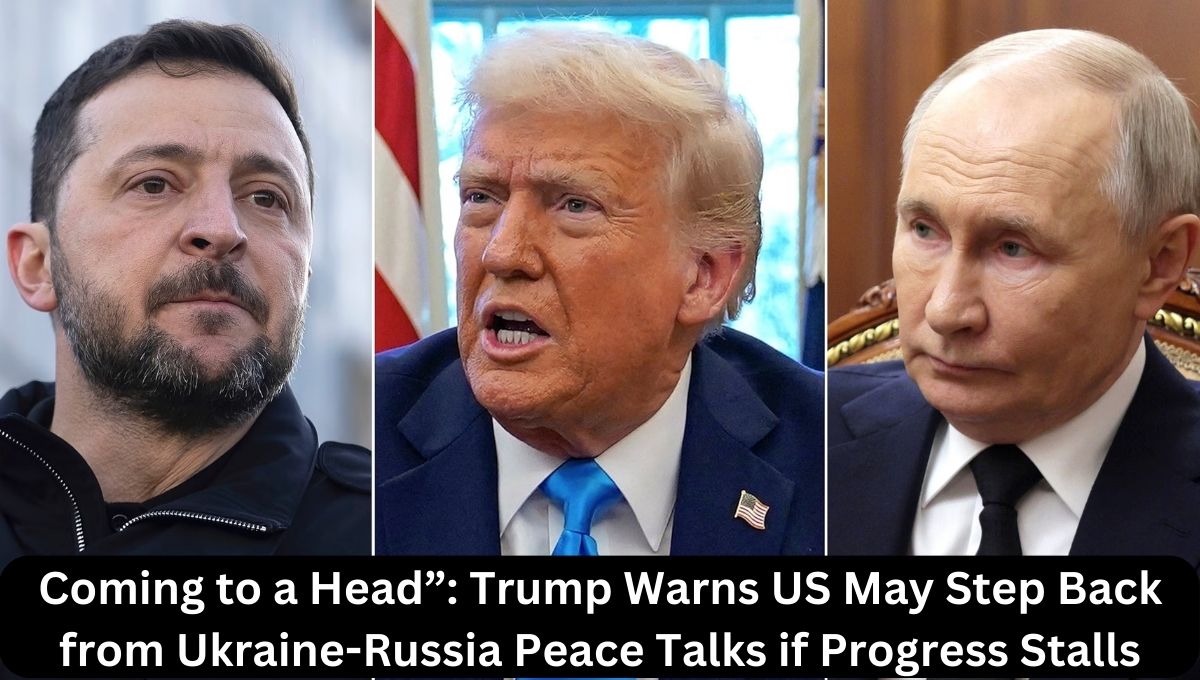
As global eyes remain fixed on the ongoing war between Ukraine and Russia, Trump Warns U.S. May Step Back from Ukraine-Russia Peace Talks if Progress Stalls. Speaking to reporters at the White House, Trump signaled a mounting frustration with both Moscow and Kyiv, saying that the time for decisive action has arrived.
Coming to a Head”: Trump Warns US May Step Back from Ukraine-Russia Peace Talks if Progress Stalls
Trump: “We’re Not Being Played”
Trump, during the press briefing, insisted that neither side in the conflict is “playing” him in his efforts to end the war. President Trump said bluntly, “If for some reason one of the two parties makes it very difficult, we’re going to say you are fools, you’re foolish, and we’re just going to take a pass.”
These remarks come amid an intense round of international diplomacy, with US and European leaders meeting in Paris to explore pathways to peace. Now in his second term, Trump has long claimed he could end the war within 24 hours, which he later admitted that the statement was partly sarcastic but remains indicative of his assertive diplomatic approach.
Rubio, Vance Signal Growing Frustration
Secretary of State Marco Rubio, who recently held talks with European counterparts, echoed Trump’s comments. If a ceasefire agreement does not appear viable within days Rubio emphasized that the US may “move on.”
Rubio said, “We’re not going to continue with this endeavor for weeks and months on end. We need to determine very quickly, and I’m talking about a matter of days, whether or not this is doable.”
Speaking from Rome, Vice President JD Vance, struck a more optimistic tone. He said, “We believe there’s still a window of opportunity for peace, but it’s closing fast.”
A US-Backed Peace Proposal on the Table
European and Ukrainian officials, in Paris, were presented with a controversial proposal by the US: freeze the conflict in place and ease sanctions on Moscow in return for a lasting ceasefire. Under the terms being discussed, Russia would maintain control over its currently occupied Ukrainian territories—including parts of Donetsk, Luhansk, Kherson, Zaporizhzhia, and Crimea. In turn, Ukraine, would shelve its long-standing ambition to join NATO.
The US proposal caused unease among Ukraine’s staunchest supporters. European leaders along with French President Emmanuel Macron and the British officials, have cautiously engaged in talks but remain wary of legitimizing territorial seizures by force.
Ukraine Pushes Back Against Land Concessions
The notion of ceding territory has been firmly rejected by the Ukrainian President Zelensky. Ukrainian President Speaking from Kyiv, rebuked Trump’s envoy Steve Witkoff for “adopting Russian strategy.” He said that Ukrainian lands are non-negotiable.
Zelensky stated, “We do not discuss territories until the ceasefire. We will never consider Ukrainian lands as Russian.”
Moscow continues to use delays to solidify its position on the battlefield, while Ukraine has agreed to a temporary ceasefire, a source close to the Ukrainian delegation stated. The source claimed, “They’re stalling to strengthen their negotiating leverage.”
Tensions Over Sanctions and Security Guarantees
The issue of sanctions is one major point of contention. Reportedly Russia has linked a ceasefire agreement to the lifting of sweeping international sanctions, unfreezing of assets and the end of arms deliveries to Ukraine. Some of those sanctions could potentially be eased by the US proposal in exchange for a halt to hostilities, though European allies remain split on this approach.
Meanwhile, France and UK to help guarantee Ukraine’s future security, are spearheading efforts to form a postwar “reassurance force.” In Paris officials hope that despite Trump’s hardline rhetoric, their visible commitment will persuade the US to stay engaged
Rubio said, “Security guarantees aren’t an illegitimate desire. Every sovereign nation on Earth has a right to defend itself.”
Russia Continues Attacks Amid Talks
Russia showed no signs of de-escalation on the ground, even as peace talks unfolded in Paris. Russian forces last week launched ballistic missiles, including some carrying cluster munitions, killing 35 civilians, at the northeastern Ukrainian city of Sumy. The Kremlin ended a limited truce covering energy infrastructure and refused a proposed ceasefire over the Black Sea.
Unless Russia halts its aggression, the entire peace process could unravel, a senior US official warned. The official said, “Without an end to the bombing, none of these proposals mean anything.”
What’s Next? Allies Reconvene in London
Next week, the next phase of discussions will take place in London, as US, European, and Ukrainian officials seek clarity on the Kremlin’s intentions. Whether Trump’s administration remains committed to brokering peace depends heavily on what emerges from those talks.
As Trump put it, “Hopefully we won’t have to walk away. But we might. We’re trying to help—but we won’t be played.”
The world waits to see, with mounting pressure, if this latest diplomatic push can finally bring an end to one of the most devastating conflicts of the decade or if it will become yet another chapter in a war with no clear end in sight.
Also Read: Trump Pressures Ukraine to Cede Crimea as U.S. Shifts Toward Russian-Led Peace Plan
Also Read: US will not ‘fly around the world’ to mediate Ukraine peace talks, Washington says
Related Posts:
- Trump’s 2025 Gaza Peace Plan Signing and Historic…

- 9 Explosive Revelations as Trump Declares His Health…

- 7 Shocking Reasons FIFA’s Peace Prize for Trump…

- 5 Powerful Highlights as Trump Lands Second Nobel…

- Impacts of the Trump-Putin Call on Ukraine’s 2025 Strategy
- Trump–Zelensky Meeting 2025: Stylish Yet Strategic…
