
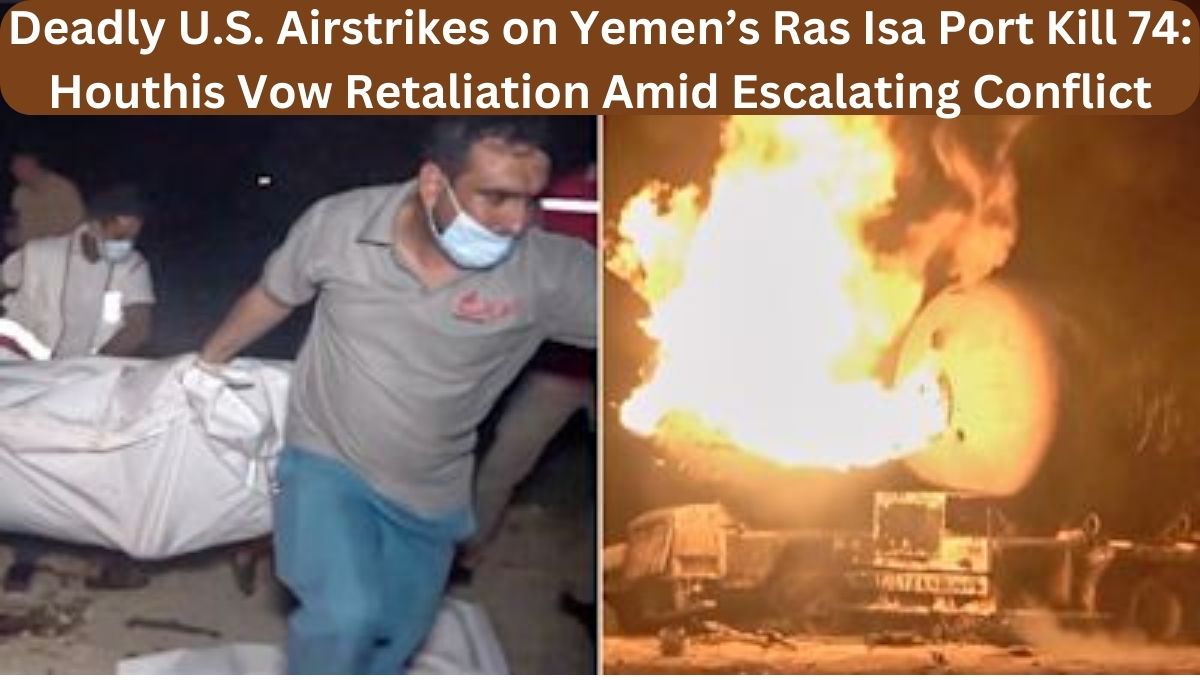
A Deadly U.S. Airstrikes on Yemen’s Ras Isa Port Kill 74: Houthis Vow Retaliation Amid Escalating Conflict. The deadly U.S. Airstrikes on Ras Isa port, Yemen, kill 74 and injure at least 171 people. During the latest surge under President Donald Trump’s renewed military push, one of the attacks, which lit up the night sky with towering fireballs, is the most devastating strike acknowledged by the Houthis.
Videos and graphic images released by the Houthi-run Al-Masirah network showed bodies strewn across the scorched port, while emergency responders struggling to navigate the chaos. The Houthis reported, among the dead were port workers, paramedics, and civilians.
Deadly U.S. Airstrikes on Yemen’s Ras Isa Port Kill 74: Houthis Vow Retaliation Amid Escalating Conflict
U.S. Justifies the Strike, but Casualties Raise Alarm
The U.S. Central Command (CENTCOM) did not acknowledge any casualties but confirmed the strike. CENTCOM said, “U.S. forces took action to eliminate this source of fuel for the Iran-backed Houthi terrorists and deprive them of illegal revenue that has funded Houthi efforts to terrorize the entire region for over 10 years.”
Officials pointed out that the operation was designed to target not Yemeni people but the Houthis’ financial base. CENTCOM added, “This strike was not intended to harm the people of Yemen.” They declined to comment on the reported civilian deaths.
Disturbing visuals from the ground combined with the growing death toll, has sparked concerns over the human cost of the campaign.
Oil Port Targeted as Economic Lifeline to Houthis
Located along the Red Sea near Kamaran Island, the Ras Isa port, has become a vital hub for the Houthis. Even though Yemen’s oil exports have halted due to war, the port has remained crucial for importing fuel, including gasoline and cooking gas. The port, via pipeline connects to the oil-rich Marib region. This area is still under the control of Yemen’s internationally recognized, exiled government.
The port’s destruction was confirmed by Satellite imagery from Planet Labs, which revealed scorched vehicles, demolished tanks, and oil leaking into the Red Sea. According to the experts this strike could significantly disrupt civilian life in Houthi-controlled regions, where access to fuel and basic necessities is already strained.
Houthis Respond with Missile Fire and Defiance
The Houthis launched a missile toward Israel, in hours following U.S. strike and according to the Israeli military, the missile was intercepted. In Tel Aviv and nearby areas, sirens blared underscoring the broader regional tension.
Houthi leaders declared they would not back down in a bold statement. A statement by the group’s armed forces read, “Yemen will not stop its support operations for the Palestinian people until Israeli aggression on Gaza ceases and the siege is lifted.” They also warned that continued U.S. “aggression” would provoke further confrontation.
A Broader Regional Crisis: China, Israel, and the Red Sea
Increasingly global powers have been drawn in by the Yemen conflict. U.S. officials in a latest press briefing, accused Chang Guang Satellite Technology Co. Ltd., a Chinese satellite firm by providing high-resolution images that helped target U.S. warships in the Red Sea thus aiding Houthi attacks.
Beijing denied direct involvement, moreover, it also disowned the company’s actions. Foreign Ministry spokesman Lin Jian said, “China has been playing a positive role in de-escalating the situation.”
Previously, the U.S. had sanctioned Chang Guang in 2023, for providing Russia’s Wagner Group, intelligence in Ukraine.
Global Trade, Civilians, and Peace Talks at Risk
The Houthis have launched over 100 attacks since November 2023, on commercial vessels, which disrupted one of the world’s busiest shipping routes through the Red Sea. This led to the sinking of two ships and death of four sailors. Each year, over $1 trillion in goods pass through the Red Sea where the implications for global trade are immense.
On March 15, the current U.S. campaign began which marks a significant departure from the more targeted approach under former President Joe Biden. Trump’s strategy includes bombing missile launch sites, airports, oil infrastructure, and now civilian-linked facilities.
Negotiations between the U.S. and Iran, a key backer of the Houthis are set to resume in Rome, but road to peace seems increasingly treacherous.
Conclusion: The Human Cost of Escalation
The Ras Isa airstrike lays bare the high stakes of the ongoing conflict: economic disruption, civilian suffering, and the risk of a broader regional war. The toll on ordinary Yemenis, many already caught in a decade-long humanitarian crisis continues to mount, while the U.S. aims to curb the Houthis’ influence and revenue streams.
As global powers jostle and missiles fly, the voices of those on the ground, the workers at Ras Isa, the families mourning their dead, and those living in fear of the next strike, serve as a sobering reminder that behind every strategic objective lies a very human cost.
Also Read: Yemen Attack Info Leaked in Signal Group Chat – Pete Hegseth Under fire
Also read: Yemen’s Houthis vow to continue attacks after more than 70 killed in US airstrikes on port
Related Posts:
- Tragedy in Ahmedabad: Air India AI-171 Crash Claims…
- 171 Gaza Flotilla Activists Deported Amid Alleged Torture

- 5 Major Takeaways from the US Supreme Court's…

- Israel–Hamas Ceasefire Under Strain: 4 More Hostage…

- 7 Heartbreaking Facts About Venezuela's Earthquake Disaster
- Afghanistan–Pakistan War 2025: Inside the 48-Hour Ceasefire
