
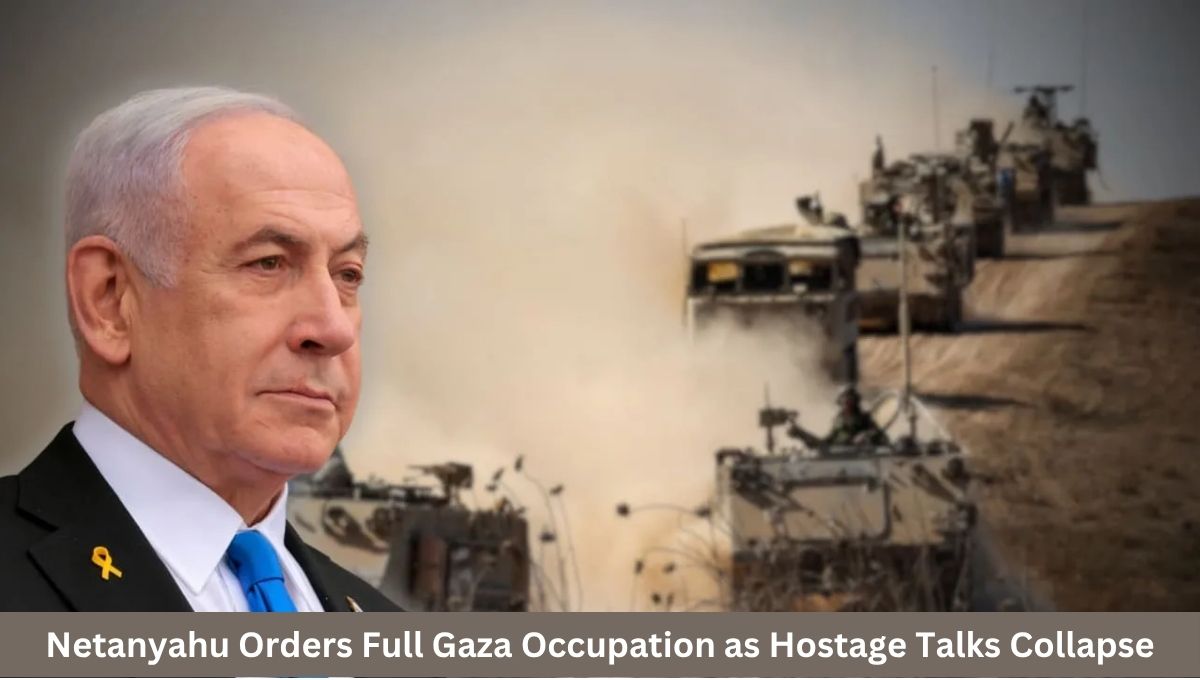
Pressuring Hamas over hostages, Netanyahu Orders full Gaza Occupation as Hostage Talks Collapse. Israeli Prime Minister Benjamin Netanyahu has reportedly ordered the Israel Defense Forces (IDF) to fully occupy the Gaza Strip in a dramatic escalation of the nearly ten-month-long war. The decision comes as ceasefire talks with Hamas break down, and harrowing hostage videos reignite pressure from the Israeli public to bring home the remaining captives.
Already in control of approximately 75% of the coastal enclave, the Israeli military is now being directed to seize the remaining territory, including areas where hostages are believed to be held.The directive, reported by The Jerusalem Post and Channel 12, signals a potential turning point in the war and has already sparked political friction, public protests, and international concern over the growing humanitarian disaster in Gaza.
Netanyahu Orders Full Gaza Occupation as Hostage Talks Collapse
Hostage Videos Trigger Escalation
The order came hours after the release of disturbing footage by Hamas and Islamic Jihad showing two Israeli hostages Rom Braslavski and Evyatar David in visibly deteriorated conditions.
Braslavski said he could no longer stand due to injuries, while David, digging what he said was his own grave, revealed he had gone days without food.
“These are horror videos,” Netanyahu said during a televised cabinet meeting. “They are designed to break us. But we will not be broken. We will not make a deal under duress.”
According to Israeli sources, 50 hostages remain in Gaza, only 20 of whom are believed to be alive. Hamas continues to refuse International Red Cross access to the captives.
Netanyahu Faces Pressure From All Sides
Following the release of the hostage footage, tens of thousands of Israelis took to the streets in one of the largest protests in recent months, demanding an immediate ceasefire and a return of hostages.
The Hostages and Missing Families Forum accused the government of deception, saying:
“Netanyahu is preparing the greatest deception of all. The repeated claims of freeing hostages through military victory are a lie and public fraud.”
Adding to the internal pressure, Netanyahu’s directive reportedly included a demand that IDF Chief of Staff Eyal Zamir either follow through with the plan or resign.
Zamir, according to Army Radio, has expressed frustration over the lack of strategic clarity from political leadership and is wary of a war of attrition in dense urban terrain.
Security Cabinet Meeting to Decide Fate of Gaza
Netanyahu has announced that a key meeting of the Israeli Security Cabinet will be held Tuesday to finalize plans for the complete conquest of the Gaza Strip.
“We must continue to stand together to achieve our war objectives: defeating Hamas, bringing home the hostages, and making sure Gaza is never a threat again,” he told his ministers.
Israeli media reports indicate that Netanyahu is leaning strongly toward re-occupying all of Gaza, including Gaza City, in hopes of flushing out Hamas militants and rescuing hostages.
Trump Envoy’s Position Sparks Confusion
Former U.S. President Donald Trump’s Middle East envoy, Steve Witkoff, has complicated the narrative. Speaking with hostage families, Witkoff reportedly said:
“The plan is not to expand the war but to end it. We think the negotiations should be changed to all or nothing. End the war and bring all 50 hostages home at the same time that’s the only way.”
Witkoff’s team declined to elaborate, but Trump confirmed his envoy may travel to Moscow this week to push a multilateral solution.
It remains unclear whether Netanyahu’s full conquest strategy aligns with Trump’s evolving diplomatic approach.
Civilian Toll in Gaza Reaches Catastrophic Levels
As Netanyahu eyes a full Gaza occupation, the humanitarian catastrophe inside the territory continues to worsen.
According to the World Health Organization, malnutrition and hunger-related deaths have spiked, especially among children.
From March to May, Israel imposed a complete blockade on the enclave, barring all humanitarian supplies.
Though restrictions have since been relaxed under international pressure, access to food and medicine remains severely limited.
The UN Office for the Coordination of Humanitarian Affairs (OCHA) estimates that nearly 1,400 Palestinians have died since May while trying to access food aid most near distribution sites run by the U.S.-backed Gaza Humanitarian Foundation.
Daily Aid Still Falls Far Short
According to the Hamas-run Government Media Office in Gaza, 600 truckloads of humanitarian aid are needed daily. Last week, only an average of 84 trucks per day entered the territory.
The Israeli agency COGAT, responsible for coordinating aid deliveries, claimed that over 200 trucks entered Gaza on Sunday, but many were reportedly looted by desperate civilians or criminal gangs.
On Monday alone, 30 civilians were killed while seeking food 19 in northern Gaza and 11 near an aid site in Rafah according to the Palestinian Health Ministry.
Global Condemnation of Gaza Crisis
UN High Commissioner for Human Rights Volker Turk condemned the situation as “heart-rending and intolerable.”
“That we have reached this stage is an affront to our collective humanity,” Turk said. “Continued denial of aid access may amount to a war crime.”
He urged immediate access to hostages and safe humanitarian corridors to prevent further loss of life. Israel denies targeting civilians directly and claims it uses warning shots to manage chaotic aid distributions.
Re-Occupation Plan Branded a “Leaked Escalation”
The Palestinian Authority’s Foreign Ministry has labeled Netanyahu’s strategy a “leaked re-occupation plan” and called on global powers to intervene immediately.
It warned that full occupation would exacerbate the humanitarian crisis and derail any hope of diplomatic resolution.
Basem Naim, a senior Hamas political official, reiterated that talks will only resume when the starvation crisis is resolved.
“There’s no point in further talks if Gaza’s catastrophic humanitarian situation is not addressed,” said another Hamas figure, Mahmoud Mardawi.
Israeli Public Opinion Divided
A recent poll by the Institute for National Security Studies revealed that 38% of Israeli Jews believe Hamas cannot be disarmed, while 57% remain hopeful it can.
The country remains divided over whether continued military operations can realistically free hostages or simply increase the death toll.
Hundreds of retired Israeli security officials issued a public letter urging Trump to pressure Netanyahu into ending the war.
“This was a just war at the start,” said Ami Ayalon, former director of Shin Bet. “But we’ve achieved our military objectives. Now, this war no longer serves a just purpose.”
UN Security Council Set to Discuss Crisis
A critical UN Security Council session, requested by Israel with backing from the U.S. and Panama, will convene this week to spotlight the hostage crisis.
Israeli Foreign Minister Gideon Sa’ar declared:
“The world must put an end to the phenomenon of kidnapping civilians.”
But observers note the broader context of the war will likely dominate the conversation, especially in light of rising civilian deaths and worsening famine conditions in Gaza.
Far-Right Push for Population Displacement
Some far-right Israeli ministers are openly advocating not only for full occupation but also for policies that would encourage Palestinians to leave Gaza permanently a move that has drawn harsh criticism from international legal and human rights experts.
Such rhetoric is fueling global fears that the war is shifting from a counter-terrorism campaign into a potential re-engineering of the Gaza population, with possible implications for regional stability.
Conclusion: A War at the Crossroads
With Netanyahu preparing to instruct the IDF on “final war goals” and ceasefire talks deadlocked, Israel appears poised for its most aggressive phase of the Gaza war yet. The Prime Minister’s gamble hinges on an assumption that full occupation can rescue hostages and end Hamas rule an outcome many inside Israel and abroad question.
At the same time, Gaza’s two million civilians face deepening hunger, fear, and death, with humanitarian agencies warning of irreversible collapse. As both diplomatic and military timelines narrow, the international community is bracing for what may be the most critical week yet in this devastating conflict.
Also Read: Netanyahu wants to ‘occupy Gaza’. What do Israeli people, military think?
Also Read: Netanyahu’s Gaza City Takeover Plan Sparks Global Outrage
Related Posts:
- Israel’s Gaza Takeover Plan: What’s Been Achieved…

- 5 Key Developments as Israel Confirms Hamas Handed…

- Israel–Hamas Ceasefire Under Strain: 4 More Hostage…

- Netanyahu Orders Gaza Hostage Talks as Israel Pushes…

- Hostage Crisis Escalates: Hamas Offers Red Cross…

- Israel Demands Full Hostage Release, Gaza Ceasefire…
