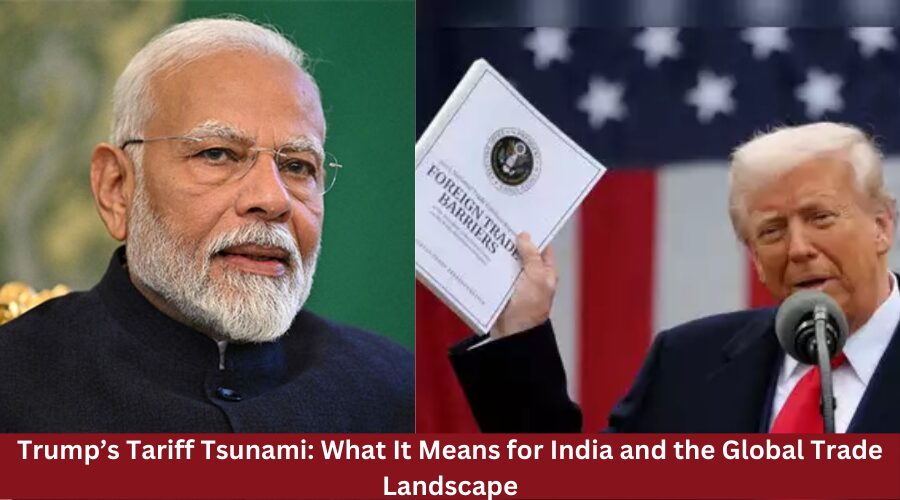
Yet to be decoded, Trump’s Tariff Tsunami: What It Means for India and the Global Trade Landscape. U.S. President Donald Trump has announced reciprocal tariffs on dozens of countries, as well as India. On the Liberation Day a new baseline tariffs of 10% was introduced, which will take effect from April 5th along with country-specific rates taking effect from April 9.
Apart from other countries, India is also facing Trump’s Tariff Tsunami. India faces about 27% adjusted tariff on exports to the United States which is ten times higher than its previous average rate of 2.7%.
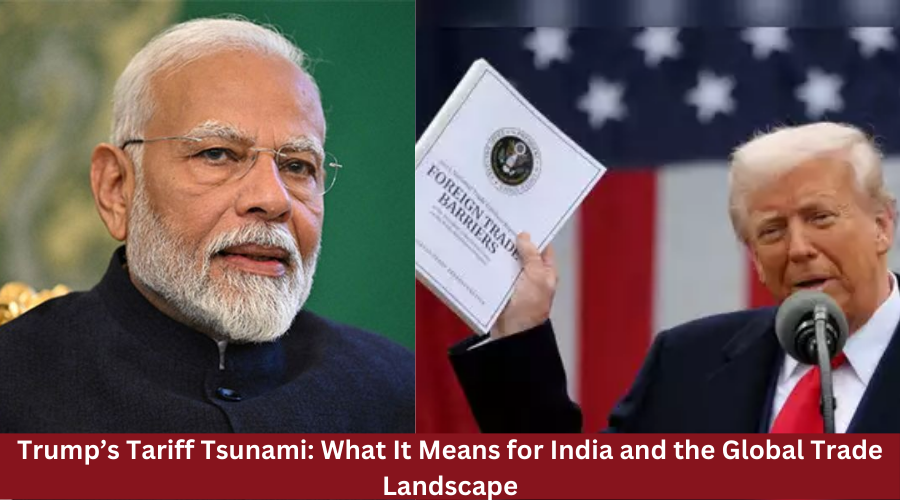
Trump’s Tariff Tsunami: What It Means for India and the Global Trade Landscape
The India-US Trade Equation: What’s at Stake?
In recent years, India-US trade equation, has grown increasingly complex. A significant portion of exports in textiles, pharmaceuticals, software, energy products, and machinery, the United States is India’s largest export market. India along with the U.S., runs a healthy trade surplus, which has since a very long time served as a cushion for its overall trade deficit.
However, Trump’s new tariff regime, has turned this equilibrium upside down. Barclays report states that previously Indian exports faced a 2.7% tariff on average and American goods encountered a 10.5% tariff entering India. In a move to level out the playing field, a 27% tariff is imposed by the U.S. on Indian goods which puts Indian exporters in a tight spot forcing New Delhi either to retaliate or negotiate.
At this point, the Indian government has not given any formal indication of any retaliatory measures. While the trade negotiations going on between India and the US is in the initial stages, India needs to come up with a cautious strategy that would preserve the long-term relationship while minimizing immediate economic disruption.
Sectoral Impact: Winners, Losers, and the Uncertain Middle
The Sectoral Impact of the tariffs could vary by sector on Indian exports. However, analysis by Ernst & Young highlights a mixed outlook:
- Textiles: Compared to countries like Bangladesh (37% tariff) and Vietnam (46%) Indian textiles may still remain competitive despite higher tariff. If global buyers shift sourcing to India, it would be a positive aspect.
- Energy Exports: Challenges that hinder progress are expected, as U.S. aims to become more self-sufficient and less dependent on foreign energy. There can be reduced volumes and tighter margins in the Indian energy firms.
- Pharmaceuticals: Trump’s tariff order exclude critical medicines and related exports, so this sector could see minimal disruption.
- Technology and Software Services: This sector is not directly tariffed; concerns linger around regulatory pressures and visa policies which might compound the overall business climate.
Global Ripple Effects: Lesotho and the African Fallout
India is not the only nation to be hit by Trump’s tariffs, African countries have also been hit hard. A small southern African nation, Lesotho, which exports jeans and diamonds to the U.S., faces 50% tariff.
Mokhethi Shelile, Lesotho’s Trade Minister expressed potential factory shutdowns and job losses. U.S. imports from Lesotho stands at $237.3 million while exports a meager $2.8 million, and the White House took such drastic measures as a justification for such a trade imbalance. Ironically, the reason for this trade punishment is Lesotho’s success under the African Growth and Opportunity Act (AGOA)—a U.S. initiative to support African economies.
Other African nations slapped with high tariffs include Madagascar (47%), Mauritius (40%), Botswana (37%), and South Africa (30%). As the U.S. does not run a trade deficit with Nigeria and Kenya, they will face the baseline of 10%. The experts believe that this could lead to an intra-African trade and deeper ties with the Global South.
Strategic Options for India
In this global trade turmoil, India must be very careful and cautious. India has agreed to make concessions such as removing the equalization levy on digital services and slashing tariffs on luxury cars but there is a mounting pressure to do more. At this time, a U.S.-India trade agreement is seeming more critical than ever.
Some Strategic Options for India include:
- Bilateral Negotiation: Continuing high-level dialogues with Washington is of vital importance. India must tap for sector-specific relief, especially in areas where its exports are extremely important to American supply chains.
- Targeted Retaliation: A full-blown trade war is undesirable and to balance the scales India should consider measured retaliatory tariffs on not indispensable U.S. imports.
- Export Diversification: Focus on expanding trade with the EU, ASEAN, Latin America, and Africa while relying less on the U.S. market could help reduce the potential negative impact.
- Currency Strategy: Indian exports could become more competitive with a weaker rupee, although it comes with its own inflationary risks.
- Domestic Reforms: India needs a comprehensive and ambitious trade reform agenda to make its manufacturing and services sectors more competitive on the global stage.
A Historical Parallel: Echoes of Smoot-Hawley?
Trump’s tariff hikes have been compared with the infamous Smoot-Hawley Tariff Act of 1930, which aggravated the Great Depression by choking off global trade. According to economists at JP Morgan sustained tariffs could push both the U.S. and global economies into recession.
According to the chief economist at Investec, Annabel Bishop, this moment could mark a turning point for international trade dynamics. For India this change presents both a challenge and an opportunity to modify its long-term economic strategy.
The Road Ahead: Diplomacy, Strategy, and Resilience
After resilient Trump’s tariff bombshell, countries are scrambling to reconsider their economic outlooks and the road ahead. India, caught between a desire for harmonious relations with the U.S. and the need to protect its domestic industries, must act strategically.
The coming weeks will be decisive. Whether behind closed doors diplomacy or more public retaliatory measures, India’s choices will define not just its own trade perspective but potentially shape broader norms in a rapidly evolving global trade ecosystem.
Also Read: Global Trade War Intensifies as Trump Slaps Massive Tariffs on China and Allies
Also Read: A Sea Of Uncertainty
Related Posts:
- Trump’s 2025 Gaza Peace Plan Signing and Historic…

- What’s Next for Donald Trump After Court Rules His…

- Can the EU and NATO Impose Tariffs on India and…

- 11 Explosive Revelations From Ted Cruz’s Leaked…

- 5 Powerful Highlights as Trump Lands Second Nobel…

- 9 Explosive Revelations as Trump Declares His Health…