

In a dramatic escalation of U.S. trade policy, Trump’s ‘Take-It-Or-Leave-It’ Tariff Letters Shake Global Trade Talks. President Donald Trump has confirmed the delivery of “take-it-or-leave-it” tariff letters to 12 nations, set to go out Monday, July 7. These letters, part of a sweeping trade overhaul, lay out steep new tariff terms some reaching as high as 70% with implementation scheduled for August 1, just two days after a critical 90-day suspension period ends.
The move sends a strong message to countries including India, the European Union, and BRICS-aligned nations, significantly raising the stakes in already tense negotiations. With July 9 marked as the final deadline for trade deals, governments now face a stark decision: accept U.S. terms or risk severe economic consequences.
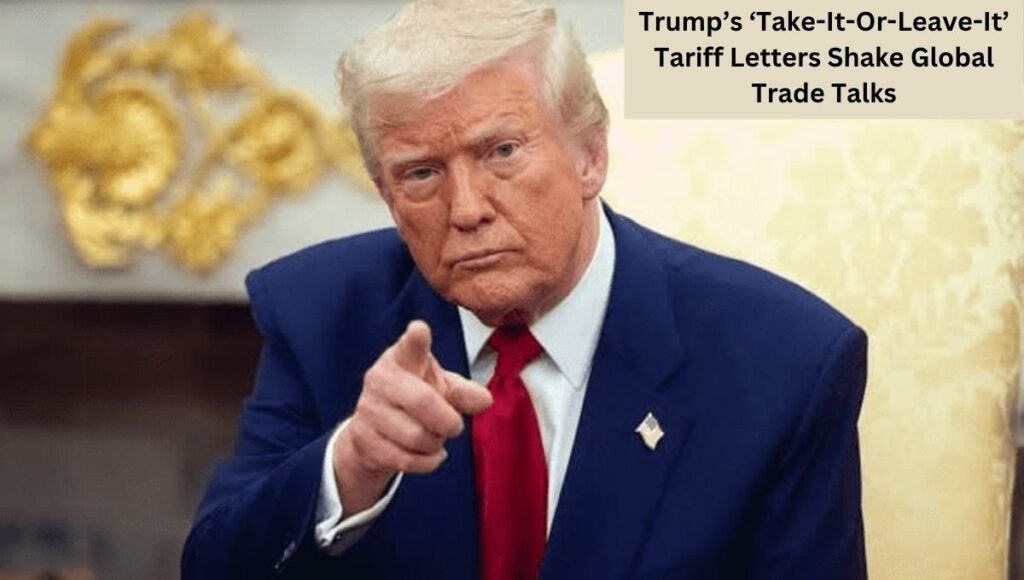
Trump’s ‘Take-It-Or-Leave-It’ Tariff Letters Shake Global Trade Talks
Trump’s Ultimatum: What Was Announced?
Speaking aboard Air Force One, Trump outlined his aggressive new approach:
“I signed some letters and they’ll go out on Monday, probably twelve… Different amounts of money, different amounts of tariffs… could be as high as 70%.”
He described the tariff letters as non-negotiable offers, ending the era of multilateral trade bargaining in favor of direct, time-bound bilateral pressure.
According to Commerce Secretary Howard Lutnick, countries have until August 1 to accept or face reversion to April 2 baseline tariffs or worse.
Why Target These 12 Nations? India in the Spotlight
While Trump has not publicly named the recipients, diplomatic sources suggest India is almost certainly among the 12.
Talks between U.S. and Indian officials intensified throughout late June but reportedly failed to resolve major disputes, leaving India vulnerable to tariff hikes.
Key Issues in U.S.-India Trade Talks:
- Agricultural Market Access: U.S. demands India lift restrictions on genetically modified crops and dairy imports.
- Automobile Sector: The U.S. seeks duty-free access to Indian auto markets, while India resists due to steel and aluminum tariffs imposed by Washington.
- GM Crops Ban: India enforces strict bans on GM produce unless certified, clashing with U.S. export goals.
India’s government, led by Commerce Minister Piyush Goyal, has rejected deadline-driven deals, emphasizing that India “will not negotiate under pressure.”
However, sources suggest a “first tranche” or mini trade deal may still be announced by July 9, possibly averting some of the more severe consequences.
What’s at Risk If India Refuses?
If India declines Trump’s tariff offer by August 1, several critical sectors may face tariffs of up to 70%, including:
- Steel and aluminum exports
- Automobiles and components
- Agricultural commodities, especially those currently facing restrictions
India also issued a formal 30-day WTO notice on July 3, signaling potential reciprocal tariffs or trade action if forced into a corner.
“Maximum Pressure”: Trump’s Strategy
This round of tariff letters marks a clear shift in U.S. trade tactics. Described by the administration as “maximum pressure” diplomacy, Trump’s strategy aims to:
- Compress timelines for trade deals
- Eliminate negotiation wiggle room
- Reward compliant countries with tariff relief
- Punish resistance with harsh economic penalties
Treasury Secretary Scott Bessent reinforced the message in a weekend interview: “This isn’t a soft deadline. August 1 means enforcement. The letters going out Monday are final.”
BRICS Alignment Brings Additional 10% Tariff
In another explosive development, Trump announced a new policy imposing an extra 10% tariff on countries aligning with the “anti-American policies of BRICS.”
Who’s Included in the BRICS Bloc?
- Founding members: Brazil, Russia, India, China, South Africa
- New additions: Iran, Egypt, UAE, Ethiopia, Saudi Arabia, Indonesia
Trump said “no exceptions will be granted”, despite longstanding U.S. ties with countries like Saudi Arabia and the UAE.
This dual-layer tariff policy economic and geopolitical intensifies global concerns over a fragmented international trade order.
Countries With Completed Deals (So Far)
So far, only three nations have successfully finalized trade agreements with the U.S. under this new regime:
1. Vietnam
- Initial tariff threat: 46%
- Final agreement: 20% on exports, 40% on transshipped goods
- U.S. receives zero-tariff access to Vietnamese markets
2. United Kingdom
- Maintains 10% baseline tariff
- Sectoral relief for autos and aircraft parts
3. China
- Tariffs on Chinese exports reduced from 145% to 30%
- U.S. export duties cut from 125% to 10%
- Temporary deal expires in 90 days if no progress is made
These deals serve as templates for upcoming agreements, but critics note they overwhelmingly favor U.S. interests, setting a tough benchmark for other countries.
European Union, Japan, Thailand: In Limbo
European Union
- Working on a “skeletal” deal to meet the July 9 deadline.
- Talks are ongoing, but a breakthrough remains uncertain.
Japan
- Prime Minister Shigeru Ishiba stated Japan “won’t easily compromise.”
Thailand
- Now offering greater market access to U.S. agricultural and industrial goods.
- May increase energy and Boeing aircraft purchases to avoid a 36% tariff.
Trade War Risks: Economic Consequences of Trump’s Tariff Plan
Economists remain split on the long-term effects of Trump’s escalating trade war. Some praise it as bold economic leadership, while others warn of inflation, trade retaliation, and stagnation.
Positive Indicators:
- U.S. stock markets hit all-time highs in early July.
- June jobs data: 147,000 new positions added.
- Inflation remained at 2.3%, within the Federal Reserve’s target range.
Warning Signs:
- Consumer spending fell by 0.1% in May the first dip in 2025.
- Global economic forecasts lowered:
- World Bank: from 2.8% to 2.3%
- OECD: from 3.3% to 2.9%
JP Morgan Analysis:
- A 10% universal tariff and 110% China tariff could slash 1% off global GDP.
- A 60% tariff on China alone could cut global growth by 0.7%.
India’s Strategic Dilemma
India finds itself navigating between economic urgency and political sovereignty. While a deal could protect vital sectors like agriculture and auto manufacturing, accepting U.S. terms could compromise domestic policies on GM crops, food safety, and market protections.
India’s long-term strategy aims to double bilateral trade with the U.S. to $500 billion by 2030, a goal reaffirmed during the February Modi-Trump summit.
But in the short term, India faces one of the most difficult trade decisions of the decade.
What’s Next? Key Dates to Watch
July 7:
- Tariff letters dispatched to 12 countries
- Final terms made official
July 9:
- End of 90-day tariff suspension
- Last chance to finalize trade deals
August 1:
- Enforcement of new tariffs begins
- Non-compliant countries face steep duties
Conclusion: A Defining Moment for Global Trade
Trump’s “take-it-or-leave-it” tariff policy marks a major departure from traditional trade diplomacy, replacing multilateralism with unilateral deadlines and pressure. While it has yielded a handful of agreements, the broader risk of retaliation, global division, and rising consumer prices cannot be ignored.
For India, the European Union, and other trade partners, the decision over the next few days will define not only trade policy but geopolitical alignment for years to come. As the August 1 tariff date looms, the world watches to see whether nations will fold under pressure or push back against a new era of tariff-driven diplomacy.
Also Read: Trump’s 30% Tariffs on EU, Mexico Spark Global Trade Turmoil
Also Read: Take it or leave it? EU faces dilemma in tariff showdown with Trump.
Related Posts:
- Trump’s 20-Point Gaza Peace Plan Gains Urgent Global…

- What’s Next for Donald Trump After Court Rules His…

- 10 Explosive Facts About Donald Trump’s $1 Billion…

- Trump’s 2025 Tariffs: Shocking Impacts on Global Peace
- Trump’s 2025 Gaza Peace Plan Signing and Historic…

- Putin’s Shocking Risks Ahead of Trump–Hungary Summit 2025
