66 Dramatic Exits: Trump’s Bold Global Pullout Shakes World Order and multilateral leadership.US President Donald Trump has ordered one of the most sweeping retreats from international cooperation in modern American history, directing the United States to withdraw from 66 international organisations and treaties, including key United Nations bodies and the world’s foundational climate agreement.
The decision, announced by the White House through a presidential memorandum and proclamation, affects 35 non-UN organisations and 31 UN-linked entities. It immediately halts US participation and funding for institutions the administration says promote “radical climate policies, global governance, and ideological programs that conflict with US sovereignty and economic strength.”
The move reinforces Trump’s long-standing “America First” doctrine and signals a decisive shift away from multilateral diplomacy—one that allies warn could weaken global stability, climate action, public health coordination and democratic institutions.
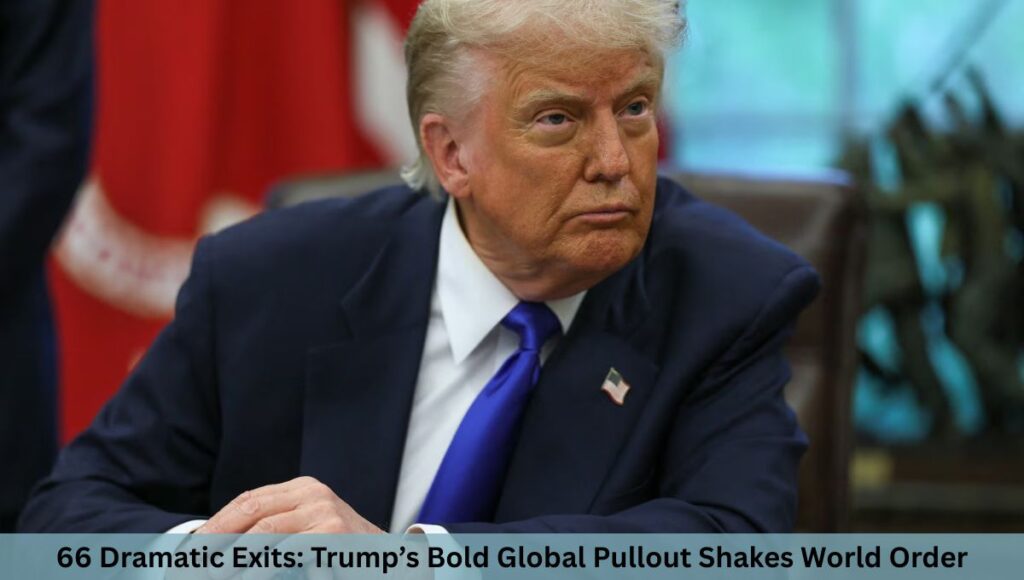
66 Dramatic Exits: Trump’s Bold Global Pullout Shakes World Order
What the White House Announced
A Sweeping Presidential Directive
According to the White House, Trump signed the directive following a comprehensive review of all international intergovernmental organisations, conventions and treaties to which the United States is a party.
“These withdrawals will end American taxpayer funding and involvement in entities that advance globalist agendas over US priorities,” the statement said. “In many cases, US taxpayer dollars are better allocated elsewhere.”
While the administration initially declined to release a full list, a detailed breakdown later confirmed withdrawals from dozens of prominent global bodies, including institutions central to climate governance, democracy promotion, gender equality, public health and peacebuilding.
The Organisations the US Is Leaving
Key UN Bodies Targeted
Among the 31 United Nations entities the US will exit are:
- UN Framework Convention on Climate Change (UNFCCC)
- UN Women
- UN Population Fund (UNFPA)
- UN Democracy Fund
- UN Office of the Special Representative for Children in Armed Conflict
- UN Peacebuilding Commission
- UN Trade and Development (UNCTAD)
- UN Economic and Social Council’s regional commissions
The UNFCCC is particularly significant. It is the bedrock treaty underpinning global climate cooperation, including the Kyoto Protocol and the Paris Agreement.
If completed, the US would become the first country ever to withdraw from the UNFCCC, a treaty ratified by the US Senate in 1992.
Non-UN Organisations Also Affected
The 35 non-UN organisations include:
- Intergovernmental Panel on Climate Change (IPCC)
- International Renewable Energy Agency (IRENA)
- International Institute for Democracy and Electoral Assistance
- International Union for Conservation of Nature
- Global Counterterrorism Forum
- Global Forum on Migration and Development
- International Solar Alliance (India-led)
Although the IPCC is technically a UN-affiliated body, it was listed separately by the White House. The group is responsible for Nobel Prize–winning climate science assessments relied upon worldwide.
Why Trump Says the US Is Leaving
‘America First’ Reasserted
The Trump administration argues that many international institutions have become inefficient, ideologically driven and hostile to US interests.
“We will not continue expending resources, diplomatic capital and the legitimizing weight of our participation in institutions that are irrelevant to or in conflict with our interests,” Secretary of State Marco Rubio said.
Officials said many of the organisations promote climate, gender, governance and development policies that clash with US economic priorities and national sovereignty.
Climate Treaties at the Center of the Storm
Exit From the UNFCCC
The most consequential decision is the planned withdrawal from the UN Framework Convention on Climate Change, which the US joined under President George H.W. Bush.
The treaty does not mandate emissions cuts, but establishes global cooperation, data reporting and annual climate negotiations.
Under the UNFCCC:
- The Kyoto Protocol was negotiated in 1995
- The Paris Agreement was adopted in 2015
- Countries submit annual emissions inventories
The Trump administration skipped submitting the US climate inventory this year and also boycotted the UN climate summit for the first time in 30 years.
Paris Agreement and WHO Already Targeted
Trump withdrew the US from the Paris climate agreement on his first day back in office and ordered the country’s exit from the World Health Organization (WHO).
The WHO withdrawal is scheduled to take effect on January 22, 2026, one year after notification.
Between 2024 and 2025, the US contributed $261 million to the WHO—about 18 percent of its total funding.
Global Reaction: Alarm and Condemnation
Environmental Groups Warn of Isolation
Climate leaders reacted with alarm, warning the move hands strategic advantage to rivals like China.
“This is a gift to China and a get-out-of-jail-free card for polluters,” said former US climate envoy John Kerry.
Rachel Cleetus of the Union of Concerned Scientists called the decision “a new low,” warning it would isolate the US and undermine global climate action.
Economic and Strategic Costs
David Widawsky of the World Resources Institute said withdrawing from the UNFCCC would push the US out of the fastest-growing clean energy markets.
“Walking away doesn’t just put America on the sidelines—it takes the US out of the arena entirely,” he said.
Impact on Global Health and Humanitarian Work
WHO and UNFPA Funding Cuts
The US has already cut funding to the UN Population Fund, which supports maternal and child health in over 150 countries.
The administration has also extended a funding ban on UNRWA, the UN agency for Palestinian refugees.
Humanitarian groups warn these decisions will affect:
- Maternal healthcare
- Child nutrition
- Disease prevention
- Refugee services
Trump’s History of Multilateral Skepticism
A Longstanding Pattern
Trump has consistently criticized international organisations as wasteful and biased.
During his first term, he:
- Quit the Paris Agreement
- Left the WHO
- Withdrew from UNESCO
- Threatened UN funding cuts
Most of those decisions were reversed by President Joe Biden—but Trump has now reinstated and expanded them during his second term.
Legal and Political Questions
Can Trump Withdraw Unilaterally?
Because the UNFCCC was ratified by the US Senate, legal experts say it is unclear whether a president can unilaterally withdraw.
However, with Republicans holding congressional majorities, legislative resistance appears unlikely.
If completed, the move could complicate future US efforts to rejoin climate agreements.
UN Response Awaited
A spokesperson for UN Secretary-General António Guterres said the organisation would respond formally after reviewing the announcement.
Privately, diplomats warn the decision undermines decades of US leadership in shaping international rules and norms.
Implications for Allies and Rivals
Strained Alliances
The withdrawal risks straining relations with:
- European Union
- Climate-vulnerable nations
- NATO allies prioritizing climate security
Trump recently questioned whether NATO would defend the US if attacked, adding to concerns about America’s global commitments.
China’s Expanding Influence
As the US steps back, analysts say China is poised to expand its leadership in:
- Climate diplomacy
- Development finance
- Global governance institutions
A Fundamental Shift in US Global Role
The decision marks more than a policy change—it represents a philosophical rejection of post-war multilateralism.
Where previous administrations viewed global institutions as tools to project influence, Trump sees them as constraints on sovereignty.
Conclusion: America Steps Back, World Adjusts
Donald Trump’s decision to withdraw the United States from 66 international organisations represents one of the most consequential foreign policy shifts of his presidency.
Supporters hail it as a restoration of sovereignty and fiscal discipline. Critics warn it weakens global cooperation, sidelines US leadership and leaves critical challenges—from climate change to pandemics—unaddressed.
As the world adapts to a less engaged United States, one question looms large:
who fills the vacuum left behind?
Also Read: 7 Explosive Truths Behind Trump’s $2 Billion Venezuela Oil Gamble
Also Read: Which are the 66 global organisations the US is leaving under Trump?
Related Posts:
- 5 Major Takeaways from the US Supreme Court's…

- Trump’s 20-Point Gaza Peace Plan Gains Urgent Global…

- Dramatic Moments Behind Trump’s Gaza Peace Push and…

- 7 Powerful Measures: Trump Sanctions Russian Oil…

- 9 Explosive Claims as Trump Says US Winning Iran War
- 7 Powerful Facts About Ayatollah Ali Khamenei’s…