

A historic Trump-Putin Alaska Summit: Putin Demands Donbas, Trump Pushes Ukraine Toward Deal. The much-anticipated Alaska summit between U.S. President Donald Trump and Russian President Vladimir Putin has shaken Kyiv, Moscow, and European capitals alike. The meeting, held at an airforce base in Alaska, marked the first encounter between an American president and the Kremlin chief since before Russia’s full-scale invasion of Ukraine in February 2022.
According to multiple sources briefed on Moscow’s thinking, Putin presented a controversial proposal: Ukraine should cede full control of the eastern Donbas region Donetsk and Luhansk in exchange for Russia freezing its offensive in southern Ukraine.
While Trump described the talks as a step toward peace, Ukrainian President Volodymyr Zelenskyy flatly rejected the idea, insisting that Ukraine cannot and will not give up sovereign territory. The developments mark a major shift in U.S. foreign policy and have ignited fierce debates over whether Trump is leaning dangerously close to Putin’s demands or genuinely trying to end Europe’s deadliest war in 80 years.
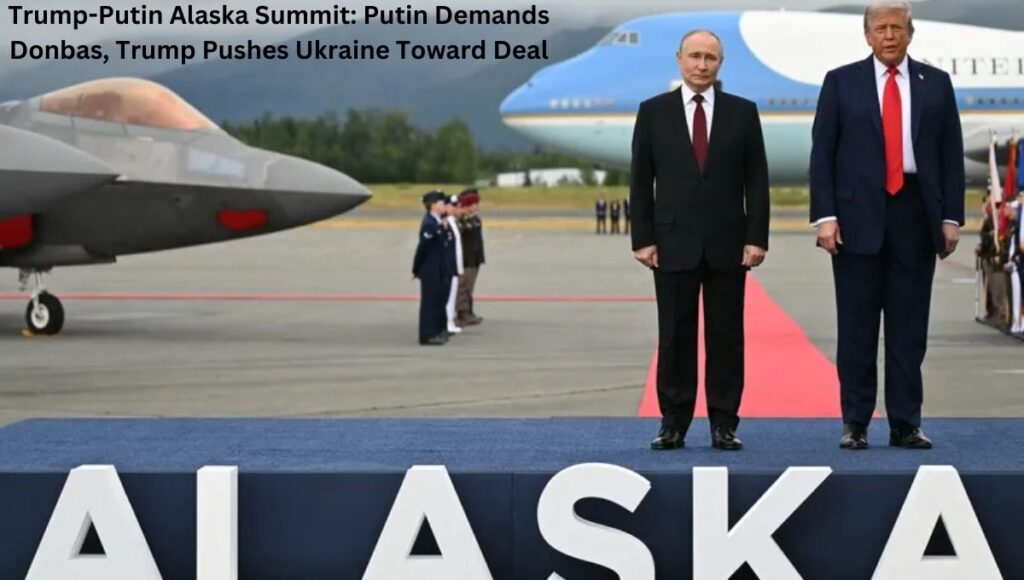
Trump-Putin Alaska Summit: Putin Demands Donbas, Trump Pushes Ukraine Toward Deal
Putin’s Donbas Demand: Land for Peace
At the heart of the Alaska summit was Putin’s proposal for a land-for-peace exchange.
Under the reported deal:
- Ukraine would withdraw from Donetsk and Luhansk entirely, including areas it currently controls.
- In return, Russia would freeze front lines in the Kherson and Zaporizhzhia regions, halting further southern offensives.
- Moscow also hinted at returning small occupied pockets in Sumy and Kharkiv — tiny compared to the vast territory demanded in Donbas.
- Russia would expect formal recognition of Crimea as Russian territory, seized in 2014.
- Ukraine would be barred from NATO membership, though some form of U.S.-backed “security guarantees” could be considered.
For Kyiv, such terms represent nothing short of capitulation. Zelenskyy reiterated that Ukraine’s constitution forbids territorial concessions and stressed that Donetsk and Luhansk serve as crucial defensive strongholds against further Russian aggression.
Trump’s Reaction: “Pretty Close to a Deal”
Despite Ukraine’s rejection, Trump signaled optimism. Speaking to Fox News host Sean Hannity after the summit, he said:
“I think we’re pretty close to a deal. Ukraine has to agree to it. Maybe they’ll say ‘no’.”
The U.S. president suggested that peace should not be delayed by a temporary ceasefire, insisting that only a comprehensive settlement could truly end the war.
Trump reportedly briefed both Zelenskyy and European leaders after his meeting with Putin, framing the negotiations as a path toward ending the devastating conflict.
However, critics argue that Trump’s stance aligns dangerously with Putin’s agenda, pressuring Ukraine to give up land it has fought bitterly to defend.
Zelenskyy’s Firm Rejection
Ukrainian President Volodymyr Zelenskyy wasted no time rejecting the plan.
In calls with Trump and during remarks to his own people, Zelenskyy emphasized that Ukraine will not surrender Donbas or any part of its sovereign territory.
He reminded allies that concessions would only embolden Russia and pave the way for future invasions.
Zelenskyy is set to travel to Washington on Monday for face-to-face talks with Trump, where he is expected to reiterate Kyiv’s red lines and push for ironclad U.S. and European security guarantees instead of territorial concessions.
Europe’s Uneasy Response
European leaders, while welcoming Trump’s initiative to engage Putin directly, are deeply uneasy about the direction of U.S. policy.
- UK Prime Minister Keir Starmer acknowledged that “an end to the war is closer than ever” but vowed to tighten sanctions until Russia halts its assault.
- Italian Prime Minister Giorgia Meloni highlighted the importance of new security guarantees for Ukraine, modeled on NATO’s Article 5.
- Former German ambassador Wolfgang Ischinger slammed the summit as a clear win for Putin, saying: “No real progress – a clear 1-0 for Putin.”
For Europe, the fear is clear: Trump may be handing Putin a diplomatic victory, legitimizing his territorial ambitions while leaving Ukraine exposed.
Security Guarantees: The Key Debate
One of the summit’s most significant outcomes was the discussion of security guarantees for Ukraine.
Trump reportedly floated the idea of a NATO-style “Article 5” commitment outside the alliance, meaning the U.S. and its partners would pledge to defend Ukraine in case of future attacks.
This could represent a middle ground: Ukraine avoids formal NATO membership, appeasing Russia, while still gaining protective commitments from the West.
However, the details remain murky, and analysts warn that without a clear enforcement mechanism, such guarantees risk being little more than paper promises.
Putin’s Broader Demands
Beyond territory, Putin’s reported demands included:
- Recognition of Russian sovereignty in Crimea
- Partial lifting of Western sanctions
- Official status for the Russian language inside Ukraine
- Freedom for the Russian Orthodox Church to operate
Each of these points presents major obstacles for Kyiv and its allies. Ukraine’s parliament has banned Russian-linked religious organizations, accusing them of espionage and propaganda.
Formal recognition of Crimea is a red line for both Kyiv and Europe, and sanctions remain one of the West’s strongest tools against Moscow.
Why Trump’s Shift Matters
Before the summit, Trump had insisted he wanted a ceasefire first. His pivot toward discussing a full peace deal without a ceasefire marks a policy U-turn that has rattled allies.
For Moscow, this is welcome news. Russia has long rejected temporary pauses in fighting, insisting only a final settlement could end the war.
By appearing to validate Putin’s approach, Trump may have handed the Kremlin a propaganda victory.
At the same time, Trump’s defenders argue that his bold approach could succeed where years of Western policy have failed, potentially ending a war that has killed or wounded over one million people.
What Comes Next
- Zelenskyy meets Trump in Washington on Monday, joined by European leaders.
- Talks are expected to focus on security guarantees and the future of U.S. military and financial aid.
- A possible trilateral meeting with Putin has not yet been confirmed, though Trump hinted it could happen “very soon”.
The world will be watching closely. For Ukraine, the stakes could not be higher. For Russia, the summit already represents a symbolic victory: Putin has re-entered high-level diplomacy after years of isolation.
Conclusion: Peace or Capitulation?
The Alaska summit may mark the beginning of a new phase in the Russia-Ukraine war. Whether it leads to genuine peace or Ukrainian capitulation depends on the choices made in Washington and Kyiv in the coming days.
Trump insists a deal is “pretty close.”
Putin has laid out his terms.
Zelenskyy has drawn his red lines. The coming week could determine whether Europe moves closer to peace or deeper into conflict.
Also Read: Trump says he’s arranging a meeting between Zelenskyy and Putin after hosting Ukrainian leader
Also Read: Trump, Zelensky, and EU Leaders Present United Front Ahead of Alaska Summit With Putin
Related Posts:
- 7 Critical Reasons the Donbas Is the Most Explosive…
- 5 Powerful Highlights as Trump Lands Second Nobel…

- 11 Explosive Revelations From Ted Cruz’s Leaked…

- Can the EU and NATO Impose Tariffs on India and…

- Impacts of the Trump-Putin Call on Ukraine’s 2025 Strategy

- 7 Powerful Measures: Trump Sanctions Russian Oil…
