

The global trade partners scurry to finalize deals as Trump’s July 9 Tariff Deadline Nears: Where Trade Talks Stand. With just days remaining before the July 9 deadline set by President Donald Trump to finalize trade agreements, global partners are racing against the clock to avert punishing new US tariffs some as high as 70%. The White House has signaled that absent formal deals, countries will begin receiving letters detailing their new tariff rates, set to take effect August 1.
Let’s break down where things stand across key global partners ahead of this high-stakes deadline.
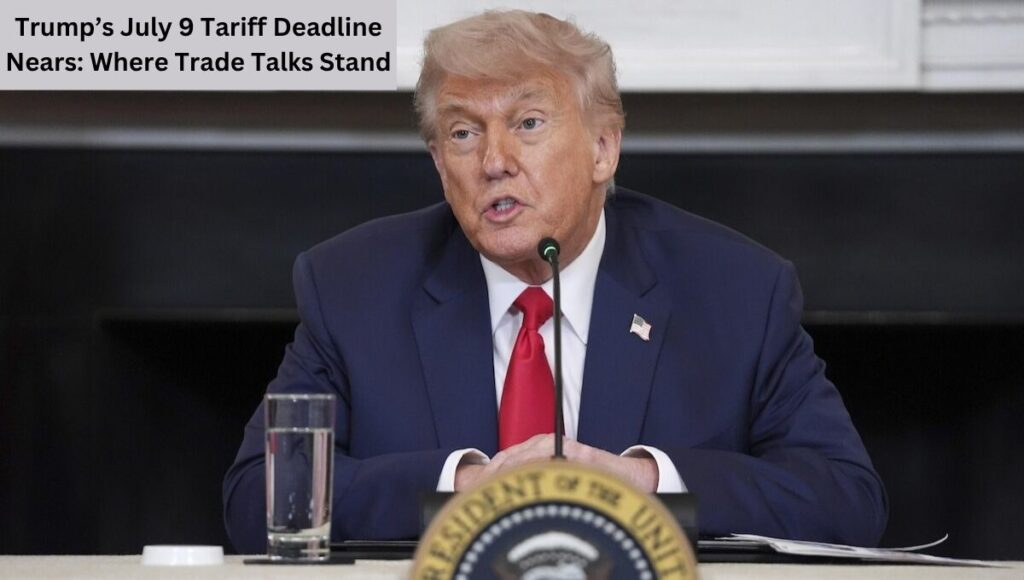
Trump’s July 9 Tariff Deadline Nears: Where Trade Talks Stand
Why Trump Is Raising Tariffs
The new tariffs stem from Trump’s April 2 “Liberation Day” announcement, where he imposed so-called “reciprocal” tariffs of up to 50% on nearly all US trade partners. The justification? A lack of “reciprocity” in global trade relationships.
Markets reacted sharply to the announcement, with US stocks entering bear-market territory. Under pressure, Trump paused the hikes for 90 days, setting July 9 as the date for countries to either strike deals or face steeper levies.
Now, with time running out, Trump appears poised to act. He has signed up to 12 trade letters, which will notify countries of their new tariff rates ranging from 10% to 70%.
European Union: Hoping for an 11th-Hour Agreement
The European Union has emerged as one of the most active negotiators. European Commission President Ursula von der Leyen confirmed the EU is “ready for a deal,” targeting an “agreement in principle” ahead of the July 9 tariff deadline.
Currently, EU goods face a 10% baseline tariff. If no agreement is reached, tariffs could double to 20%, with Trump having previously floated the possibility of 50%.
An EU diplomat told CNN that talks remain “constructive but difficult” and may continue through the weekend. Olof Gill, a trade spokesperson, declined to comment on specifics, calling it a “sensitive phase of negotiations.”
Vietnam: A Deal with Strings Attached
Vietnam has already announced a framework agreement with the US, narrowly avoiding Trump’s original 46% tariff.
Under the new arrangement, goods manufactured in Vietnam will be taxed at 20%, while goods merely routed through Vietnam to evade tariffs known as transshipping will face a 40% levy.
While this deal offers partial relief, questions remain about how the US will treat Vietnamese exports containing foreign components, particularly from China. Analysts also warn of potential retaliatory measures from Beijing.
Japan: Close Ally, Cold Shoulder?
Japan finds itself in an unusual position a US ally facing an escalating trade dispute. Despite frequent visits to Washington by Japanese envoy Ryosei Akazawa, Trump has voiced frustration over Japan’s limited openness to US rice and auto exports.
“I’m not sure we’re going to make a deal,” Trump said, threatening tariffs of “30%, 35%, or whatever the number is that we determine.”
Tokyo currently faces a 24% tariff from April. With no breakthrough yet, Japanese exports may be among the hardest hit by August 1.
India: Optimism With Caveats
India remains hopeful it can avoid the 26% tariff proposed in April. Trump hinted at a “very big” trade deal with India, and Ajay Sahai, head of the Federation of Indian Export Organisations, reported positive signals from Washington.
However, Finance Minister Nirmala Sitharaman emphasized that agriculture and dairy are “big red lines” for India in any agreement.
Still, the White House has suggested that India is among the countries making a good-faith effort, which may earn it flexibility past the July 9 deadline.
South Korea: Clouded by Uncertainty
Already grappling with US tariffs on autos and steel, South Korea now faces the threat of a 25% blanket tariff on all exports. President Lee Jae Myung said the two sides have yet to clearly define their expectations.
“I can’t say with confidence that we’ll be able to wrap everything up by July 8,” he admitted on Thursday. Seoul has floated shipbuilding cooperation as a bargaining chip, but results remain elusive.
Taiwan, Indonesia, Thailand: Waiting with Unease
Other Asian economies Taiwan, Indonesia, Thailand, and Cambodia are watching nervously. Taiwan, a close US ally, could see a 32% tariff unless a deal is reached. Cambodia faces a stunning 49% tariff under Trump’s new framework.
Indonesia has indicated it may increase agricultural and energy imports from the US to ease tensions, while Bangladesh is reportedly offering to purchase Boeing planes as part of a proposed trade compromise.
Taiwanese Vice President Hsiao Bi-khim said, “Negotiators from both sides are working diligently” to find a resolution.
Switzerland: Hoping for a Grace Period
The Swiss government said the US has acknowledged Switzerland’s “good faith” efforts and believes its 10% tariff will stay in place past July 9. However, the country has not received formal confirmation, and without presidential sign-off, rates could still rise to 31%.
Trump’s Letters: A New Form of Diplomacy
Rather than negotiate dozens of separate deals, Trump has opted to send letters to each nation, detailing the tariffs they will face.
“It’s just much easier,” Trump said. “We have far more than 170 countries… How many deals could you make?”
The letters, which began going out Friday, July 5, outline tariff rates ranging from 10% to 70%, with implementation on August 1.
While UK and Vietnam have agreements in place, most others are still in flux. Trump’s flexibility appears limited, with the president saying, “Not really” when asked if any country would be granted an extension.
What’s Next: August 1 Implementation
Treasury Secretary Scott Bessent and White House Press Secretary Karoline Leavitt have offered mixed signals with Bessent suggesting deals could be finalized by Labor Day, but Trump insisting tariffs will start August 1.
Despite some uncertainty, the US is expected to begin collecting new tariff revenues next month, with May figures already showing a record $24.2 billion a nearly fourfold increase year over year.
Conclusion: Trade Pressure Is Peaking
With less than a week to go, the Trump administration is pressing forward with a strategy that blends aggressive negotiation, hard deadlines, and unilateral tariff decisions. While some countries like Vietnam and the UK have managed to strike deals, most others including major partners like Japan, India, and the EU remain in limbo.
Trump’s tactic of using tariff letters rather than traditional negotiation could reset how the US engages with global trade. Whether this leads to stable long-term agreements or further economic turmoil remains to be seen as the July 9 deadline looms large.
Also Read: Trump Set to Send Tariff Ultimatums as July 9 Deadline Looms
Also Read: Trump letters and who’s talking: State of play as tariff deadline nears
Related Posts:
- What’s Next for Donald Trump After Court Rules His…

- Trump’s ‘Take-It-Or-Leave-It’ Tariff Letters Shake…
- Trump Targets Sri Lanka, BRICS with Sweeping Tariffs
- Trump’s 2025 Gaza Peace Plan Signing and Historic…

- Trump’s 2025 Tariffs: Shocking Impacts on Global Peace
- 10 Big Takeaways from Trump’s 155% Tariff Warning to China
