
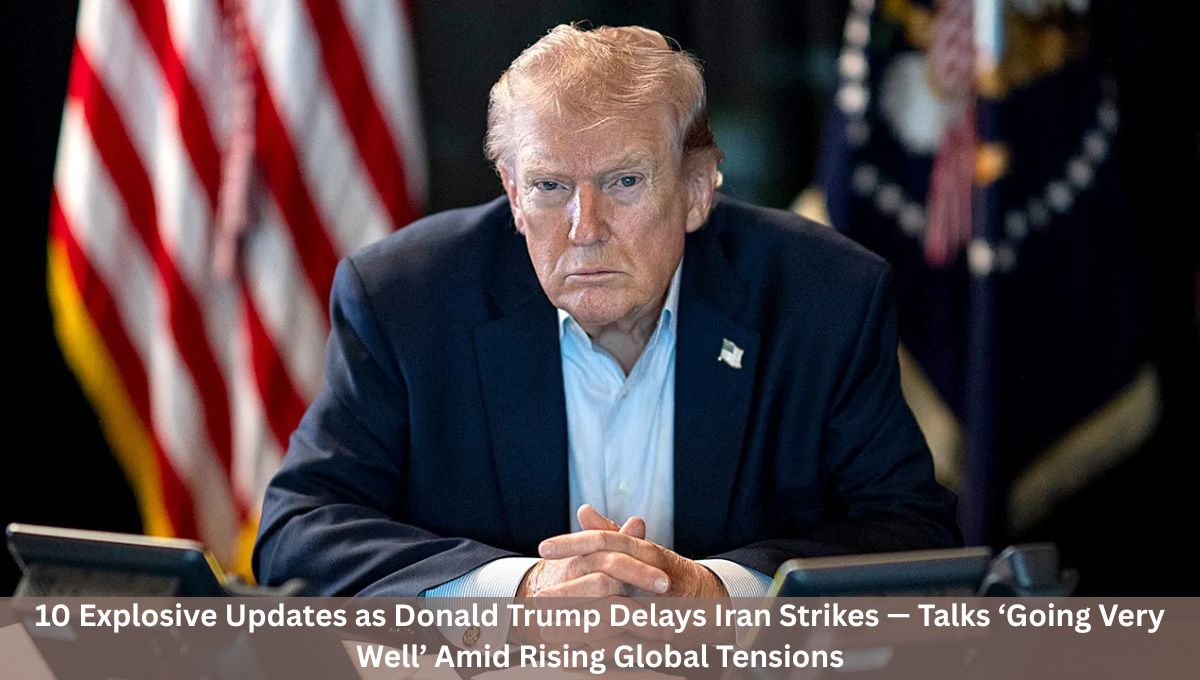
10 Explosive Updates as Donald Trump Delays Iran Strikes — Talks ‘Going Very Well’ Amid Rising Global Tensions, as Iran denies seeking pause. The geopolitical landscape in the Middle East remains on edge after Donald Trump announced a 10-day pause on potential strikes targeting Iran’s energy infrastructure, pushing the deadline to April 6, 2026.
The decision, framed as a diplomatic window, comes amid conflicting narratives, intensifying military activity, and growing global economic anxiety.
While Washington claims negotiations are progressing, Tehran disputes key elements of the narrative — raising questions about whether diplomacy is genuinely advancing or merely buying time in an increasingly volatile conflict.
10 Explosive Updates as Donald Trump Delays Iran Strikes — Talks ‘Going Very Well’ Amid Rising Global Tensions
A Sudden Pause in Escalation
In a post on Truth Social, Trump declared that he would delay strikes on Iranian energy facilities, stating that the move was made at Tehran’s request.
He emphasized that talks were “going very well”, despite skepticism from media outlets and international observers.
However, Iranian officials and mediators quickly contradicted this claim, stating that no formal request for a pause was made.
This contradiction highlights a recurring theme in the crisis:
competing narratives shaping global perception.
The pause extends a previously announced five-day halt, signaling that Washington may be prioritizing diplomatic leverage over immediate military escalation.
The Strategic Importance of the Strait of Hormuz
At the heart of the conflict lies the Strait of Hormuz, one of the world’s most critical energy corridors.
Roughly 20% of global oil and liquefied natural gas flows through this narrow passage, making it a strategic flashpoint.
Iran’s effective blockade of the strait has:
- Disrupted global shipping routes
- Driven oil prices above $100 per barrel
- Triggered fears of prolonged supply shortages
- Intensified inflation concerns worldwide
Trump’s ultimatum — demanding Iran reopen the strait — underscores its centrality to global economic stability.
War Timeline — How the Crisis Escalated
The current conflict began on February 28, when the United States and Israel launched coordinated strikes on Iranian targets following failed negotiations over Tehran’s nuclear program.
Since then:
- Missile exchanges have intensified
- Regional actors have been drawn into the conflict
- Civilian infrastructure has increasingly been targeted
- Diplomatic efforts have struggled to gain traction
The war has already resulted in thousands of casualties and widespread destruction across multiple countries.
Conflicting Claims Over Diplomacy
US Position
The US administration insists that:
- Talks are ongoing through intermediaries
- A 15-point proposal has been delivered to Iran
- There are “strong signals” of Iranian willingness to negotiate
Special envoy Steve Witkoff described the situation as a potential “turning point”.
Iran’s Response
Iran, however, has:
- Denied direct negotiations with Washington
- Rejected key elements of the US proposal
- Demanded broader concessions
According to Iranian sources, Tehran’s conditions include:
- An end to US and Israeli strikes
- Financial reparations
- Recognition of its authority over the Strait of Hormuz
These demands go far beyond the US framework, highlighting a significant gap between both sides.
Military Pressure Continues Despite Pause
Despite the diplomatic pause, military operations have not stopped.
Iran has:
- Launched missile strikes on Israeli cities like Tel Aviv and Haifa
- Targeted US bases and Gulf infrastructure
- Continued to disrupt regional stability
Meanwhile, the US and Israel have:
- Conducted strikes in cities such as Isfahan and Shiraz
- Expanded military deployments
- Introduced advanced technologies, including drone speedboats
This dual-track approach — diplomacy alongside sustained military pressure — reflects a high-risk strategy.
Rising Risk of Ground Invasion
Reports suggest the Pentagon is considering deploying up to 10,000 additional troops to the region.
Military analysts outline several possible scenarios:
- Seizing strategic Iranian islands
- Targeting key oil export hubs
- Securing nuclear facilities
- Conducting limited tactical operations
One focal point is Kharg Island, responsible for over 90% of Iran’s oil exports. Capturing or disabling it could cripple Iran’s economy — but at a high operational cost.
Israel’s Growing Concerns
Inside Israel, cracks are beginning to appear.
Opposition leader Yair Lapid has warned that:
- The military is overstretched
- The country is fighting a multi-front war
- Resources are insufficient for prolonged conflict
Israeli military officials have also acknowledged the need for more troops, particularly along the Lebanese front.
These developments indicate that even key US allies are feeling the strain of the prolonged war.
Global Economic Fallout
The conflict has already had severe global economic consequences:
Energy Markets
- Oil prices have surged by 40–50%
- LNG prices have spiked sharply
- Fuel shortages threaten multiple regions
Financial Markets
- Major stock indices have declined
- The Nasdaq entered correction territory
- Investor confidence has weakened
Inflation Pressures
- Rising fuel costs are driving global inflation
- Food production costs are increasing due to fertilizer price spikes
International institutions warn that the crisis could trigger long-term economic instability.
The Role of Mediators
Countries like Pakistan, Turkey, and Egypt have stepped in as intermediaries, facilitating indirect communication between Washington and Tehran.
Pakistan, in particular, has emerged as a key diplomatic bridge, transmitting proposals and responses between both sides.
However, the effectiveness of these efforts remains uncertain, as neither side has shown willingness to compromise on core demands.
The Credibility Gap
One of the most striking aspects of the crisis is the credibility gap between official statements and ground realities.
- Trump claims Iran requested the pause
- Iran denies making such a request
- The US speaks of ongoing talks
- Iran insists no direct negotiations are taking place
This divergence raises concerns about information warfare and strategic messaging, where narratives are used as tools of leverage.
Oil, Power, and Strategic Leverage
Trump’s suggestion that the US could take control of Iran’s oil resources adds another layer of complexity.
Such a move would:
- Redefine global energy geopolitics
- Risk escalating the conflict further
- Invite international backlash
The comparison to past US actions in Venezuela signals a resource-driven strategic approach, blending economic and military objectives.
Humanitarian and Civilian Impact
Beyond geopolitics, the conflict is having a devastating impact on civilians:
- Power outages threaten essential services
- Water supply systems are at risk
- Urban centers face repeated missile strikes
- Displacement and humanitarian crises are worsening
The targeting of energy infrastructure raises concerns about long-term damage to civilian life and regional stability.
What Happens Next?
The next 10 days could prove crucial.
Key scenarios include:
1. Breakthrough in Talks
If negotiations gain momentum, the pause could lead to a ceasefire framework.
2. Renewed Strikes
Failure to reach agreement may result in large-scale attacks on Iranian energy infrastructure.
3. Limited Military Operation
The US could opt for targeted operations rather than full-scale escalation.
4. Wider Regional War
Further escalation could draw in additional countries, expanding the conflict beyond current boundaries.
A Fragile Window for Diplomacy
Trump’s decision to delay strikes offers a brief window for diplomacy, but the underlying tensions remain unresolved.
The situation is characterized by:
- Deep mistrust between the US and Iran
- Conflicting strategic objectives
- Ongoing military engagement
- Global economic pressure
Whether this pause represents a genuine opportunity for peace or merely a tactical delay remains uncertain.
Conclusion
The extension of the strike deadline reflects the complex interplay between diplomacy and military strategy in one of the most volatile conflicts of recent times.
While Donald Trump projects optimism, the reality on the ground suggests a far more fragile situation.
With Iran maintaining a firm stance and global markets reacting nervously, the stakes could not be higher.
As the April 6 deadline approaches, the world watches closely — aware that the outcome could reshape not only the Middle East but the global economic and geopolitical order.
Also Read: 7 Shocking Reasons Donald Trump Approval Rating Crashed Amid Iran War & Fuel Price Surge
Related Posts:
- 11 Explosive Warnings as Trump Vows to ‘Knock the…

- 10 Explosive Warnings as Donald Trump Calls Iran…
- 7 Explosive Impacts of Trump’s 25% Iran Tariff on…
- 10 Powerful Revelations from the Trump–Putin Call on…

- 12 Explosive Claims as Donald Trump Says Iran War…
- Trump’s 2025 Gaza Peace Plan Signing and Historic…
