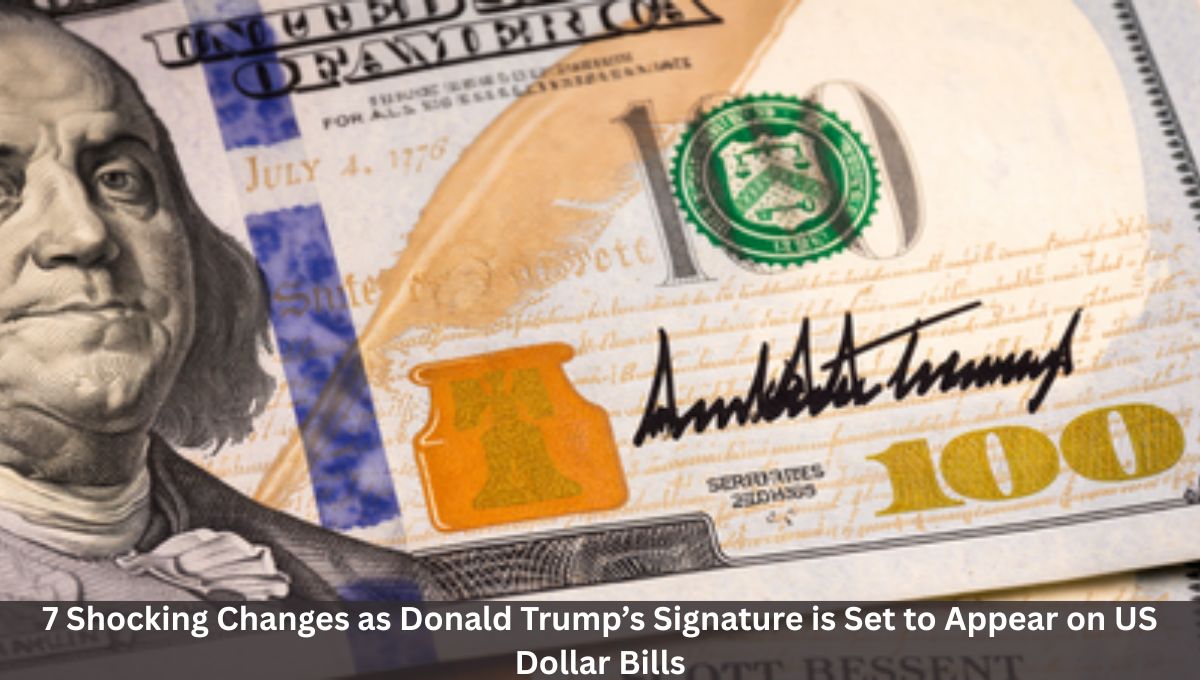
7 Shocking Changes as Donald Trump’s Signature is Set to Appear on US Dollar Bills, in historic first. In a move that is already stirring global debate, Donald Trump’s signature is set to appear on United States paper currency — marking the first time a sitting president’s signature will be printed on dollar bills since the system began in 1861.
The decision, announced by the United States Department of the Treasury, is part of a broader initiative to commemorate the 250th anniversary of American Independence, also known as the Semiquincentennial.
While supporters hail it as a symbolic tribute to leadership and national progress, critics argue it represents a break from long-standing institutional norms and risks politicising one of the world’s most trusted financial instruments.
7 Shocking Changes as Donald Trump’s Signature is Set to Appear on US Dollar Bills
A Historic Break from a 165-Year Tradition
For more than a century and a half, US paper currency has followed a consistent design principle:
- Signatures of the Treasury Secretary
- Signatures of the US Treasurer
The President’s name has never appeared on circulating paper money — until now.
Under the new policy:
- Trump’s signature will replace that of the US Treasurer
- It will appear alongside Treasury Secretary Scott Bessent
- The change will apply to newly printed notes
This effectively ends a 165-year-old tradition, marking one of the most significant symbolic shifts in modern US monetary history.
Why Now? The 250th Anniversary Factor
The timing of the decision is closely tied to the upcoming 250th anniversary of US Independence, celebrated on July 4, 2026.
Officials argue that:
- The milestone justifies a “historic” redesign
- The change reflects national achievements
- It honors leadership during a transformative period
According to Treasury statements, the updated currency is intended to serve as a lasting symbol of America’s economic strength and resilience.
How the New Dollar Bills Will Roll Out
Initial Launch
- First redesigned $100 bills expected to be printed in June
- Gradual rollout across other denominations
Circulation Timeline
- New notes may take weeks or months to reach banks
- Existing currency will remain valid and continue circulating
Design Changes
- No major visual redesign of the bill
- Only signature placement will change
The Bureau of Engraving and Printing will oversee production, ensuring continuity in security features and anti-counterfeiting measures.
The Commemorative Coin Controversy
The currency change is not happening in isolation.
Earlier, a federal arts commission approved a 24-karat gold commemorative coin featuring Trump’s image — only the second time a living president has been depicted on a coin.
Traditionally:
- US law restricts depiction of living individuals on circulating currency
- Exceptions exist for commemorative coins
This dual move — signature on notes and image on coins — underscores a broader effort to embed presidential legacy into national symbols.
Supporters Call It a Symbol of Leadership
Officials backing the move argue that it reflects:
- Economic growth under Trump’s leadership
- Strength of the US dollar globally
- A defining period in American history
Treasury Secretary Scott Bessent described the decision as:
- A recognition of “historic achievements”
- A tribute to fiscal stability and economic progress
US Treasurer Brandon Beach added that the move is “appropriate and well deserved”, calling Trump the architect of a “golden age economic revival.”
Critics Warn of Politicising Currency
Not everyone agrees.
Critics, including political leaders and economists, argue that:
- Currency should remain politically neutral
- The move risks undermining institutional credibility
- It sets a precedent for future administrations
Gavin Newsom mocked the decision, linking it to rising living costs and questioning its relevance to everyday Americans.
Some analysts have gone further, comparing the move to practices in countries where leaders place their image or identity prominently on national symbols.
Legal and Institutional Questions
Is It Legal?
Experts note that:
- US law restricts portraits, not signatures
- The Treasury Secretary has broad authority over design
This creates a legal grey area, allowing the change without directly violating existing statutes.
Institutional Impact
However, concerns remain about:
- Erosion of institutional traditions
- Increased personalization of governance
- Long-term implications for monetary policy perception
Global Implications — Why the World Is Watching
The US dollar is not just America’s currency — it is the world’s primary reserve currency.
Changes to its design carry global significance:
Market Confidence
- Investors rely on the dollar’s stability
- Symbolic changes can influence perception
Geopolitical Signaling
- The move may be interpreted as a shift in governance style
- It reflects broader trends in US domestic and foreign policy
Currency Branding
- The dollar has historically projected institutional neutrality
- Personalization may alter its symbolic meaning
For countries and central banks worldwide, even subtle shifts in the dollar’s identity can have outsized psychological and financial effects.
Economic Context Behind the Decision
The announcement comes amid a complex economic backdrop:
- Moderate GDP growth
- Persistent inflation concerns
- Volatility in global markets
While the administration highlights economic strength, critics point out that:
- Growth rates align with post-pandemic trends
- Cost-of-living pressures remain high
This context adds another layer to the debate over whether the move is symbolic celebration or political messaging.
Trump’s Expanding Institutional Footprint
The currency update is part of a broader pattern.
Since returning to office, Donald Trump has:
- Attached his name to government programs
- Renamed major institutions
- Proposed new initiatives carrying his branding
This strategy reflects a deliberate effort to shape legacy through institutional identity.
Public Reaction — Deeply Divided
Supporters
- View it as patriotic recognition
- See it as deserved acknowledgment of leadership
- Embrace it as part of anniversary celebrations
Critics
- Call it self-promotion
- Question its necessity
- Express concerns over precedent
Neutral Observers
- Describe it as symbolic but significant
- Highlight its potential long-term implications
The reaction underscores a broader divide in how leadership and national identity are perceived.
Could These Bills Become Collectibles?
Currency experts suggest the new notes could become:
- Highly sought-after collector items
- Historically significant artifacts
- Rare examples of institutional change
Because of their uniqueness, early prints — especially the first $100 bills — may gain numismatic value over time.
What This Means for Everyday People
For most individuals:
- Existing currency remains valid
- No immediate action is required
- Changes will be gradual
However, the psychological impact could be notable, as people begin to see a living president’s signature on everyday money.
A Shift in Symbolism
Currency is more than a medium of exchange — it is a symbol of national identity and trust.
This move signals a shift:
- From institutional representation
- Toward individual recognition
Whether this strengthens or weakens public trust remains an open question.
What Happens Next?
Looking ahead:
- Printing begins in June
- Circulation will expand gradually
- Debate is likely to intensify
Potential future developments include:
- Additional commemorative currency
- Legal challenges
- Policy reversals under future administrations
Conclusion
The decision to place Donald Trump’s signature on US dollar bills marks a historic turning point in American monetary tradition.
Supporters see it as a fitting tribute during a landmark anniversary. Critics view it as a troubling departure from neutrality.
What is certain is that the move will:
- Reshape perceptions of US currency
- Influence political discourse
- Leave a lasting imprint on financial history
As the United States approaches its 250th anniversary, this unprecedented change reflects a broader question facing the nation — how it chooses to define its identity, leadership, and legacy in a rapidly evolving world.
Also Read: 7 Explosive Reasons Trump Shifted from Threatening Iran to Pushing Peace Talks — Part 1
Also Read: Donald Trump’s signature on dollar bills to mark 250th year of U.S. Independence