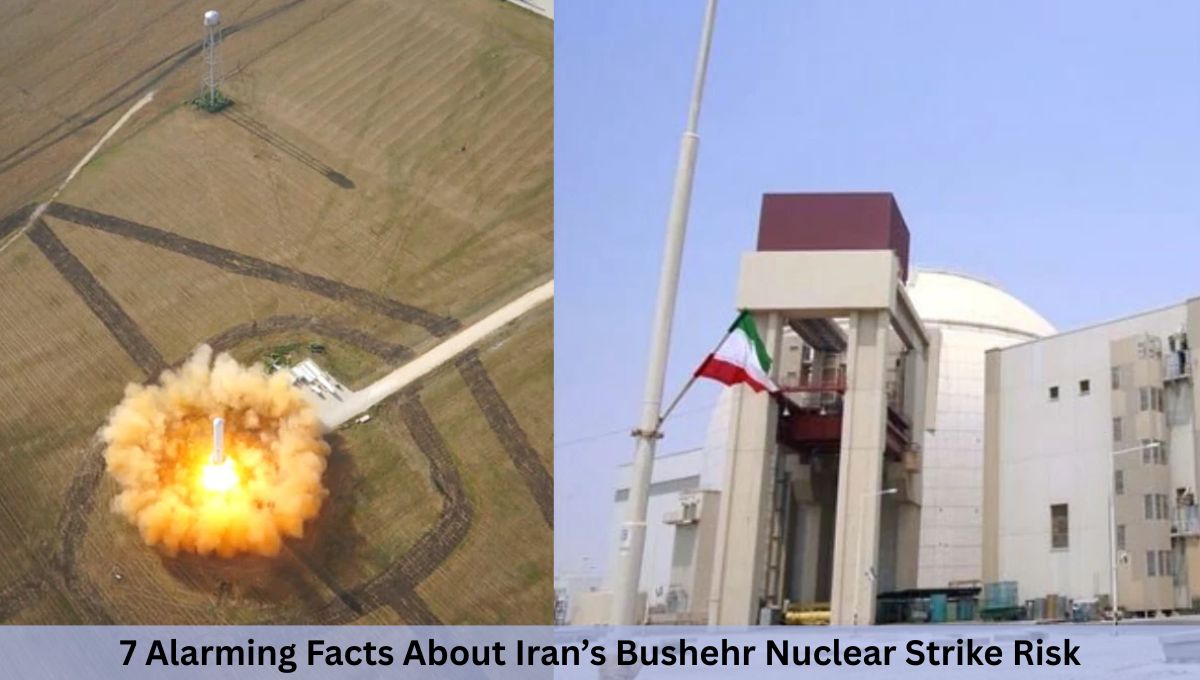
7 Alarming Facts About Iran’s Bushehr Nuclear Strike Risk after repeated US-Israel strikes. The escalating conflict involving Iran, United States, and Israel has taken a deeply concerning turn, with repeated strikes near Iran’s only operational nuclear power facility—the Bushehr Nuclear Power Plant.
Thank you for reading this post, don't forget to subscribe!After the fourth reported strike, Iranian officials have issued stark warnings about a potential “radioactive catastrophe” that could extend far beyond Iran’s borders.
The situation has triggered alarm across the Gulf region and drawn concern from global nuclear watchdogs, including the International Atomic Energy Agency (IAEA).
This article breaks down the critical facts, risks, and global implications of the Bushehr situation in a clear, comprehensive manner for a global audience.
7 Alarming Facts About Iran’s Bushehr Nuclear Strike Risk
What Happened at Bushehr Nuclear Plant?
Iranian Foreign Minister Abbas Araghchi warned that repeated strikes near the Bushehr plant could lead to radioactive fallout affecting Gulf nations more severely than Iran itself.
According to reports:
- The plant has been targeted four times since the conflict escalated on February 28.
- A projectile struck within 350 meters of the facility.
- At least one person was killed, and auxiliary structures were damaged.
- The main reactor remains operational—for now.
The IAEA confirmed that no radiation leak has been detected yet, but emphasized that attacks near nuclear facilities are inherently dangerous.
Why Bushehr Is Uniquely Dangerous
Geographic Vulnerability
The city of Bushehr sits along the Persian Gulf, placing it closer to Gulf capitals than to Tehran.
Distances highlight the risk:
- Kuwait City: ~270 km
- Manama: ~350 km
- Doha: ~450 km
This proximity means radioactive fallout could reach Gulf countries faster than Iran’s own capital.
A Nuclear Facility by the Sea
Unlike inland reactors, Bushehr’s coastal location introduces a critical variable:
water contamination.
If radioactive material enters the Gulf:
- It could spread rapidly across multiple countries.
- Marine ecosystems would be devastated.
- Drinking water supplies could collapse.
The Gulf’s Biggest Fear: Water Crisis
Countries like Qatar, Bahrain, and Kuwait rely heavily on desalination plants.
Why This Matters
- These nations have minimal natural freshwater sources.
- Drinking water comes almost entirely from desalinated seawater.
- Desalination plants cannot effectively filter radioactive materials.
Qatar’s Prime Minister Sheikh Mohammed bin Abdulrahman Al Thani previously warned:
A strike on Bushehr could leave the region with “no water, no fish, nothing… no life.”
Experts estimate:
- Water supplies could collapse in as little as three days.
- Millions of people could be affected immediately.
What Happens If the Reactor Is Hit?
A direct strike on the reactor or fuel storage could release radioactive isotopes, especially:
Caesium-137
- Highly toxic radioactive material
- Spreads via air and water
- Contaminates soil, crops, and water
- Remains dangerous for decades
The release could:
- Cause immediate burns and fatalities
- Increase long-term cancer risks
- Force mass evacuations across multiple countries
IAEA Warning: “Never Target Nuclear Sites”
IAEA Director General Rafael Grossi has repeatedly stressed:
- Nuclear facilities must never be attacked
- Even auxiliary buildings may contain critical safety systems
- Damage to power supply could trigger reactor meltdown
A failure in cooling systems could result in:
- Core overheating
- Meltdown scenario
- Massive radiation release
Could This Become Another Chernobyl or Fukushima?
Two major nuclear disasters illustrate the stakes:
Chernobyl disaster
- Explosion released massive radiation
- 300,000+ people evacuated
- Long-term cancer surge
Fukushima disaster
- Triggered by earthquake and tsunami
- 160,000 evacuated
- Long-term environmental damage
Why Bushehr Could Be Worse
- Located near a shallow, enclosed sea
- Surrounded by densely populated countries
- Region depends on shared water systems
Even if not identical in scale, experts warn:
The water contamination risk at Bushehr may be more devastating than atmospheric fallout.
The Role of Wind and Geography
Natural factors could worsen the crisis:
- Zagros Mountains block northward spread
- Prevailing winds push fallout toward Gulf nations
- Contaminants would drift across:
- Kuwait
- Bahrain
- Qatar
- UAE
This makes the Gulf region the primary exposure zone.
How Much Nuclear Material Is at Risk?
The Bushehr facility reportedly contains:
- ~72 tons of active fuel
- ~210 tons of spent fuel
- Significant quantities of Caesium-137
Estimates suggest radioactive inventory could exceed:
- 10 times the release from Chernobyl (in stored material)
While not all would be released, the potential scale is alarming.
Iran’s Warning to the United Nations
Iran has formally escalated the issue to the United Nations.
In a letter to Secretary-General Antonio Guterres, Araghchi warned:
- Continued attacks pose “grave human and environmental consequences”
- The situation risks regional catastrophe
- Immediate international attention is required
Are These Attacks Legal Under International Law?
Under the Geneva Conventions:
- Attacks on nuclear facilities are prohibited
- Especially if they risk civilian casualties and environmental damage
Article 56 specifically protects:
- Dams
- Nuclear plants
- Facilities containing dangerous forces
Violations could be considered:
- War crimes
Why the Global Response Matters
Iran has criticized what it calls “Western hypocrisy”, comparing reactions to:
Zaporizhzhia Nuclear Power Plant
When it was attacked:
- Emergency UN meetings were held
- NATO issued strong warnings
- Global condemnation was swift
In contrast:
- Response to Bushehr has been muted
- Fewer coordinated global actions
This disparity is fueling geopolitical tension.
Broader Conflict Context
The strikes are part of a wider conflict involving:
- Iran
- United States
- Israel
Other Iranian nuclear sites include:
- Natanz
- Fordow
- Isfahan
- Arak
The targeting of such facilities signals:
- Escalation in military strategy
- Increased risk of nuclear-related incidents
What Experts Are Saying
Analysts warn that:
- Even near-misses increase risk
- Repeated strikes raise probability of system failure
- Psychological and economic impacts could be severe
Alan Eyre of the Middle East Institute notes:
Water contamination—not explosion—may be the most dangerous outcome.
Immediate vs Long-Term Impact
Immediate Effects
- Deaths from exposure
- Infrastructure damage
- Panic and evacuations
Long-Term Effects
- Cancer spikes
- Agricultural collapse
- Uninhabitable zones
- Economic devastation
Could the Situation Be Contained?
Modern reactors are designed with safety systems:
- Automatic shutdown mechanisms
- Reinforced containment structures
However:
- Repeated attacks increase failure risk
- Cooling system damage remains critical vulnerability
Containment is not guaranteed.
Why the World Should Pay Attention
This is not just a regional issue.
A nuclear incident at Bushehr could:
- Disrupt global energy markets
- Trigger mass migration
- Create long-term environmental damage
- Escalate into broader geopolitical conflict
Final Analysis: A Ticking Nuclear Risk
The Bushehr situation represents one of the most dangerous intersections of:
- War
- Nuclear infrastructure
- Environmental vulnerability
While no radiation leak has occurred yet, the margin for error is shrinking.
The repeated strikes have pushed the region closer to a scenario that experts describe in one word:
Catastrophic.
Key Takeaways
- Bushehr nuclear plant has been struck four times
- No radiation leak yet—but risk is rising
- Gulf countries face greater danger than Iran
- Water contamination could trigger humanitarian crisis
- International law prohibits such attacks
- Global response remains limited
Also Read: 10 Explosive Updates as Israel Strikes Iran Nuclear Sites, War Escalates
Also Read: Why an attack on Bushehr nuclear plant would be catastrophic for the Gulf
Related Posts:
- 3 Explosive Conditions Iran Sets to End War with US…

- 7 Powerful Facts About Ayatollah Ali Khamenei’s…

- 10 Explosive Warnings as Donald Trump Calls Iran…

- 9 Explosive Claims as Trump Says US Winning Iran War

- 11 Explosive Warnings as Trump Vows to ‘Knock the…

- 7 Explosive Signs Russia Is Quietly Backing Iran in…