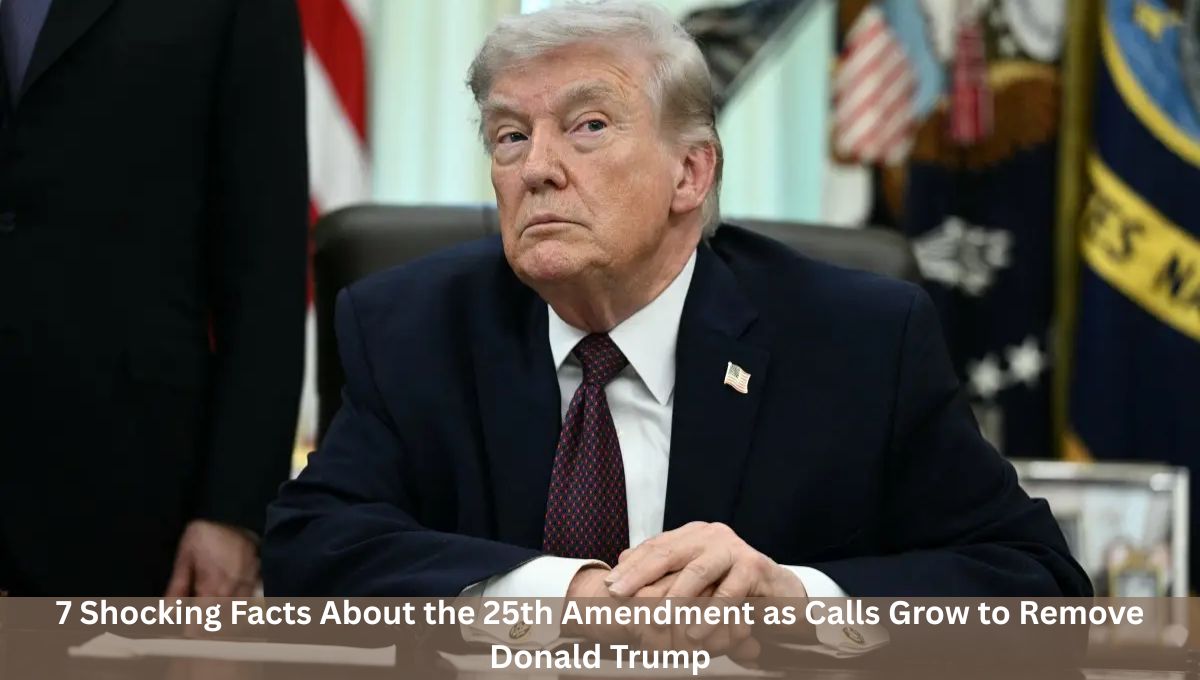
7 Shocking Facts About the 25th Amendment as Calls Grow to Remove Donald Trump amid the Iran conflict. As tensions escalate in the Middle East and rhetoric intensifies, calls are growing in Washington to invoke one of the most dramatic provisions in American constitutional law — Section 4 of the 25th Amendment.
Recent statements and threats made by Donald Trump regarding Iran have sparked widespread concern among lawmakers, analysts, and the public. Some critics are now openly questioning whether the amendment could be used to remove a sitting president against his will.
But how realistic is this scenario? Has it ever happened before? And what would it actually take to remove a U.S. president using this mechanism?
Here’s a comprehensive, fact-based breakdown.
7 Shocking Facts About the 25th Amendment as Calls Grow to Remove Donald Trump
What Is the 25th Amendment?
The 25th Amendment to the U.S. Constitution was ratified in 1967 in the aftermath of the assassination of John F. Kennedy.
Its primary purpose was to clarify presidential succession and establish procedures for handling situations where a president is unable to perform their duties.
The amendment contains four sections, each dealing with different scenarios:
Section 1
Covers succession — when the president dies, resigns, or is removed, the vice president becomes president.
Section 2
Allows the president to appoint a new vice president if the position becomes vacant (subject to Congressional approval).
Section 3
Permits the president to voluntarily transfer power temporarily, usually for medical reasons.
Section 4 (Most Controversial)
Enables the vice president and Cabinet to declare the president unfit — even against their will.
What Exactly Is Section 4?
Section 4 is the most powerful and controversial part of the amendment.
It allows the vice president and a majority of the Cabinet to formally declare that the president is:
“unable to discharge the powers and duties of his office.”
Once invoked:
- The vice president immediately becomes Acting President
- The president can contest the decision
- Congress must then vote within a set timeframe
The Critical Threshold
To keep the president sidelined:
- A two-thirds majority is required in both the House and Senate
This makes it an extremely high bar — both legally and politically.
Has Section 4 Ever Been Used?
No — Section 4 has never been invoked in U.S. history.
Despite multiple moments of political tension and presidential health concerns over decades, no administration has ever taken this step.
This is a crucial point:
while widely discussed, it remains entirely untested in practice.
When Has the 25th Amendment Been Used?
Although Section 4 has never been used, other parts of the amendment have been invoked.
Section 2 – Filling Vice Presidential Vacancies
- In 1973, Richard Nixon appointed Gerald Ford as vice president after Spiro Agnew resigned
- Later, Ford became president and appointed Nelson Rockefeller as VP
Section 3 – Temporary Transfer of Power
Used during medical procedures:
- George W. Bush (twice)
- Joe Biden (2021)
In these cases, power was temporarily transferred to the vice president and then returned.
Why Are Calls Growing Now?
The renewed focus on Section 4 comes amid rising global tensions, particularly involving Iran.
Recent statements by Donald Trump — including aggressive threats targeting infrastructure — have drawn criticism from lawmakers and political observers.
Key Concerns Raised
- Rapidly changing policy statements
- Escalatory rhetoric toward Iran and allies
- Concerns about decision-making stability during a crisis
Some lawmakers, including Chris Murphy, have publicly urged consideration of the amendment.
The Role of Prediction Markets
Interestingly, the debate has extended beyond politics into financial markets.
Platforms like Kalshi have seen increased trading activity on whether the 25th Amendment might be used.
What the Data Shows
- “Yes” probability rose from 15% to over 35%
- Millions of dollars in trading volume
- Reflects growing public speculation, not certainty
Prediction markets don’t determine outcomes — but they do indicate shifting sentiment.
Could Donald Trump Actually Be Removed?
In theory, yes. In practice, it is extremely unlikely.
Why It’s So Difficult
1. Cabinet Loyalty
The process requires a majority of the president’s own Cabinet — typically political allies.
2. Vice President’s Role
The vice president must lead the process, making it politically sensitive.
3. Congressional Supermajority
A two-thirds vote in both chambers is extraordinarily hard to achieve.
4. Legal and Political Fallout
Invoking Section 4 would trigger a constitutional crisis and intense political backlash.
25th Amendment vs Impeachment
Many people confuse the 25th Amendment with impeachment, but they are very different mechanisms.
Key Differences
| 25th Amendment | Impeachment |
| Based on incapacity | Based on misconduct |
| Initiated by VP & Cabinet | Initiated by Congress |
| Immediate transfer of power | Trial process required |
| Not punitive | Can lead to removal and disqualification |
Notably, Donald Trump has already been impeached twice — in 2019 and 2021 — but was acquitted both times.
Health Concerns and Public Speculation
Another factor driving the debate is speculation about the president’s health.
While the White House has dismissed rumors of serious medical issues, discussions have intensified due to:
- Viral videos (later debunked)
- Reports of physical symptoms
- Claims of cognitive slips
However, no official medical finding has declared the president unfit for office.
Why Section 4 Is So Controversial
Section 4 is rarely discussed in normal political discourse because of its implications.
Major Concerns
- Could be perceived as a political coup
- Risks undermining democratic legitimacy
- Sets a precedent for future administrations
This is why it has remained unused for nearly six decades.
Global Implications
The debate is not just domestic — it has global consequences.
With ongoing tensions in the Middle East:
- Leadership stability in the U.S. affects global markets
- Oil prices and security risks are directly impacted
- Allies and adversaries closely monitor U.S. decision-making
The situation underscores how internal constitutional mechanisms can have worldwide effects.
What Happens If Section 4 Is Invoked?
If it were ever triggered, the process would unfold rapidly:
- Vice President and Cabinet issue a declaration
- Vice President becomes Acting President
- President can challenge the decision
- Congress votes within days
- Two-thirds majority determines outcome
This would likely be one of the most dramatic constitutional moments in U.S. history.
Expert Perspective
Most constitutional experts agree:
- Section 4 is designed as a last resort
- It is intended for clear incapacity (e.g., coma, severe illness)
- Political disagreements alone are not sufficient grounds
This makes its use in a politically charged environment highly unlikely.
Conclusion
So, has Section 4 of the 25th Amendment ever been used?
No — it has never been invoked.
Despite growing calls amid the Iran crisis and rising political tensions, the threshold for using it remains extraordinarily high.
While speculation continues — fueled by political rhetoric, market trends, and global instability — the reality is that removing a sitting U.S. president through this mechanism would require unprecedented consensus at the highest levels of government.
For now, the 25th Amendment remains what it has always been:
a powerful but unused safeguard in the American constitutional system.
Also Read: Trump’s Iran Airstrikes Spark War Powers Fight as Lawmakers Push to Limit Military Action
Also Read: Trump faces 25th Amendment row: Insider calls for Section 4 over health and hospital updates