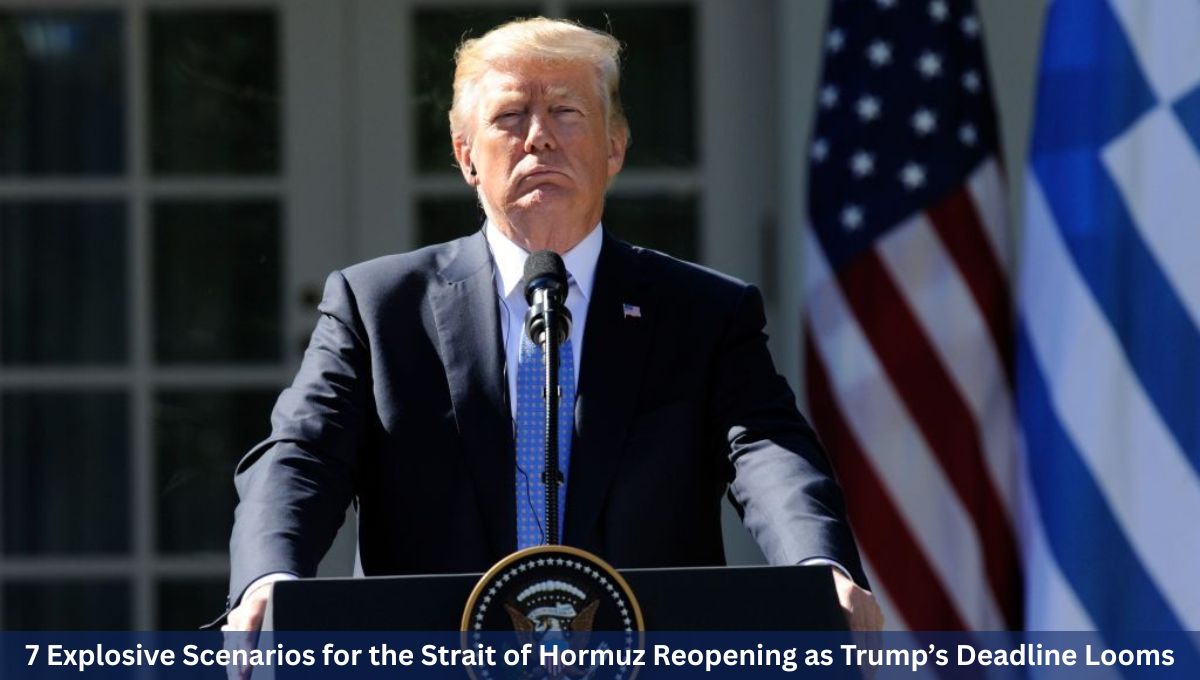
7 Explosive Scenarios for the Strait of Hormuz Reopening as Trump’s Deadline Looms while governments brace for escalation. The world stands at a critical geopolitical crossroads as the deadline set by U.S. President Donald Trump for reopening the Strait of Hormuz approaches. With tensions escalating between the United States and Iran, the situation has evolved into one of the most dangerous flashpoints in recent global history.
The Strait of Hormuz, a narrow yet strategically vital waterway connecting the Persian Gulf to the Gulf of Oman, carries nearly 20% of the world’s oil supply. Its disruption has already triggered a sharp rise in energy prices and heightened fears of a prolonged global economic crisis.
As diplomatic efforts falter and military threats intensify, the question dominating global discourse is simple yet consequential:
Will the Strait of Hormuz reopen peacefully, or is the world on the brink of a wider war?
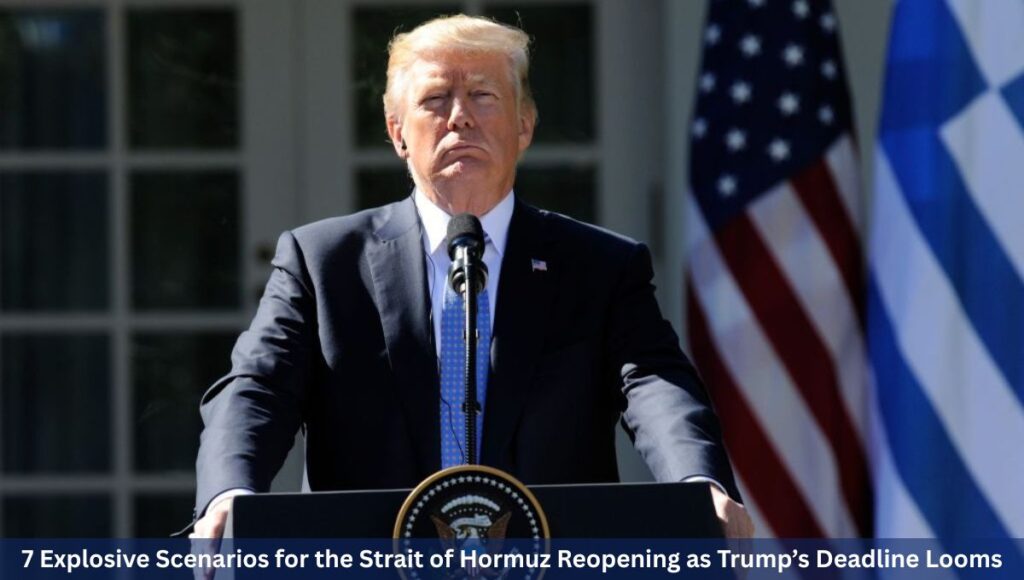
7 Explosive Scenarios for the Strait of Hormuz Reopening as Trump’s Deadline Looms
Why the Strait of Hormuz Matters to the World
The Strait of Hormuz is not just a regional chokepoint—it is a cornerstone of the global energy system.
Every day, millions of barrels of crude oil and petroleum products pass through this narrow passage.
Key Facts About the Strait:
- Handles roughly one-fifth of global oil trade
- Critical for energy supply to Asia, Europe, and beyond
- Essential for global shipping and logistics networks
Since the outbreak of the US-Iran conflict, traffic through the strait has plummeted. While some tankers have resumed limited transit, volumes remain far below pre-war levels.
This disruption has caused:
- Oil prices to surge above $110 per barrel
- Increased costs for fuel, transportation, and goods
- Rising inflation risks across major economies
The longer the strait remains partially closed, the deeper the global economic impact will become.
War Escalation as Deadline Approaches
The ongoing conflict between the United States and Iran has already resulted in widespread devastation across multiple regions, including Iran, Israel, and Lebanon.
Missile exchanges, airstrikes, and targeted attacks on infrastructure have intensified in recent weeks.
Civilian and military casualties continue to rise, while critical facilities such as power plants and oil installations have become primary targets.
Trump’s Escalating Warnings
President Trump has issued some of the strongest warnings yet, stating that the United States could “decimate” Iran’s infrastructure within hours if the Strait of Hormuz is not reopened.
Key elements of the threat include:
- Targeting bridges and power plants
- Destroying energy infrastructure
- Conducting rapid, large-scale military strikes
Trump has also dismissed concerns about potential war crimes, drawing criticism from international organizations.
Meanwhile, the United Nations has warned that attacks on civilian infrastructure would violate international law, adding another layer of complexity to the crisis.
Iran’s Position: Defiance and Strategic Leverage
Iran has remained defiant despite mounting pressure.
The country has rejected temporary ceasefire proposals and instead pushed for broader conditions, including:
- A permanent end to hostilities
- Removal of economic sanctions
- Reconstruction assistance
- Recognition of its regional influence
Tehran has also emphasized its strategic control over the Strait of Hormuz, signaling that it will not yield to external deadlines.
This stance reflects a broader strategy:
leveraging geography to maintain long-term influence over global energy flows.
Three Key Scenarios for Reopening the Strait of Hormuz
As the deadline nears, analysts broadly agree on three possible pathways through which the Strait of Hormuz could reopen.
1. Ceasefire Agreement Between the US and Iran
The most immediate and least destructive option is a negotiated ceasefire.
Under this scenario:
- Iran agrees to reopen the strait temporarily
- Diplomatic talks continue alongside reduced hostilities
- Shipping resumes under monitored conditions
However, this solution comes with significant caveats.
Potential Risks:
- Iran may impose informal restrictions or tolls
- Continued uncertainty for global markets
- Limited trust between negotiating parties
Even if a ceasefire is achieved, the strait may not return to full operational stability quickly.
2. US-Led Military Intervention
A more aggressive approach involves direct U.S. military action to reopen the waterway.
This could include:
- Naval mine-clearing operations
- Armed escorts for oil tankers
- Expanded strikes on Iranian strategic assets
The United States has already deployed substantial forces to the region, suggesting readiness for escalation.
Major Risks:
- Regional war involving multiple countries
- Significant military and civilian casualties
- Disruption of global trade beyond oil
While this option could reopen the strait quickly, it carries the highest geopolitical risk.
3. Multinational Effort Led by Global Powers
The third scenario involves a coordinated international response, potentially under a United Nations mandate.
This approach would:
- Establish a multinational naval coalition
- Secure shipping lanes collectively
- Reduce unilateral military escalation
Countries such as the UK, Australia, and Asian powers could participate in such an effort.
Challenges:
- Requires consensus among major powers
- Likely delayed until active conflict subsides
- Complex coordination and command structure
This scenario is often seen as a fallback option if bilateral efforts fail.
Oil Markets React: Prices Surge Amid Uncertainty
The crisis has already sent shockwaves through global energy markets.
Current Market Trends:
- Brent crude hovering above $110 per barrel
- WTI crude exceeding $114 per barrel
- Increased volatility in fuel and commodity markets
The partial closure of the strait has created a supply shock, with ripple effects across industries.
Broader Economic Impact:
- Rising transportation costs
- Increased food and goods prices
- Pressure on emerging economies
Investors remain uncertain, caught between hopes for a diplomatic breakthrough and fears of further escalation.
A Timeline of Escalation: From 48 Hours to 408
One of the most striking aspects of the crisis has been the shifting timeline of U.S. ultimatums.
Key Developments:
- Initial 48-hour deadline issued
- Multiple extensions granted amid negotiations
- Escalating rhetoric with each delay
- Final deadline set amid heightened threats
This evolving timeline reflects both diplomatic uncertainty and strategic signaling.
It has also contributed to skepticism among Iranian officials, who question whether negotiations can prevent military action.
Diplomatic Efforts: Still Alive but Fragile
Despite rising tensions, diplomatic channels remain open.
Mediators continue to engage both sides, attempting to bridge significant gaps in expectations.
Key Sticking Points:
- Temporary vs permanent ceasefire
- Sanctions relief
- Security guarantees
- Control over the Strait
Iran has proposed a comprehensive framework, while the United States has deemed it insufficient.
This deadlock underscores the complexity of reaching a mutually acceptable agreement.
Military Build-Up and Strategic Calculations
Both sides are positioning themselves for potential escalation.
United States:
- Significant troop presence in the region
- Advanced naval and air capabilities
- Preparedness for rapid strikes
Iran:
- Missile and drone capabilities
- Strategic geographic advantage
- Regional alliances and proxies
These dynamics create a volatile environment where miscalculation could trigger wider conflict.
The Global Stakes: Beyond Oil
While energy markets are at the center of the crisis, the implications extend far beyond oil.
Key Global Risks:
- Disruption of international trade routes
- Escalation into a broader Middle East war
- Strain on global alliances
- Humanitarian crises in affected regions
The Strait of Hormuz crisis is a stark reminder of how interconnected the world has become—and how vulnerable it remains to geopolitical shocks.
A New Reality for Global Energy Security
Even if the Strait of Hormuz reopens, experts warn that the pre-crisis status quo is unlikely to return.
Long-Term Implications:
- Increased focus on alternative energy routes
- Diversification of energy sources
- Greater investment in energy security
Countries may accelerate efforts to reduce dependence on chokepoints like Hormuz.
This could reshape global energy dynamics for years to come.
What Happens Next?
As the deadline approaches, several outcomes remain possible:
- A last-minute diplomatic breakthrough
- Another extension of the deadline
- Immediate military escalation
The situation remains fluid, with developments unfolding rapidly.
What is clear, however, is that the stakes could not be higher.
Conclusion: World on Edge as Crisis Deepens
The Strait of Hormuz crisis represents a decisive moment in global geopolitics.
With energy markets, military forces, and diplomatic channels all converging, the coming hours and days will be critical.
Whether through diplomacy, military action, or international cooperation, the reopening of the strait will shape the trajectory of the global economy and security landscape.
For now, the world watches—and waits.
Also Read: 12 Explosive Insights as Trump Signals Early End to Iran War Despite Strait of Hormuz Crisis
Also Read: As Deadline Looms, Iran Says It Has Shut All Channels Of Talks With US: Report
Related Posts:
- 7 Shocking Reasons FIFA’s Peace Prize for Trump…

- 9 Explosive Revelations as Trump Declares His Health…

- Strait of Hormuz Standoff: Iran Rejects Oman's…
- Trump to Host 2026 G20 Summit at His Florida Golf…

- 7 Explosive Moments in the Trump–Macron Davos Showdown

- 12 Explosive Claims as Donald Trump Says Iran War…