India Wins 7th Term Unopposed to UN Human Rights Council (2026–28) – reaffirms global human rights commitment. India has been elected unopposed to the United Nations Human Rights Council (UNHRC) for the 2026–2028 term, securing a seventh tenure on the world’s top human rights body.
The election, held by the UN General Assembly on Tuesday, saw India receive 177 votes out of 188 cast — a result hailed in New Delhi as proof of its “unwavering commitment to human rights and multilateralism.” India’s Permanent Representative to the UN, Ambassador Parvathaneni Harish, expressed gratitude to member states for their “overwhelming support.”
“India was elected to the Human Rights Council for the term 2026–28 at the United Nations for the seventh time today. This election reflects India’s unwavering commitment to human rights and fundamental freedoms. We look forward to serving this objective during our tenure,” Harish wrote on X (formerly Twitter).
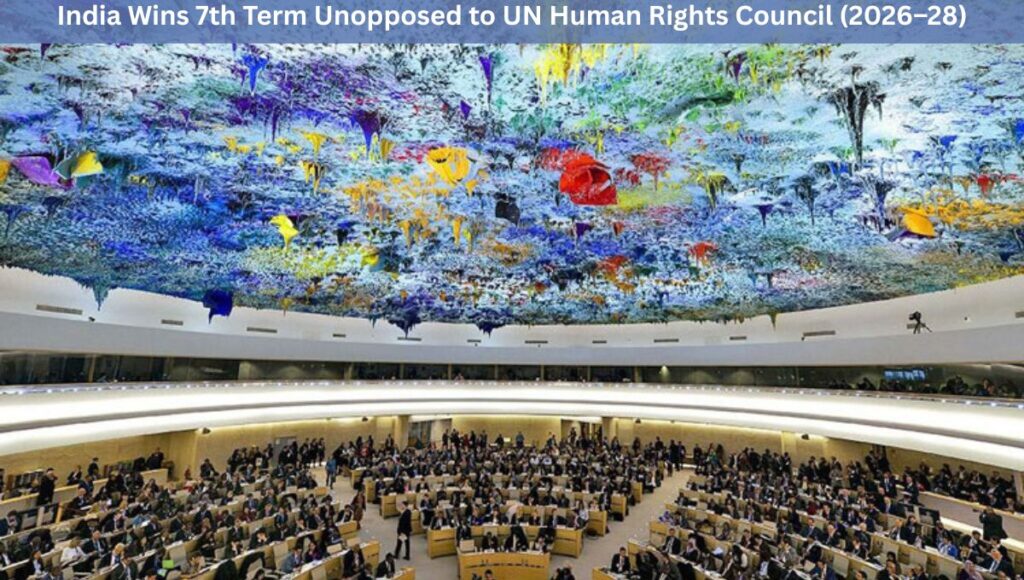
India Wins 7th Term Unopposed to UN Human Rights Council (2026–28)
India’s Steadfast Commitment to Global Human Rights
India’s latest election marks the seventh time it will serve on the 47-member Human Rights Council, headquartered in Geneva. Established in 2006, the Council is the UN’s principal intergovernmental body mandated to promote and protect human rights worldwide and to review the human rights situations in member countries.
Seats on the Council are allocated on a regional rotation basis. India was a candidate for one of the four Asia-Pacific seats available this year, joining Pakistan, Iraq, Egypt, the UK, Italy, and South Africa among others in the successful slate.
India’s term will begin on January 1, 2026, and run until December 31, 2028. It follows two consecutive terms that ended in 2024, after which India took a mandatory one-year break, as countries are not permitted to serve more than two consecutive terms.
“Vasudhaiva Kutumbakam” – A Guiding Philosophy
In its official candidature statement, India emphasized its enduring philosophy of “Vasudhaiva Kutumbakam” (The world is one family) — a theme central to its foreign policy and diplomacy.
“India’s candidature reflects its dedication to advancing the principles of human rights globally, fostering dialogue and bridging divides to achieve collective progress,” the statement said.
India pledged to act as a “bridge-builder” within the Council, advocating constructive engagement and mutual respect among nations at a time of rising global polarization.
“Our commitment to human rights is rooted in our Constitution, which guarantees fundamental rights to all citizens and promotes the ideals of justice, liberty, and equality,” the mission noted.
India’s Track Record and Leadership at the UNHRC
India’s election continues a long record of participation in the Human Rights Council since its creation in 2006. It previously served terms in 2006–07, 2008–10, 2012–14, 2015–17, 2019–21, and 2022–24, consistently contributing to debates on gender equality, sustainable development, and global digital governance.
Analysts say India’s consistent re-election reflects not only diplomatic outreach but also the trust of member states in India’s balanced approach to human rights issues.
As the world’s largest democracy, India has often positioned itself as a voice for the Global South, calling for human rights to be viewed holistically — encompassing not only civil and political rights but also economic, social, and cultural rights, including the right to development.
Global Endorsement and Diplomatic Support
India’s unopposed win highlights the broad consensus within the Asia-Pacific group on its role as a moderating and constructive voice in international human rights discourse.
Ambassador Harish described the support as “overwhelming,” while several diplomats from Africa and Latin America congratulated India publicly, citing its balanced multilateral engagement and principled diplomacy.
“India’s re-election underscores its credibility as a bridge-builder between the developing and developed world,” said a Geneva-based South American diplomat.
Observers note that India’s tenure at the Human Rights Council comes at a critical time when global divisions over rights, technology, and conflicts are intensifying.
Balancing Rights, Development, and Multilateralism
In a statement following the election, the Permanent Mission of India to the United Nations reaffirmed that India’s approach to global governance is guided by multilateralism and dialogue, emphasizing inclusive cooperation over confrontation.
“India remains steadfast in its efforts to work with all Member States in the spirit of multilateralism to achieve comprehensive and equitable solutions to global challenges,” the statement said.
These challenges, it added, include peacebuilding and peacekeeping, sustainable development, climate change, terrorism, disarmament, health crises, migration, cybersecurity, and frontier technologies — areas where India intends to advocate a rights-based approach.
Role in Global Peace and Human Rights
India’s election also signals continuity in its leadership on peacekeeping, humanitarian assistance, and digital inclusion — fields where the country has been among the top contributors globally.
As a founding member of the United Nations, India has consistently supported the principles of the UN Charter and has participated in shaping major human rights conventions and reforms.
Diplomats in New York say India’s renewed term will strengthen its voice in discussions on climate justice, women’s empowerment, and digital human rights, especially in the Global South.
“India brings to the Council a pluralistic and democratic ethos — one that prioritizes consensus-building and inclusivity,” said an official from the Indian mission.
Bridging Divides Amid Polarisation
The election comes amid growing polarization within the Human Rights Council, where debates over humanitarian interventions and geopolitical alignments have deepened.
India has pledged to bridge divides within the body by promoting constructive dialogue between North and South, and between developed and developing nations.
“At a time when ideological rifts and competing national interests often hinder collective action, India’s diplomatic balancing role becomes even more crucial,” said Dr. Ananya Dutta, a foreign policy scholar at Jawaharlal Nehru University.
India has also called for reforming global governance institutions to better reflect the realities of the 21st century, including representation for developing nations in decision-making forums.
Regional Context and Other Elected Members
Alongside India, 13 other countries were elected to the Human Rights Council on Tuesday, including Angola, Britain, Chile, Ecuador, Egypt, Estonia, Iraq, Italy, Mauritius, Pakistan, Slovenia, South Africa, and Viet Nam.
Under UN rules, each region is allocated a specific number of seats to ensure equitable geographical distribution. The Asia-Pacific region accounts for 17 of the Council’s 47 seats, with four up for election this year.
Looking Ahead: India’s Agenda for 2026–28
During its upcoming term, India is expected to prioritize:
- Strengthening global cooperation on human rights and sustainable development.
- Promoting dialogue-based conflict resolution and peacebuilding.
- Advocating reformed multilateralism that empowers developing nations.
- Addressing emerging concerns like cybersecurity, AI ethics, and digital rights.
India’s upcoming tenure, diplomats say, will build on its bridge-building diplomacy, reflecting the ethos of “One Earth, One Family, One Future” — the same guiding principle that shaped its G20 presidency.
At a Glance: India’s Human Rights Council Journey
- Elected Term: 2026–2028 (7th tenure)
- Votes Secured: 177 out of 188 cast
- Body: 47-member UN Human Rights Council, Geneva
- Previous Terms: 2006–07, 2008–10, 2012–14, 2015–17, 2019–21, 2022–24
- Guiding Principle: Vasudhaiva Kutumbakam – “The world is one family”
Key Focus: Dialogue, development, democracy, and global unity
Also Read: UN Security Council Blocks China-Russia Resolution as Tehran Faces Snapback Measures
Also Read: Pakistan elected to UN Human Rights Council for three-year term
Related Posts:
- US President Donald Trump Fuels Third-Term…

- 3 Explosive Claims: Steve Bannon Says Trump Will…

- 7 Powerful Reasons Russia Is Backing India’s BRICS…

- 7 Powerful Signals as India Joins G7 Critical…

- Trump Says JD Vance 'Most Likely' MAGA Heir; Rubio…

- 5 Key Signals from PM Modi’s Virtual ASEAN Summit Appearance