In a bid to avoid new tariffs India Pushes to Finalize US Trade Deal Before Tariff Deadline. India is moving swiftly to finalize a bilateral trade agreement with the United States in a bid to avoid looming tariffs set to take effect on August 1, 2025. According to Chief Negotiator Rajesh Agrawal, both countries are working towards an interim trade deal, which could evolve into a broader bilateral trade agreement (BTA) covering complex sectors such as services, customs, and process facilitation.
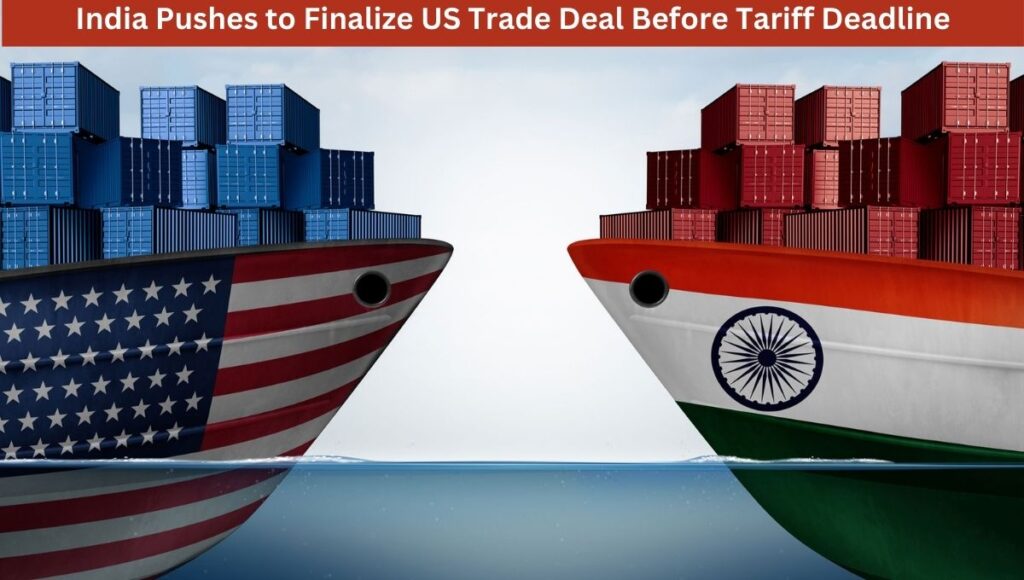
India Pushes to Finalize US Trade Deal Before Tariff Deadline
Interim Agreement Expected by Autumn
Rajesh Agrawal, Special Secretary in the Department of Commerce, confirmed that India aims to conclude an interim trade deal with the US before autumn.
Negotiations for the first phase are already underway and expected to wrap up by September or October 2025.
“We are integrating with major markets,” said Agrawal, noting that India has already signed over 14 Free Trade Agreements (FTAs) with 26 countries.
“We’re also in advanced stages of negotiations with the UK and EU, and are actively pursuing talks with the US, Chile, Peru, and New Zealand.”
Focus on Logistics to Boost Trade
Agrawal emphasized that logistics and tariff predictability are crucial for fostering long-term investment and trade. “Our tariffs will be bilaterally cut, and that will help businesses make long-term decisions,” he said.
India is currently working to reduce logistics costs to boost its global trade share from 2% to a target of 10%.
“We need better control over the logistics ecosystem, including shipping and air cargo,” Agrawal warned. Citing foreign dominance in these sectors, he noted that India loses about $50 billion in the services trade deficit due to maritime logistics alone.
Global Value Chain Integration
While 70% of global trade is driven by Global Value Chains (GVCs), Agrawal acknowledged that India still lags behind major economies in GVC integration.
He stressed the need for strong customs and trade facilitation commitments in any FTA, adding that seamless logistics is key to participating more meaningfully in global trade.
US and India Ready Phase Two of Talks
Indian negotiators, led by Agrawal, are set to return to Washington next week to begin phase two of trade discussions. These talks will address complex areas such as rules of origin, technical trade barriers, and services.
Phase one, focused on goods, has already concluded, but the outcome still awaits President Trump’s final approval.
“Now the ball is in his court,” a source familiar with the negotiations said. The US is pushing for full market access for its farm produce and automobiles a sticking point for India, which is seeking reciprocity and protection for its sensitive agricultural sectors.
Trump Postpones Tariffs Until August 1
Initially scheduled for July 9, the Trump administration has postponed the imposition of country-specific tariffs to August 1.
This delay gives India crucial time to finalize the agreement. Trump has expressed optimism, saying, “We are close to making a deal with India.”
India’s exemption from the latest round of tariff letters, which were sent to countries including Brazil, Iraq, and South Korea, reflects its strategic importance.
However, Trump has warned that the tariff relief will not be extended beyond August 1.
New Tariff Threat Linked to BRICS
Adding complexity, Trump introduced a separate 10% tariff threat against India based on its membership in BRICS.
“They [India] will certainly have to pay 10% if they are in BRICS because BRICS was set up to hurt us,” Trump claimed.
This statement has raised concerns in New Delhi, as BRICS which includes Brazil, Russia, India, China, and South Africa is increasingly seen by Washington as a geopolitical rival.
WTO Dispute and Retaliation Measures
India has escalated the issue to the World Trade Organization (WTO), contesting recent US safeguard duties of up to 50% on steel and aluminum. In response, India has proposed its own retaliatory tariffs on US goods.
“These safeguard duties are excessive and unilateral,” said a senior official in India’s trade ministry. India initially proposed 25% retaliatory tariffs in March but revised them upwards after the US expanded its own tariff regime in June.
Early Harvest Deal Still in Limbo
Despite four rounds of in-person meetings, an early harvest deal covering goods remains unsigned. Sources say political hesitancy in Washington especially over agriculture access is holding up progress.
“The US wants unfettered access for its farm and auto products, which India is not ready to concede without reciprocal benefits,” one negotiator said.
Services, IT, and Pharma in Spotlight
India is also advocating for greater access to the US market for its IT services, pharmaceuticals, and auto parts industries.
These sectors have been vital to India’s exports and are expected to benefit significantly from a successful agreement.
The US remains one of India’s largest trading partners, and any disruptions due to tariffs could impact sectors that are highly dependent on the American market.
Countdown to Deadline
With just weeks left until the August 1 deadline, both sides are intensifying efforts to reach a mutually beneficial trade agreement.
The Indian government, keen to shield its exporters from Trump’s looming tariffs, is reportedly pulling out all the stops to ensure the interim deal is finalized in time.
Experts: Final Push Needed
Trade analysts believe this window is India’s best shot at securing a stable and long-term trade framework with the US.
“The momentum is there, but now it needs political will,” said trade expert Dr. Arvind Sahai. “If India can avoid the August 1 tariffs and get a balanced deal, it could open the floodgates for long-term growth in bilateral trade.”
Looking Ahead: Mission $500 Billion
Both Prime Minister Narendra Modi and President Donald Trump have committed to “Mission 500″an ambitious plan to grow India-US bilateral trade to $500 billion by 2030.
Finalizing this trade agreement is a crucial milestone on that path. While significant hurdles remain, particularly in sensitive sectors like agriculture and dairy, the ongoing talks reflect a broader strategic alignment between the two nations.
Conclusion:
India and the US are at a critical juncture in trade negotiations, with August 1 looming as a hard deadline. While technical discussions show progress, political decisions will ultimately determine whether the interim deal can avert tariffs and pave the way for deeper economic ties. With logistics, global value chain participation, and trade facilitation on the agenda, the stakes are higher than ever for both nations.
Also Read: Trump Warns 10% Tariff on Countries Backing BRICS ‘Anti-American Policies’
Also Read: Explained: Why India is looking to finalise a US trade deal before Trump’s August tariff deadline
Related Posts:
- 7 Critical Reasons India Is Pushing a High-Stakes…

- India-EFTA Free Trade Agreement Comes Into Force:…

- Trump Confirms Rare Earths Deal with China, Signals…
- Trump says India Working Toward Trade Deal Similar…
- 11 Explosive Revelations From Ted Cruz’s Leaked…

- 10 Powerful Reasons the US ‘Unfair Trade’ Probe on…