On Friday Trump Visits Flood-Hit Texas, Commends Rescue Efforts Amid Controversy Over Warning Delays. President Donald Trump traveled to Kerrville, Texas on Friday, visiting areas severely damaged by last week’s catastrophic flash flooding. The disaster, which took over 120 lives and left 160 people missing, has left a deep mark on the region, especially in Kerr County, which bore the brunt of the tragedy.
While Trump assured residents of federal support and praised rescue efforts, the visit was marked by a sharp confrontation with the media over questions about flood warning delays—a clash that has further politicized the national conversation around disaster response.
Trump Visits Flood-Hit Texas, Commends Rescue Efforts Amid Controversy Over Warning Delays
“We Will Rebuild”: Trump and Melania Tour Flood Zones
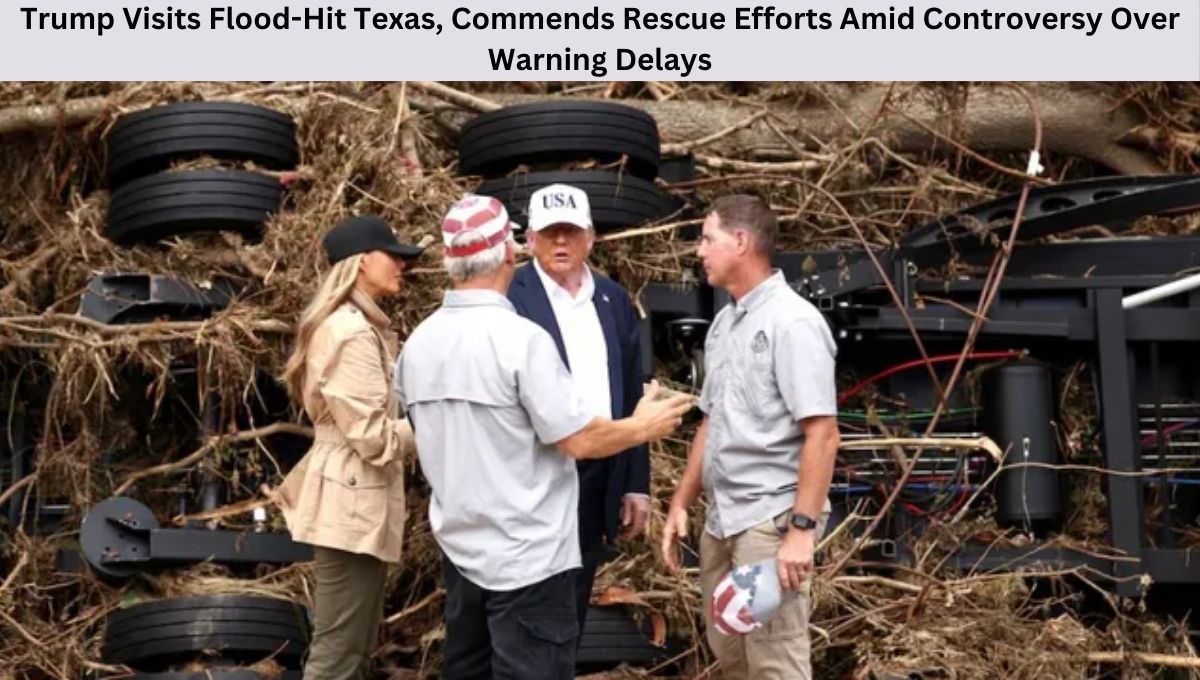
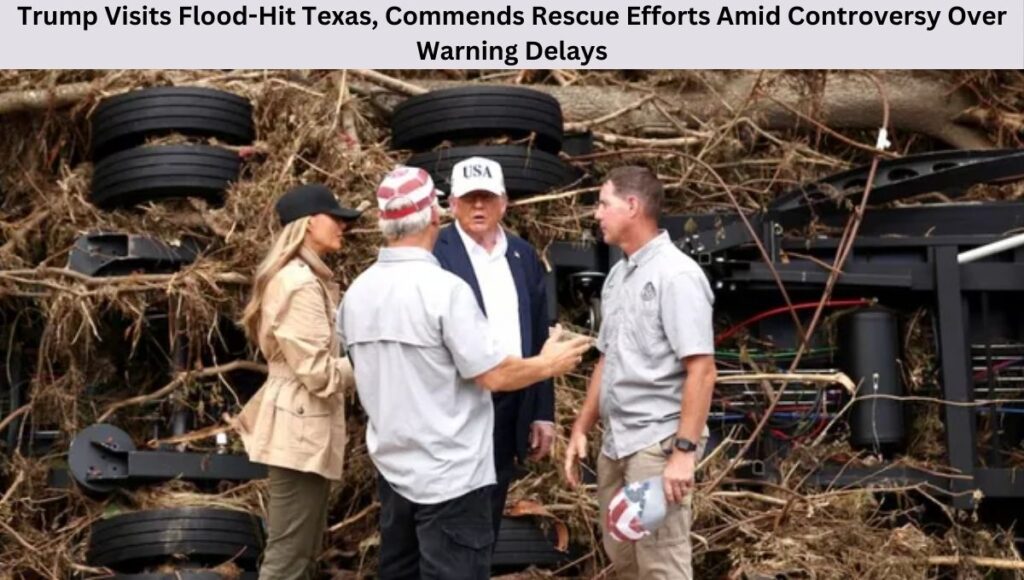
Accompanied by First Lady Melania Trump, President Trump toured the damage both from the air and on foot.
At one point, the couple stood in front of an overturned tractor-trailer, surrounded by toppled trees and muddy debris remnants of the Guadalupe River’s violent rise that inundated homes, roads, and camps.
“I’ve never seen anything like it,” Trump said. “It’s a horrible thing, nobody can even believe it that much water, that fast.”
The First Lady, who typically keeps a low profile, took part in intimate meetings with victims’ families.
“My deepest sympathy to all of the parents who lost beautiful young souls,” she said, after hugging grieving families and praying with them. She also promised to return to the area to continue offering support.
Melania Trump Honors Camp Mystic Victims with Tribute Bracelet
During the visit, Melania Trump was presented with a bracelet honoring the victims of Camp Mystic, a conservative Christian girls’ camp along the Guadalupe River that lost 27 young campers and counselors in the flood.
“They were there because they loved God,” President Trump said during a press briefing. “We take comfort in the knowledge that God has welcomed those little beautiful girls into His arms.”
Melania’s heartfelt tribute was somewhat overshadowed by social media chatter over her choice of a black baseball cap, but locals appreciated her presence and message of compassion.
Search Continues: 12,300 Volunteers Join Efforts
The floodwaters caught the community by surprise. In just 45 minutes, the Guadalupe River rose by over 26 feet, overwhelming cabins, camps, and homes.
The timing pre-dawn and a lack of sufficient alerts left residents with little time to react.
More than 12,300 volunteers have joined search crews, combing debris for signs of the 160 people still missing.
Many volunteers have been working 10-hour shifts daily since the flood hit, determined not to stop until every individual is accounted for.
Praise for First Responders and Local Officials
At a roundtable meeting held at a Kerrville youth center, Trump expressed deep admiration for first responders, calling them “unbelievable” and “the best people” doing an “incredible job under the circumstances.”
“The search for the missing continues,” he said. “The people that are doing it are unbelievable. You couldn’t get better people, and they’re doing the job like I don’t think anybody else could, frankly.”
Trump also praised Governor Greg Abbott, Texas Lt. Governor Dan Patrick, and local emergency services, reinforcing his administration’s support.
Heated Moment: Trump Calls Reporter “Very Evil”
Despite the solemn tone of the visit, a sharp moment of controversy erupted when a reporter asked if delays in issuing flood warnings may have contributed to the high death toll.
Trump bristled at the question, responding, “Only a bad person would ask a question like that,” and doubling down with: “Only a very evil person would ask a question like that.”
He then pivoted to a reporter from conservative media outlet Real America’s Voice, who thanked him for his visit. “Now, that’s a nice reporter,” Trump said, with a smile avoiding further discussion of the issue.
Criticism Over Disaster Preparedness and Warning Systems
As grief mounts in Texas, questions are also growing louder. Critics argue that Kerr County lacked warning sirens and that the flood alerts were not adequately communicated especially in areas with patchy cell service.
Some experts say that, while the National Weather Service (NWS) alerts were timely, the speed and severity of the flood, paired with underfunded local infrastructure, led to the deadly outcome.
Adding to the controversy, Democrats have cited Trump-era budget cuts to agencies like NOAA and the NWS as a potential factor in weakening the country’s disaster readiness.
White House Denies Cuts Played a Role
The White House was quick to push back against this narrative. Press Secretary Karoline Leavitt called such claims “depraved and despicable,” insisting that early and consistent warnings were issued by the NWS.
Trump himself dismissed the notion that more could have been done, telling NBC, “After seeing this horrible event, I would imagine you’d put alarms up in some form,” but adding no further comment on federal agency cuts.
Disaster Declaration and Emergency Aid
President Trump signed a disaster declaration on Sunday, allowing federal funds and FEMA support to be deployed to affected areas.
Homeland Security Secretary Kristi Noem confirmed that U.S. Coast Guard assets have joined the rescue mission.
Governor Abbott has also called a special legislative session, with a focus on improving flood alert systems and allocating state funds for warning sirens in underserved rural communities.
Senator Ted Cruz stated that Trump promised him Texas would get “anything it needs” from the federal government.
A Pattern of Politicized Disaster Response?
Observers have noted that Trump’s praise for Republican-led Texas stands in contrast to how he responded to past disasters in Democratic-led states like California.
After wildfires devastated Los Angeles earlier this year, Trump blamed Governor Gavin Newsom and Mayor Karen Bass for “gross incompetence.” Federal aid was delayed, and Trump accused the state of mismanaging water resources.
Political scientist Claire Rubin called the Texas vs. California comparison “the most glaring example of how disaster events are politicized.”
Despite the White House’s defense, the contrast in tone and response fuels perceptions of favoritism along party lines.
The Bigger Picture: Politics, Trust, and Resilience
In the aftermath of natural disasters, building public trust is key to recovery. Experts like Daniel Aldrich, a disaster researcher at Northeastern University, warn that politicized rhetoric damages that trust.
“Trust is the engine of mitigation and the engine of recovery,” Aldrich said. “When political leaders undermine trust whether in science, the media, or each other it weakens the nation’s resilience.”
Trump’s controversial clash with the press and his dismissal of legitimate questions about preparedness could, critics argue, harm future public cooperation during crises.
Conclusion: Tragedy, Unity, and Lingering Questions
President Trump’s visit to flood-ravaged central Texas was meant to offer solace, federal backing, and leadership in a time of heartbreak. In many ways, it succeeded thanks to heartfelt tributes, visible aid deployment, and national attention.
But the visit also reignited long-standing concerns over preparedness, fairness, and the politicization of disaster response. As the death toll continues to rise and families cling to hope for their missing loved ones, the focus is split between recovery efforts and a broader debate over what could and should have been done differently. As the floodwaters recede, the questions remain.
Also Read: Why Weren’t Texas Camps Evacuated? Camp Mystic Flood Tragedy Sparks Outrage
Also Read: Trump looks to quash criticism on natural disaster response during Texas visit
Related Posts:
- Texas Flash Floods Kill 24; 23 Girls Missing from…
- Camp Mystic TikTok Turns Tragic: Texas Flash Flood…

- Why Weren’t Texas Camps Evacuated? Camp Mystic Flood…
- Camp Mystic Tragedy: Who Are the Missing Girls After…
- Flash Floods Slam New Jersey: Roads Submerged,…

- Trump Threatens Military Action in Nigeria Over…