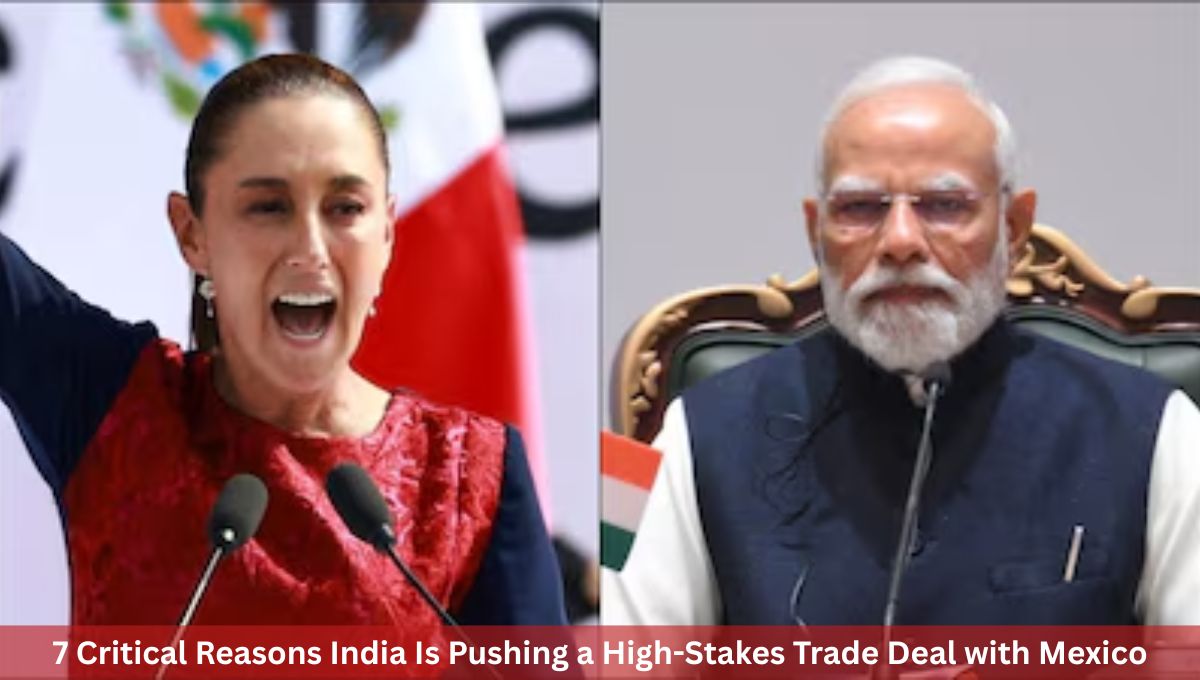
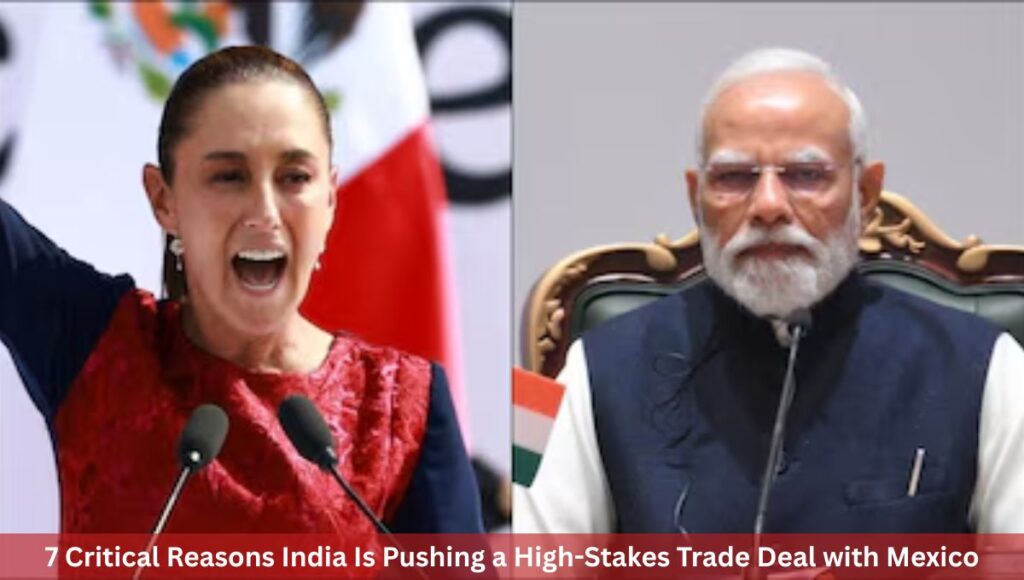
7 Critical Reasons India Is Pushing a High-Stakes Trade Deal with Mexico amid no FTA. India has proposed a Preferential Trade Agreement (PTA) with Mexico in a bid to mitigate the impact of steep import tariffs that are set to affect nearly $2 billion worth of Indian exports, Commerce Secretary Rajesh Agrawal said on Monday.
The proposal comes after Mexico’s Parliament approved tariff increases of up to 50% on imports from countries with which it does not have a free trade agreement, including India. The new duties, expected to come into force from January 1, 2026, will apply to more than 1,455 tariff lines, covering a wide range of industrial and consumer goods.
Indian officials say technical discussions are already underway, and that a PTA represents the fastest diplomatic and economic route to limit damage to Indian exporters, particularly in sectors such as automobiles, auto components, textiles, steel, plastics, leather, and footwear.
7 Critical Reasons India Is Pushing a High-Stakes Trade Deal with Mexico
Why India Is Pushing for a Preferential Trade Agreement
India’s choice to pursue a Preferential Trade Agreement rather than a full Free Trade Agreement (FTA) is a strategic one.
According to Commerce Secretary Rajesh Agrawal, an FTA would take years to negotiate and implement, while a PTA allows both sides to reduce or eliminate tariffs on a limited set of products, offering quicker relief to vulnerable supply chains.
“The only fast way forward is to try and get into a PTA because a Free Trade Agreement will take a lot of time,” Agrawal said. “Technical teams are already discussing what could be a good way forward.”
Unlike FTAs, which cover most goods and services with limited exclusions, PTAs are narrower, focusing on specific sectors where trade disruption would be most severe.
What Mexico’s New Tariffs Mean for India
Mexico’s decision to hike import tariffs affects countries that trade with it under Most Favoured Nation (MFN) terms and do not have FTAs. India falls squarely into this category.
The new tariffs range from 5% to as high as 50%, and will hit products across 1,455–1,463 tariff lines, depending on classification.
Preliminary estimates by India’s Commerce Ministry suggest:
- $2 billion worth of Indian exports could be affected
- Automobiles and auto components account for the largest share
- Textiles, iron and steel, plastics, leather, and footwear are also exposed
India exported $5.73 billion worth of goods to Mexico in 2024, while imports stood at $3.01 billion, resulting in a trade surplus of $2.72 billion.
Automobiles at the Center of the Dispute
The automobile sector is particularly vulnerable.
Mexico is India’s third-largest automobile export market, with close to $1 billion in annual vehicle shipments. Major exporters include global manufacturers with Indian supply chains such as Volkswagen and Hyundai.
Industry bodies have warned that steep tariffs could:
- Erode price competitiveness
- Disrupt supply chains built over years
- Force manufacturers to absorb costs or pass them on to consumers
The Society of Indian Automobile Manufacturers (SIAM) has urged the government to engage Mexico diplomatically, stressing that many vehicles exported from India are designed specifically for the Mexican domestic market, not for re-export to the United States.
Why Mexico Is Raising Tariffs
Mexico argues that the tariff hikes are intended to:
- Protect domestic manufacturing
- Safeguard employment
- Correct persistent trade imbalances
Officials have also clarified to Indian diplomats that the move is not targeted at India specifically.
“Mexico’s primary target is not to hit Indian exports,” Agrawal said, adding that discussions with Mexico have been ongoing since September.
From Mexico’s perspective, the tariffs apply uniformly to all non-FTA partners and are consistent with its rights under the World Trade Organization (WTO) framework.
No WTO Recourse for India
Because the tariffs are imposed on an MFN basis and fall within Mexico’s bound tariff rates, India does not have a viable path to challenge the move at the WTO.
“When MFN tariffs are increased, it impacts non-Free Trade Agreement partners. As this is WTO-compliant, we don’t see a recourse in the WTO,” Agrawal said.
This legal reality significantly narrows India’s options, making bilateral engagement the only realistic way forward.
The US Factor and the USMCA Review
A major driver behind Mexico’s move is its trade relationship with the United States. Mexico is part of the United States–Mexico–Canada Agreement (USMCA), which replaced NAFTA in 2020.
The agreement preserved free trade within North America but introduced:
- Stricter rules of origin
- Tighter enforcement mechanisms
- Higher local content requirements
The USMCA is scheduled for a review in 2026, increasing pressure on Mexico to demonstrate that it is a genuine manufacturing hub rather than a trans-shipment point for goods produced elsewhere.
Nearshoring and Mexico’s Manufacturing Strategy
Over the past three decades, Mexico has positioned itself as a nearshoring destination, offering manufacturers:
- Lower costs than the United States
- Proximity to the US consumer market
- Integrated North American supply chains
By 2023, this strategy had paid off, with Mexico becoming the United States’ largest goods trading partner.
However, stricter USMCA enforcement means that:
- “Made in Mexico” must involve real value addition
- Assembly of imported Asian components is no longer sufficient
- Vehicles and EVs must meet higher North American content thresholds
The tariff hikes on non-FTA partners help Mexico reinforce this model without singling out any one country.
Is China the Real Target?
Indian officials have repeatedly indicated that China, not India, is the primary target of Mexico’s tariff move. “From what we have heard, the measure is mainly aimed at reducing imports from China,” Agrawal said.
By applying tariffs broadly to all non-FTA partners, Mexico avoids accusations of discrimination while tightening controls on imports that could undermine its manufacturing base.
Financial Incentives Behind the Tariffs
Beyond trade compliance, the tariffs offer Mexico a significant fiscal upside.
Analysts estimate the new duties could generate around $3.7 billion in additional revenue in 2026, at a time when:
- Public spending pressures are rising
- Budget constraints are tightening
- Industrial policy is becoming more interventionist
This revenue potential explains why Mexico has pushed ahead despite opposition from business groups.
Impact on Indian Industry
Industry bodies in India have expressed serious concern.
The Federation of Indian Export Organisations (FIEO) warned that:
- Steep duties could erode competitiveness
- Supply chains could be disrupted
- Long-term trade relationships may suffer
The Automotive Component Manufacturers Association (ACMA) said domestic component makers would face higher costs and reduced margins if tariffs are imposed as planned.
What a Preferential Trade Agreement Could Do
A PTA between India and Mexico could:
- Reduce or eliminate tariffs on select products
- Protect critical supply chains
- Restore predictability for exporters
- Offer Mexico reciprocal access to Indian markets
“We can do a PTA and try to get concessions that are required for Indian supply chains, and similarly offer them concessions where they have export interests in India,” Agrawal said.
Such agreements are WTO-compatible and commonly used when full FTAs are not feasible in the short term.
Timeline and Political Process in Mexico
Mexico’s tariff proposal:
- Was re-submitted to Parliament on December 3
- Cleared both houses on December 9–10
- Now awaits Presidential gazette notification
Once notified, the tariffs will take effect from January 1, 2026, giving negotiators limited time to reach an interim arrangement.
India’s Broader Trade Strategy
The Mexico talks come as India ramps up trade engagement globally.
According to Agrawal:
- India is close to finalising a framework trade deal with the United States
- Talks with Canada on a Comprehensive Economic Partnership Agreement are set to resume
- Negotiations with the EU, Chile, and the Russia-led EAEU are ongoing
“In two years, countries have moved on, the world has moved on. A lot of other challenges in trade are coming up,” Agrawal said.
Why This Matters for India
Mexico is not just another export destination. It is:
- A gateway to Latin America
- A critical auto export market
- A strategic manufacturing partner
Without a trade agreement, Indian exporters face structural disadvantages that could worsen over time.
What Happens If Talks Fail
If a PTA is not reached:
- Exporters may have to absorb higher costs
- Prices may rise, hurting competitiveness
- Firms may look to diversify into other markets
For some sectors, especially automobiles, the impact could be long-lasting.
Conclusion: A Test of Trade Diplomacy
India’s push for a Preferential Trade Agreement with Mexico reflects the realities of modern trade diplomacy — where speed, pragmatism, and strategic alignment matter as much as ambition.
Mexico is not closing its doors to Indian goods. It is tightening the rules of engagement as it prepares for a critical review of its North American trade framework.
Whether India can secure a place within that evolving system will determine how disruptive the new tariffs ultimately become. For now, negotiations continue — and the stakes for Indian exporters could not be higher.
Also Read: 7 Alarming Signals: Trump Threatens Strikes on Mexico to ‘Stop Drugs’
Also Read: Why Mexico’s 50% tariffs on Indian goods matter: Is India considering ‘appropriate measures’?
Related Posts:
- India Pushes to Finalize US Trade Deal Before Tariff…
- 7 Powerful Reasons Mexico’s Shock Tariffs Hit India…

- India-EFTA Free Trade Agreement Comes Into Force:…

- 7 Alarming Reasons Mexico’s Shock Tariffs Hammer…

- Trump Confirms Rare Earths Deal with China, Signals…
- Trump says India Working Toward Trade Deal Similar…