Food seekers face Horror at Gaza Aid Centers: Israeli Troops Kill 32 Palestinians Seeking Food. Southern Gaza once again witnessed tragedy as Israeli troops opened fire on Palestinians seeking food, killing at least 32 civilians, according to Gaza’s Hamas-run health ministry, eyewitnesses, and hospital officials.
The violence erupted near aid distribution centers run by the Gaza Humanitarian Foundation (GHF), a controversial US- and Israeli-backed group operating in the region since May 2024. This incident is the latest in a series of deadly events where Palestinians searching for food have ended up targets of lethal force, as desperation mounts amid widespread starvation and a collapsing humanitarian infrastructure.
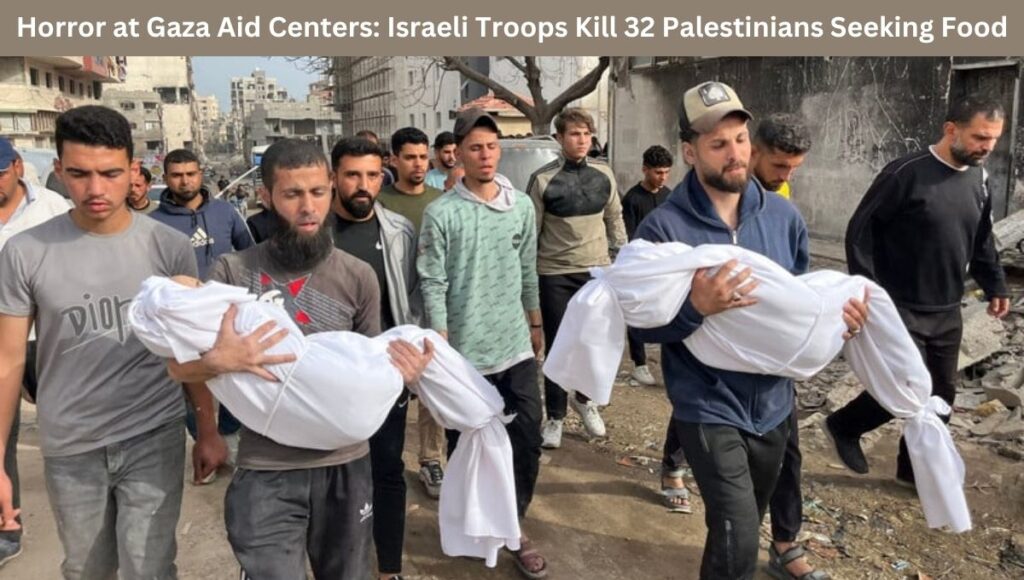
Horror at Gaza Aid Centers: Israeli Troops Kill 32 Palestinians Seeking Food
Where It Happened: Rafah and Khan Younis Turn Into Killing Grounds
The shootings occurred early Saturday in two key areas in southern Gaza near Teina, east of Khan Younis, and Shakoush, just north of Rafah.
Health officials at Nasser Hospital in Khan Younis confirmed receiving 25 bodies, while another seven civilians, including a woman, were reported killed in Rafah.
Dozens more were injured, many with severe gunshot wounds to the head and chest, according to doctors on site.
Eyewitnesses say the violence began even before the aid sites officially opened, as Israeli tanks and troops positioned nearby opened fire on approaching groups.
Some described indiscriminate shooting, while others reported being fired upon by drones and machine guns mounted on armored vehicles.
“They encircled us and started firing directly at us,” said Akram Aker, a survivor. “I saw many people lying on the ground, bleeding.”
Gaza Humanitarian Foundation Under Fire
Launched in May 2024 with the support of the United States and Israel, the Gaza Humanitarian Foundation was created to replace the traditional UN-led aid system, which Israel accuses of being infiltrated by Hamas.
The UN has strongly denied this accusation and refused to cooperate with GHF, calling the system unethical and dangerous.
While GHF claims to have delivered millions of meals, the numbers of people reportedly killed while trying to access aid continue to rise.
According to the UN Human Rights Office, at least 674 Palestinians have been killed near the GHF’s four distribution sites between late May and early July.
Despite these statistics, the GHF has denied any fatal incidents occurring “at or near” its hubs, attributing the violence to crowd panic or blaming Hamas agitators for inciting chaos though no evidence has been provided to support such claims.
Israel’s Defense: “Warning Shots” or Targeted Attacks?
The Israel Defense Forces (IDF) stated that troops only fired warning shots to deter individuals approaching military positions in Rafah, about a kilometer from the nearest aid site.
The army maintains that the shooting occurred “during operational activity” and before aid centers opened.
However, Palestinian survivors challenge this narrative.
“It wasn’t shots to scare us, it was shots to kill,” said Mohammed Al-Khalidi to Reuters. “If they wanted to organize us, they could have. But they meant to kill us.”
Another survivor, Sanaa al-Jaberi, said, “Is this food or death? Why? They don’t talk with us. They only shoot us.”
The Human Cost: Hospitals Overwhelmed, Children Starving
Doctors at Nasser Hospital report a massive influx of patients many with gunshot wounds to the head and torso.
Dr. Mohamed Saker, head of nursing, said resources were so limited that patients were treated on the floor, and children were seen holding blood bags for their wounded relatives.
Dr. Travis Melin, a foreign volunteer at the hospital, described the situation bluntly:
“Food here is a luxury of the privileged. If you’re lucky enough to have some money left, you can buy food. Everyone else goes to these massacre sites even though they know the risk.”
The humanitarian crisis in Gaza continues to worsen. According to the UN, the number of acutely malnourished children has doubled since Israel began restricting food imports in March.
69 children have died from hunger-related causes, according to the Hamas government media office.
A Broken System: GHF Distribution Called a “Death Trap”
UN officials and aid organizations are calling the GHF distribution system a “death trap.” The GHF uses private contractors to distribute food from centers located in Israeli military zones.
With no direct Israeli troop presence at the sites, security is provided remotely a system that appears to contribute to the chaos and miscommunication.
“The current aid distribution system in Gaza is a death trap for starving Palestinians,” said a spokesperson for UNRWA, the UN agency for Palestinian refugees.
Many Gazans begin walking to aid sites hours before they open, often in the dark, just to have a chance at receiving basic food rations. Transportation is nonexistent, and food is dangerously scarce.
UN vs. GHF: Conflicting Numbers, Conflicting Narratives
While GHF denies responsibility, insisting fatalities happen away from their centers and that their operations are safe, the UN’s Human Rights Office disputes this.
Their tally shows over 600 fatalities near GHF hubs, and another 201 along UN and NGO aid routes in the same timeframe.
GHF has accused the UN of relying on “false and misleading” data from Gaza’s Hamas-run health ministry.
But most international aid agencies and hospitals treating the victims recognize these figures as credible, as they are based on confirmed bodies and injuries processed by medical centers.
Ceasefire Talks Falter Again Amid Rising Deaths
While US President Donald Trump said Friday that a ceasefire deal was “very near”, both sides remain deeply divided.
Trump lauded US envoy Steve Witkoff for his negotiation efforts and expressed hope that ten more hostages could be released soon.
However, Hamas officials rejected Israel’s latest troop withdrawal map, saying it does not meet conditions for a sustainable truce.
They warn that no future pauses or hostage releases will be guaranteed unless Israel agrees to work toward a full end to the war.
“Netanyahu’s government is not genuinely concerned about the captives,” said Hamas spokesperson Abu Obaida. “They are soldiers dispensable to their leadership.”
Conclusion: “Is This Food or Death?”
The question posed by Sanaa al-Jaberi “Is this food or death?” now echoes across Gaza. What began as an attempt to solve the humanitarian crisis through alternative aid channels has instead led to hundreds of deaths, worsening despair, and shattered hope for relief.
With the Gaza Humanitarian Foundation’s role under intense scrutiny, and Israel and Hamas failing to reach a ceasefire, the people of Gaza remain trapped between starvation and violence.
Until there’s accountability, transparency, and a revival of international humanitarian norms, the suffering will persist and so will the tragic headlines.
Related Posts:
- 25 Killed as Israeli Forces Open Fire on Starving…
- Chaos at Gaza Aid Centers: 31 Killed as Hunger and…
- Israeli Military Denies Orders to Fire on Gaza Aid…
- 7 Heartbreaking Facts About Venezuela's Earthquake Disaster
- Gaza Aid Sites Turn Deadly: Over 70 Killed, UN Warns…
- Chaos Erupts at US-Backed Aid Center in Gaza as…