

Desperation Turns Deadly as Chaos Erupts at US-Backed Aid Center in Gaza as Starving Civilians Risk Everything for Food. In one of the most harrowing scenes yet of Gaza’s deepening humanitarian crisis, thousands of desperate Palestinians overran a US- and Israeli-backed aid center in Rafah on Tuesday.
The Gaza Humanitarian Foundation (GHF), already mired in controversy, attempted to distribute food in a militarized and heavily surveilled setting triggering chaos, stampedes, and reported deaths. Eyewitnesses described heartbreaking scenes of people climbing fences, dodging warning shots, and trampling each other in a frantic race for food. As starvation looms across the enclave, many say they had no choice but to risk their lives.
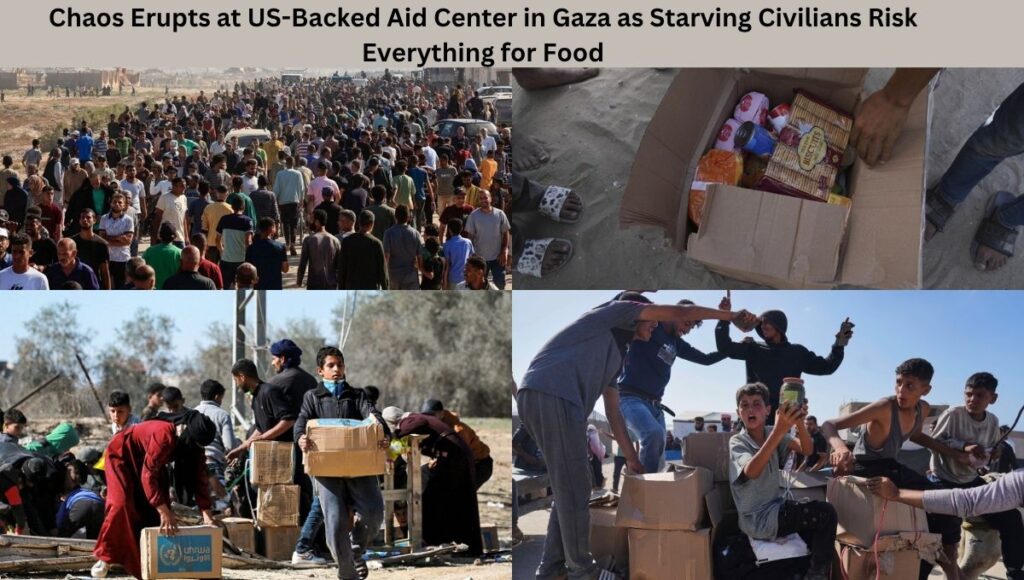
Chaos Erupts at US-Backed Aid Center in Gaza as Starving Civilians Risk Everything for Food
Famine in Gaza: Desperate Need vs. Flawed Distribution
The 11-week blockade on Gaza has left over two million people with limited access to food, clean water, and medical supplies. With Rafah now under full Israeli military control, humanitarian operations are struggling or outright failing to meet the overwhelming need.
According to GHF, 8,000 food boxes were distributed each meant to feed a family for several days. But for many, the rations were grossly inadequate.
Aid packages reportedly included flour, pasta, canned beans, tea, and sugar enough for basic sustenance, but not enough to meet the desperate hunger of displaced families.
Biometric Screening Raises Surveillance Concerns
One of the most contentious aspects of the Gaza Humanitarian Foundation operation is its use of biometric data. Facial recognition, iris scans, and militarized checkpoints are part of the GHF’s protocol, allegedly to prevent Hamas from intercepting aid.
Critics argue these measures violate human dignity and privacy, and amount to an intelligence-gathering operation disguised as humanitarian work.
The move has sparked outrage across humanitarian circles and fueled fears among Gazans, many of whom say they are forced to choose between feeding their families and being surveilled.
“They said the company belongs to Israel and is a mercenary,” said Abu Ahmed, a 55-year-old father of seven. “Even the resistance warned us not to go.”
United Nations and NGOs Boycott GHF Operations
The United Nations and major NGOs have publicly distanced themselves from the GHF, citing concerns about neutrality and the militarization of aid.
The UN Office for the Coordination of Humanitarian Affairs (OCHA) labeled the initiative “unfeasible,” warning that it distracts from real solutions such as opening all crossings and lifting the blockade.
Humanitarian groups including the International Committee of the Red Cross and Norwegian Refugee Council have criticized the GHF’s limited distribution model.
With only four mega-centers instead of hundreds of local aid points, the current system creates dangerous bottlenecks and large-scale chaos.
“This is not how aid is done,” said Ahmed Bayram from the NRC. “This is a reckless and inhumane plan.”
Aid Site Deaths Fuel Accusations of ‘Weaponized Relief’
On the ground in Rafah, the situation quickly deteriorated into tragedy. According to Gaza’s Health Ministry, at least three civilians were killed and dozens injured after Israeli troops allegedly opened fire. Israel has not confirmed casualties but acknowledged firing warning shots.
The Gaza Government Media Office accused Israeli forces of orchestrating a “deliberate massacre” by luring civilians to centralized aid points without sufficient crowd control or protection.
“They opened live fire on starving civilians who were lured to these locations under the pretense of receiving aid,” the office said in a statement.
Forced Displacement: Aid as a Political Tool?
Perhaps the most alarming criticism of the GHF model is its total absence in northern Gaza, an area still heavily populated and devastated by conflict.
By concentrating aid distribution in the south, critics argue the system effectively pressures Palestinians to abandon their homes furthering Israel’s stated goal of depopulating northern Gaza.
“This is not humanitarian aid. This is control,” said Amjad al-Shawa of the Palestinian NGO Network. “Concentrating aid in the south looks like an attempt to shape population movement.”
An Israeli official told CNN that 75% of Gaza would be “occupied” within two months, lending credence to fears of forced displacement.
Political Fallout and Leadership Shakeups
The controversial rollout of the GHF has already led to high-level resignations. Just days into the initiative, GHF’s executive director Jake Wood stepped down, citing his inability to meet humanitarian standards in the current environment.
Despite mounting criticism, the U.S. State Department has defended the initiative, calling UN opposition “hypocritical.” A spokesperson said, “The real story is food aid is going in,” while sidestepping questions about biometric surveillance and militarized logistics.
Aid Delivered, But a Drop in the Bucket
While some aid is getting through including 95 trucks that entered on Tuesday the total volume remains woefully insufficient. UN agencies estimate that 500–600 trucks per day are needed to stave off famine. Currently, less than 20% of that is being delivered.
With 400+ trucks stranded at Kerem Shalom crossing, aid experts say Gaza is hurtling toward full-scale famine, with over 93% of Gazans facing acute food insecurity.
Conclusion: Starvation Overrides Surveillance
The events in Rafah are a stark illustration of a humanitarian system in collapse, overwhelmed by military interests, political agendas, and international divisions. While food is reaching some, the price is high: biometric surveillance, long treks under threat, and deadly chaos at distribution sites.
In a region where the next meal could be a matter of life or death, Gazans face a grim choice: risk everything or go hungry.
For those living under siege, the aid they receive is not just a lifeline. It’s also a reminder of what has been lost dignity, security, and a functioning humanitarian response rooted in principles of neutrality and humanity.
Also Read: Palestinians rush US-backed aid centre despite concerns over checks
Related Posts:
- 25 Killed as Israeli Forces Open Fire on Starving…
- 7 Heartbreaking Facts About Venezuela's Earthquake Disaster
- Horror at Gaza Aid Centers: Israeli Troops Kill 32…

- Chaos at Gaza Aid Centers: 31 Killed as Hunger and…
- 5 Major Takeaways from the US Supreme Court's…

- Israel–Hamas Ceasefire Under Strain: 4 More Hostage…
