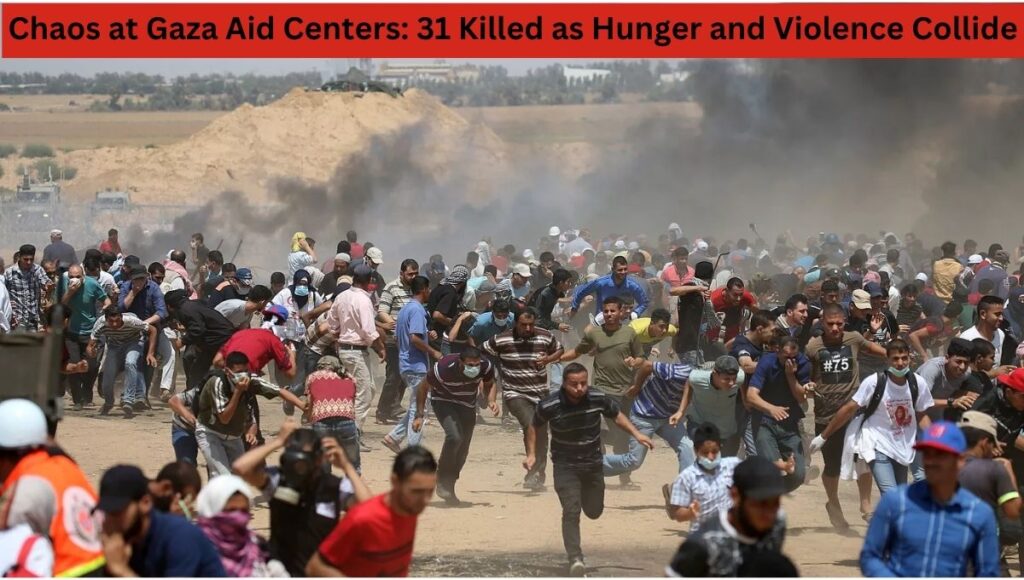
Aid distribution Chaos at Gaza Aid Centers: 31 Killed as Hunger and Violence Collide. In one of the deadliest single-day incidents involving aid distribution in Gaza, at least 31 Palestinians were killed and nearly 170 others injured on Sunday near a food aid center in Rafah, according to Gaza’s Health Ministry. Eyewitness accounts and local medical staff allege that Israeli forces opened fire on civilians waiting for food, igniting global condemnation and intensifying scrutiny over the controversial Gaza Humanitarian Foundation (GHF).
The GHF, a U.S.- and Israel-backed entity set up as a workaround to blocked UN aid routes, has already been criticized for disorganization and lack of neutrality. Sunday’s violence adds fuel to the fire, with the United Nations describing the aid sites as “death traps.”
Chaos at Gaza Aid Centers: 31 Killed as Hunger and Violence Collide
Eyewitness Testimonies Paint a Grim Picture
Families gathered before dawn in Rafah’s Al-Alam district to collect emergency food supplies. Instead, they were met with gunfire. “We came for food, not to die,” said 40-year-old Ibrahim Abu Saoud, an eyewitness. “I saw a young man get shot, and we couldn’t even help him.”
According to medical staff at Nasser Hospital and the Red Cross field hospital, most of the wounded suffered gunshot wounds to the head and chest injuries consistent with sniper fire, they said.
The International Committee of the Red Cross (ICRC) confirmed treating 179 casualties, calling it the highest single-day influx of war-related injuries since the establishment of its Rafah field hospital.
Conflicting Narratives: IDF and GHF Deny Responsibility
The Israeli Defense Forces (IDF) issued a public denial, calling the reports “false and fabricated.” The IDF said no shots were fired by its troops within or near the aid site at the time of the incident, although it acknowledged firing warning shots one hour earlier about one kilometer away.
The Gaza Humanitarian Foundation echoed the IDF’s statement, claiming that “all aid was distributed without incident.” GHF also released undated video footage showing crowds peacefully collecting food, although Reuters could not verify the footage’s authenticity or timeline.
Both the IDF and GHF have suggested that Hamas orchestrated the violence, alleging that the group may have fired on its own people to discredit Israeli-led humanitarian efforts.
Hamas and Gaza Health Ministry Tell a Different Story
In stark contrast, the Hamas-run Gaza Health Ministry stated that Israeli tanks opened fire on the crowd, killing at least 31 people and wounding 169. Many were reportedly shot in the head or chest, suggesting deliberate targeting.
Local journalist Mohammed Ghareeb told the BBC that Israeli military vehicles were seen firing shells near the aid distribution center, causing widespread panic and chaos.
The Gaza Government Media Office accused Israel and the United States of “blackmailing civilians with food,” alleging that the GHF centers were designed to draw vulnerable populations into exposed locations monitored by the Israeli military.
Humanitarian System on the Verge of Collapse
Multiple aid organizations, including Médecins Sans Frontières (MSF) and the Palestinian Medical Relief Society, described a worsening medical and humanitarian situation. Doctors at Nasser Hospital said they were donating their own blood due to a dire shortage of supplies.
A British surgeon working with MSF described “rows of patients with bullet wounds”, most consistent with high-velocity rounds.
The United Nations warned that Gaza is becoming the “hungriest place on Earth”, with most of its two million residents facing imminent famine due to Israel’s ongoing 11-week blockade and flawed aid logistics.
GHF Operations Slammed by Aid Agencies
The GHF currently operates only four distribution sites, consolidating more than 400 previous UN-led centers. This shift has led to mass overcrowding, disorder, and increasingly dangerous conditions for civilians.
Eyewitnesses and aid workers describe chaotic scenes where elderly and disabled individuals are trampled in the rush to receive small amounts of flour, pasta, and canned goods. Bassam Zaqout of the Palestinian Medical Relief Society said, “This system is not aid it’s chaos. It creates violence, not relief.”
Even GHF’s former executive director, Jake Woods, resigned days before the foundation began operations, citing an “impossible environment to maintain humanitarian principles.”
International Outcry and Calls for Accountability
The United Nations and several humanitarian NGOs, including UNRWA, have refused to cooperate with GHF due to concerns about its military alignment and lack of neutrality. Philippe Lazzarini, head of UNRWA, publicly condemned the foundation, calling the Rafah site a “death trap.”
Despite backlash, GHF Interim Director John Acree defended the organization, noting that it has delivered 4.7 million meals since its launch and plans to expand distribution into northern Gaza. “We recognize the challenges, but right now, we are the only operating channel for secure aid delivery,” Acree stated.
Ceasefire Talks Falter Amid Growing Casualties
The deadly aid site incident comes as international ceasefire negotiations teeter on the brink. Hamas recently responded to a U.S.-backed proposal, calling it “positive and responsible,” while U.S. envoy Steve Witkoff dismissed the response as “totally unacceptable.”
Egypt and Qatar continue to mediate, urging both sides to find common ground, while Hamas expressed its willingness to engage in further negotiations.
Meanwhile, Israeli Defense Minister Yoav Gallant ordered continued military operations in Rafah, suggesting that a ceasefire remains unlikely.
Gaza’s Grim Toll: 54,000 Dead and Rising
Since Israel resumed its offensive in March, over 4,100 Palestinians have died, bringing the total Gaza death toll to more than 54,000, according to the Health Ministry.
Much of Gaza’s infrastructure has been obliterated, and the majority of its population now lives in makeshift shelters and camps.
As international outrage grows, the humanitarian situation in Gaza continues to spiral. Without neutral, secure aid mechanisms and accountability from all parties, the risk of further atrocities remains dangerously high.
Conclusion: A Humanitarian Crisis in Plain Sight
The events in Rafah highlight the growing intersection of military conflict and humanitarian aid, where even food distribution has become a battleground. As civilians bear the brunt of the conflict, the need for transparent, neutral humanitarian intervention has never been more urgent.
Unless the international community takes decisive action to protect aid recipients and hold violators accountable, Gaza’s humanitarian disaster will only deepen fueling further instability in an already volatile region.
Also Read: Gaza Faces “Mass Starvation” as Death Toll from Hunger Climbs Amid Ongoing Israeli Strikes
Related Posts:
- 5 Major Takeaways from the US Supreme Court's…

- 7 Heartbreaking Facts About Venezuela's Earthquake Disaster
- Israel–Hamas Ceasefire Under Strain: 4 More Hostage…

- In 8 Moves, EU Targets China-Linked Refineries and…

- Afghanistan–Pakistan War 2025: Inside the 48-Hour Ceasefire

- 25 Killed as Israeli Forces Open Fire on Starving…