In a bold and candid address in Quetta, Shehbaz Sharif Says ‘Begging Bowl’ Era Is Over as Pakistan Seeks Trade, Not Aid. Pakistan Prime Minister Shehbaz Sharif stated that the era of approaching allied nations with a “begging bowl” is over.
Speaking to military officers at the Command and Staff College in Balochistan, Sharif emphasized a new vision of national self-reliance rooted in trade, investment, and the full use of Pakistan’s natural and human resources.
He was joined in spirit by Field Marshal Asim Munir, with whom he declared a unified front in ending Pakistan’s long-standing economic dependency. “I am the last person, along with Field Marshal Asim Munir, willing to carry this burden any longer on our shoulders,” said Sharif, referring to the economic challenges facing the nation.
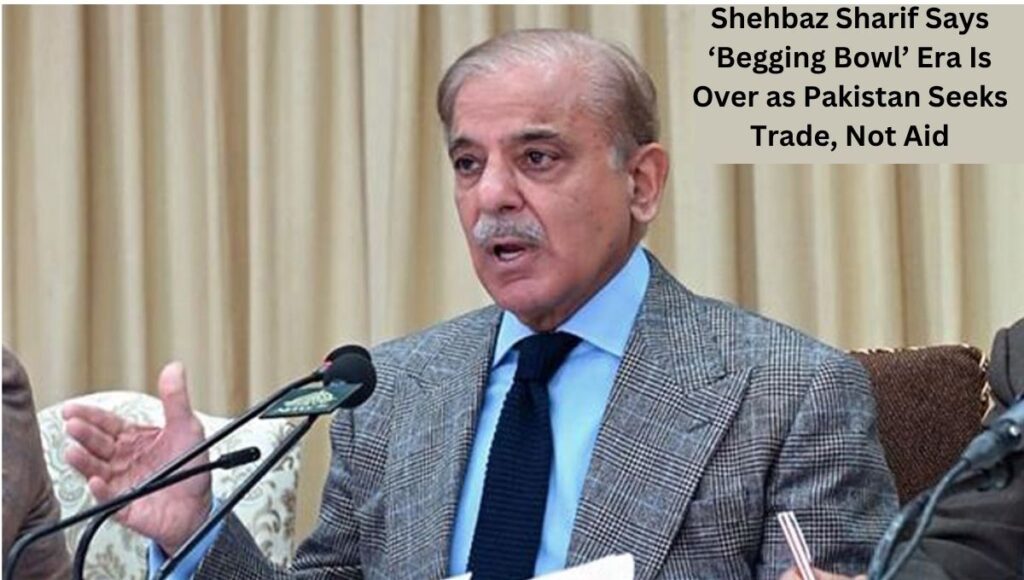
Shehbaz Sharif Says ‘Begging Bowl’ Era Is Over as Pakistan Seeks Trade, Not Aid
Strong Ties With Allies Like China, Saudi Arabia, Turkey
During his speech, Sharif praised Pakistan’s key international partners and clarified that their expectations have evolved. “China is the most time-tested friend of Pakistan. Saudi Arabia is one of the most reliable and trustworthy friends of Pakistan. This also applies to Turkey, Qatar, and the UAE,” he noted.
However, these allies, according to the Prime Minister, no longer anticipate Pakistan arriving with requests for aid. Instead, they seek “mutually profitable ventures in trade, commerce, innovation, research and development, education, and health.”
This shift, Sharif said, demands that Pakistan redefines its international engagements, prioritizing economic cooperation over dependency.
A Country Blessed With Resources Must Rise
The Pakistani Prime Minister pointed to the country’s potential, asserting that Pakistan is rich in both natural and human resources. “The Almighty has blessed us,” he said. “We must make full use of these resources and deploy them for profitable ventures.”
He criticized inefficient industries and advocated for a streamlined focus on export-driven growth. “We must not promote those idling units in Pakistan that are not making profits,” he said, reinforcing the need to support innovation and productivity.
IMF Bailout Amid Indian Opposition
The International Monetary Fund (IMF) recently approved a new $1 billion bailout package for Pakistan, part of a broader $7 billion Extended Fund Facility agreed upon in September 2024.
However, this financial assistance was met with strong objections from India, which argued that the funds could be misused to support state-sponsored cross-border terrorism.
India’s concerns were dismissed by the IMF, which clarified that the package followed standard procedures and had been agreed upon earlier. Since 1958, Pakistan has received 25 bailout packages from the IMF, underlining the severity and longevity of its economic woes.
Operation Sindoor: Admission of Military Vulnerability
The Prime Minister’s speech came at a time of escalating tensions with India, following the May 7 Operation Sindoor, in which India launched strikes on nine terror bases in Pakistan and Pakistan-Occupied Kashmir (POK). These strikes were in response to the Pahalgam terror attack on April 22 that killed 26 people, mostly tourists.
Sharif candidly admitted that the Indian strikes caught Pakistan off guard. “On the night of May 9–10, we decided to respond after Fajr prayers. But before that hour arrived, India launched another missile attack using BrahMos, hitting various provinces, including the airport in Rawalpindi,” he revealed during a speech in Azerbaijan.
He confirmed that the Nur Khan Airbase and other critical sites were struck, a rare public acknowledgment of the extent of damage sustained.
Military Support From Turkey and Azerbaijan
Despite its vulnerability, Pakistan found military support in Turkey and Azerbaijan, both of whom condemned India’s strikes and backed Islamabad during Operation Sindoor. This support was instrumental until a ceasefire was declared on May 10, halting further escalation.
While military tensions were momentarily diffused, the incident exposed Pakistan’s defence readiness gaps and further complicated its standing on the international stage.
Shift From Security Focus to Economic Development
Sharif’s speech also marked a strategic pivot from a security-first agenda to an economic revitalization plan. “If we are able to defeat terrorism, if we are able to unite the nation like never before… and are absolutely clear in our vision that we have to promote export growth then we can overcome our challenges,” he stated.
He reiterated that Pakistan must focus on innovation, education, healthcare, and profitable business ventures, instead of falling back on traditional dependency-based policies.
Conclusion: A New Path for Pakistan
Prime Minister Shehbaz Sharif’s declarations signify a turning point in Pakistan’s diplomatic and economic approach. With the support of Field Marshal Asim Munir and a cohort of historically close allies, Islamabad is positioning itself to shed the image of a financially dependent state and emerge as a partner in innovation and development.
The real test will be in the coming months whether words transform into policy, and whether Pakistan can finally leverage its natural wealth, strategic geography, and human capital to walk the path of sustainable growth.
Also Read: Trump hosts Pakistani army chief, disagrees with India over India-Pakistan war mediation
Related Posts:
- 7 Shocking Reasons US Sees Asim Munir as a Strategic…
- 9 Powerful Signals Behind Saudi Arabia Honoring…

- 9 Critical Pressures Trapping Pakistan’s Army Chief…

- 5 Major Takeaways from the US Supreme Court's…

- Afghanistan–Pakistan War 2025: Inside the 48-Hour Ceasefire

- 7 Heartbreaking Facts About Venezuela's Earthquake Disaster