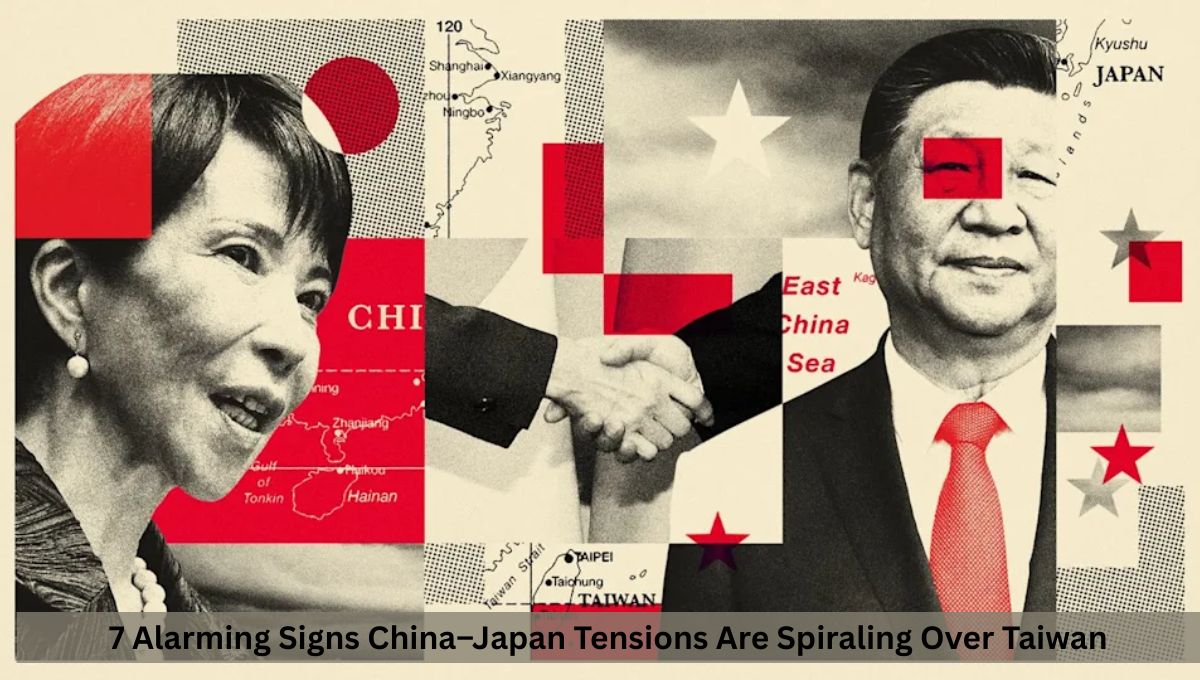
7 Alarming Signs China–Japan Tensions Are Spiraling Over Taiwan in their worst crisis in years. China and Japan are embroiled in their most serious diplomatic confrontation in years, with Beijing halting the release of major Japanese films, issuing travel warnings, and delivering unusually aggressive rhetoric following Japanese Prime Minister Sanae Takaichi’s recent remarks on Taiwan.
The cascading fallout now threatens economic ties, tourism flows, and regional security stability. Beijing has postponed the release of two Japanese films—Crayon Shin-chan the Movie: Super Hot! The Spicy Kasukabe Dancers and Cells at Work!—after Chinese state media said audience sentiment had sharply turned against Japanese cultural products.
The move is part of a broader retaliation after Takaichi suggested Japan might intervene militarily if China attempted to forcefully seize Taiwan. The crisis has rapidly expanded beyond cinema. Millions of dollars in tourism revenue are now at risk, senior envoys are shuttling between Beijing and Tokyo, and the region is on high alert amid increasingly sharp military and diplomatic exchanges.
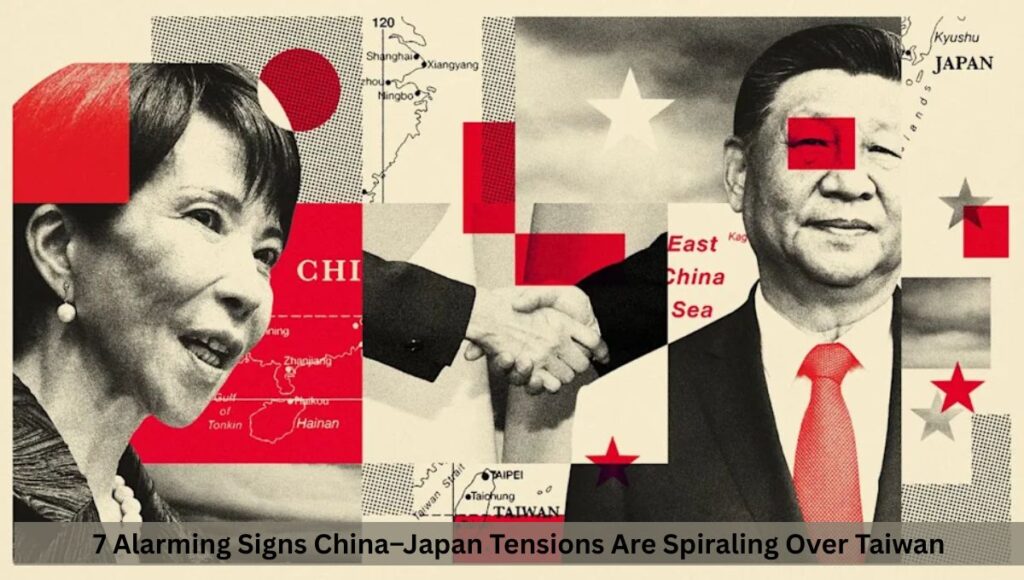
7 Alarming Signs China–Japan Tensions Are Spiraling Over Taiwan
Why Beijing Suspended Japanese Film Releases
Audience sentiment and political pressure
Chinese state broadcaster CCTV announced that distributors made a “prudent” decision to postpone the two Japanese films due to “Chinese audience sentiment” and “market performance.” In reality, analysts say the move fits a familiar pattern in China’s geopolitical playbook: using cultural and economic tools to exert pressure on foreign governments.
CCTV claimed that Prime Minister Sanae Takaichi’s “provocative remarks” on Taiwan would inevitably influence Chinese perceptions of Japanese movies, making immediate release “unsuitable.” The outlet also noted that Demon Slayer: Infinity Castle, one of Japan’s most popular exports, had seen declining sales since the diplomatic row escalated.
China’s cultural retaliation strategy
Naoise McDonagh, an expert on economic coercion at Edith Cowan University, said China typically targets sectors that are symbolic yet not essential to its own economy.
“China is usually careful to target trade that is non-essential for China but which will impact Japanese firms,” McDonagh said. “This creates financial costs and symbolic pressure.”
By freezing film releases, China signals that Japanese cultural products are no longer politically “safe,” giving Beijing leverage without harming vital Chinese industries.
What Triggered the Crisis? Takaichi’s Warning on Taiwan
Takaichi’s remarks on military intervention
The row began after Japanese Prime Minister Sanae Takaichi—a known China hawk—told the Japanese parliament on November 7 that a Chinese blockade or military action against Taiwan could constitute a “survival-threatening situation” for Japan.
Her exact words were:
“If there are battleships and the use of force, no matter how you think about it, it could constitute a survival-threatening situation.”
Under Japan’s security laws, such a situation could justify deployment of the Self-Defense Forces alongside allies like the United States.
Beijing’s furious response
Beijing denounced the comments as “egregious” and an interference in China’s internal affairs. China insists Taiwan is part of its sovereign territory and has not ruled out the use of force to achieve reunification.
The Chinese Foreign Ministry demanded a retraction. Takaichi refused, though she said she would adopt a “more cautious tone” in future remarks.
Explosive Rhetoric: Chinese Consul Threatens to ‘Cut Off’ Prime Minister’s Head
In one of the most shocking episodes of the crisis, Xue Jian, the Chinese consul general in Osaka, posted a threatening message on social media:
“There would be no choice but to cut off that filthy head without a moment’s hesitation.”
The post was later deleted, but not before it sparked outrage in Tokyo.
Japan’s Chief Cabinet Secretary Minoru Kihara condemned the remarks as “extremely inappropriate,” confirming Japan lodged a formal protest. He also revealed that Xue had made “multiple” inflammatory remarks previously.
However, Beijing did not discipline the diplomat. Instead, Foreign Ministry spokesperson Lin Jian defended the comments, insisting they were made in response to Takaichi’s “wrongful and dangerous” statements.
China Escalates With Travel Warnings and Economic Pressure
Travel and study advisories
Following Takaichi’s remarks, China issued a travel advisory warning its citizens about “serious safety risks” in Japan. It also urged students to reconsider studying there—a significant blow given that Chinese students represent a large share of Japan’s foreign student population.
Tourism stocks plunge in Japan
The economic impact was immediate.
Tourism-exposed Japanese stocks dropped sharply:
- Shiseido fell 9.08%
- Isetan Mitsukoshi Holdings plunged over 11%
- Oriental Land, operator of Tokyo Disney Resort, fell 5.68%
- ANA Holdings dropped 3.35%
China is one of Japan’s largest sources of tourists. Nearly 7.5 million Chinese visitors traveled to Japan in the first nine months of this year alone. Any slowdown threatens Japan’s tourism and retail sectors.
Chinese airlines even began offering full refunds and free itinerary changes for flights to Japan.
Japan issues its own advisory
Tokyo responded by warning Japanese citizens traveling in China to avoid crowded places and respect local customs—an indication of the rising tension and fears of public backlash.
Military Signaling: Warships, Patrols, and ‘Crushing Defeat’ Threats
China deploys ships near disputed islands
China dispatched four armed China Coast Guard vessels to patrol waters around the Senkaku/Diaoyu Islands, claimed by China but controlled by Japan. Frequent maritime confrontations have occurred in the area, but Beijing’s latest moves were clearly timed to coincide with the diplomatic fallout.
Beijing threatens Japan with ‘crushing defeat’
In a separate escalation, Chinese Defense Ministry spokesperson Jiang Bin warned:
“Japan will only suffer a crushing defeat against the steel-willed People’s Liberation Army and pay a heavy price”
if it attempted to intervene militarily over Taiwan.
This language is unusually direct even by Chinese defense standards.
Diplomacy in Overdrive: Japan Sends Senior Envoy to Beijing
Recognizing the severity of the crisis, Japan has dispatched senior foreign ministry official Masaaki Kanai to Beijing to meet Chinese counterpart Liu Jinsong. Kanai is expected to clarify that Japan’s core security policy has not changed and to urge Beijing to keep its response “measured.”
Chief Cabinet Secretary Kihara also said that Japan maintains “an open stance” toward dialogue with China.
The visit follows weeks of rising hostility and comes shortly before the G20 summit, where Beijing has already announced that Premier Li Qiang has no plans to meet Takaichi.
Cultural Fallout: Japanese Anime and Entertainment Targeted
China’s suspension of Japanese films is not unprecedented. Cultural products from Japan, South Korea, and Western countries have all been used as tools of political message-sending in the past.
Films affected
- Crayon Shin-chan the Movie: Super Hot! The Spicy Kasukabe Dancers
– An upcoming comedic anime film featuring the popular character Shin-chan. - Cells at Work!
– A live-action adaptation of the hit manga depicting blood cells fighting viruses. - Demon Slayer: Infinity Castle
– Not banned but facing reduced sales amid negative public sentiment.
CCTV did not specify when, or if, the delayed films would be released.
The Taiwan Question: The Heart of the Crisis
China’s view
Beijing sees Taiwan as a breakaway province that must be “reunified” with the mainland, by force if necessary.
Japan’s concern
Japan views Taiwan’s security as directly linked to its own due to:
- Taiwan’s proximity (about 110 km from Japanese islands)
- Japan’s trade routes crossing Taiwan’s surrounding waters
- The U.S.–Japan security alliance
Taiwan’s position
Most Taiwanese support maintaining the status quo—neither declaring independence nor unifying with China.
Economic Stakes: A Threat Japan Cannot Ignore
Tourism and retail dependence
Chinese tourists make up nearly 20% of Japan’s international visitors. Their spending is crucial to Japan’s hospitality, retail, and cosmetics industries.
A prolonged downturn could damage Japan’s economic recovery, especially as the country recently posted a 0.4% GDP contraction in the third quarter—an annualized decline of 1.8%.
Trade and investment links
China is Japan’s largest trading partner. A full-scale economic retaliation—similar to measures China used against South Korea after the THAAD missile system deployment—could significantly affect Japanese companies.
What Happens Next?
Short-term outlook
- Film postponements may become cancellations
- Travel restrictions could tighten further
- Public sentiment in China may continue turning against Japanese brands
- Diplomatic talks could stabilize tensions if both sides commit to de-escalation
Long-term implications
The crisis underscores the volatility of the China–Japan–Taiwan triangle. Japan is increasingly vocal on Taiwan due to regional security concerns. China, meanwhile, is more assertive than ever in defending what it calls its “red lines.”
This crisis may serve as a preview of how future Taiwan-related confrontations could unfold—with cultural sanctions, economic pressure, intense rhetoric, and military signaling all used as tools of statecraft.
Conclusion
The suspension of Japanese film releases in China is far more than a cultural dispute—it is a symbol of the worsening tensions between Asia’s two largest economies. What began as a single comment by Japan’s new prime minister has spiraled into a multidimensional confrontation involving diplomacy, economy, tourism, military posturing, and even personal threats.
As Japan sends senior envoys to Beijing and both countries issue travel advisories, the world is watching closely. What happens next will shape the balance of power in the Asia-Pacific and could influence the trajectory of any future Taiwan crisis.
Also Read: 7 Alarming Signals in the China–Japan Clash Over PM Takaichi’s Taiwan Remarks
Also Read: China, Japan hold talks to tone down tensions over PM Takaichi’s remarks on Taiwan