
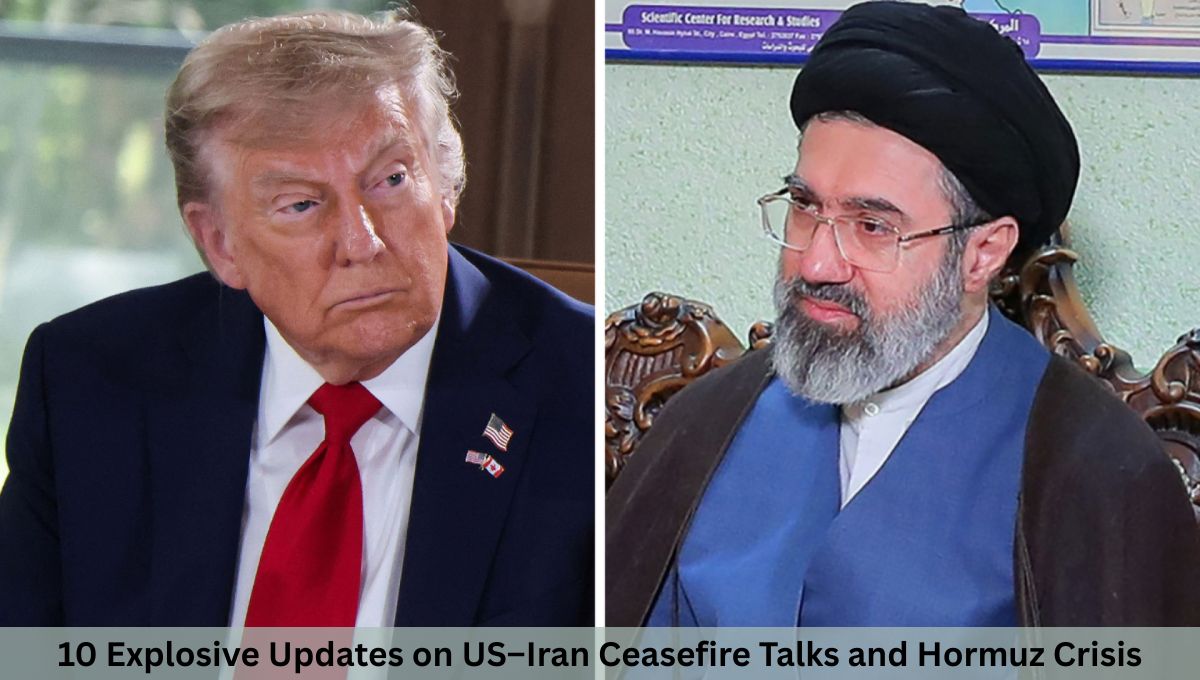
10 Explosive Updates on US–Iran Ceasefire Talks and Hormuz Crisis while oil prices surge. The ongoing conflict between the United States and Iran has entered a critical phase, marked by a complex mix of military escalation, diplomatic signaling, and economic disruption.
Reports suggest that Washington and Tehran are exploring a possible ceasefire deal—one that hinges on the reopening of the strategically vital Strait of Hormuz.
This narrow waterway, through which nearly one-fifth of the world’s oil supply flows, has become the central bargaining chip in negotiations.
However, despite backchannel discussions and global mediation efforts, both sides continue to issue contradictory statements, raising doubts about whether a meaningful breakthrough is within reach.
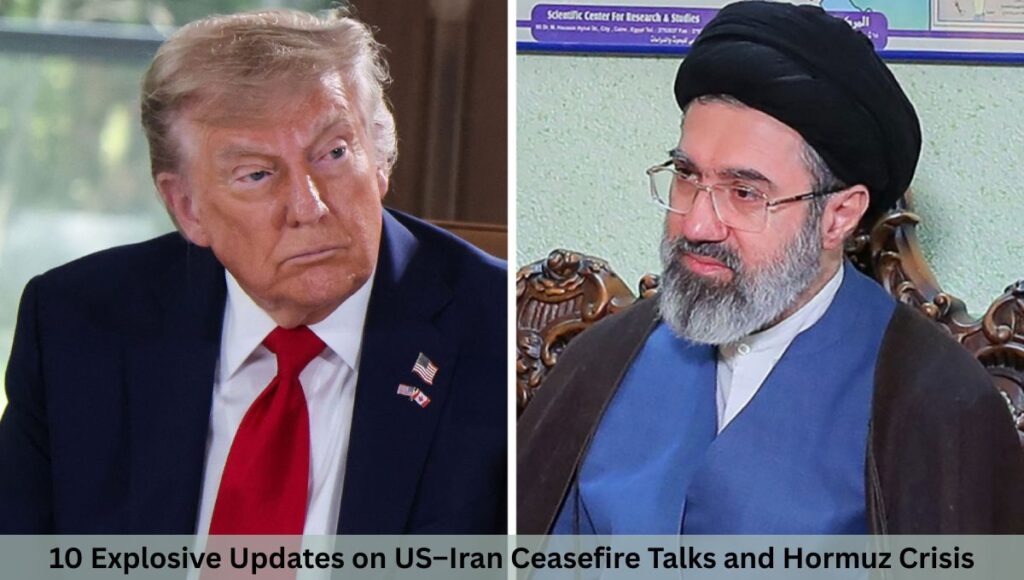
10 Explosive Updates on US–Iran Ceasefire Talks and Hormuz Crisis
1. Ceasefire Talks Linked to Strait of Hormuz
At the heart of the current diplomatic efforts is a proposed trade-off:
a ceasefire in exchange for Iran reopening the Strait of Hormuz.
The reported framework suggests:
- Iran would allow safe passage for global oil shipments.
- The US would scale down or halt its military operations.
- Broader de-escalation could follow if initial terms are met.
However, the negotiations remain fragile. While US officials hint at progress, Iranian authorities have publicly denied that any formal agreement is underway, calling such claims “false and baseless.”
2. Strategic Importance of the Strait of Hormuz
The Strait of Hormuz is not just a regional chokepoint—it is a cornerstone of the global energy system.
Why it matters:
- Handles ~20% of global oil trade.
- Critical for Asian economies like China, India, Japan, and South Korea.
- Any disruption directly impacts global fuel prices and inflation.
Since the conflict began, traffic through the strait has nearly halted, triggering one of the most severe energy shocks in recent years.
3. Trump’s Ceasefire Conditions
US leadership has made its position clear:
no ceasefire without full reopening of the strait.
Key conditions include:
- Guaranteed safe passage for oil tankers.
- Removal of Iranian threats to maritime routes.
- Assurance that Iran cannot leverage the strait as a geopolitical weapon.
Public statements have been notably aggressive, with warnings of intensified military action if demands are not met.
4. Conflicting Narratives from Washington and Tehran
One of the biggest obstacles to progress is the stark disconnect between US and Iranian messaging.
US claims:
- Iran is seeking a ceasefire.
- Negotiations are ongoing via intermediaries.
- Military objectives are nearly complete.
Iran’s response:
- Denies requesting any ceasefire.
- Rejects US claims as propaganda.
- Emphasizes resistance against “threats and deadlines.”
This divergence highlights a broader issue: a complete breakdown of trust between the two nations.
5. Role of Intermediaries: China and Pakistan
With direct dialogue strained, third-party mediation has become crucial.
Countries like China and Pakistan have:
- Proposed ceasefire frameworks.
- Encouraged reopening of Hormuz.
- Acted as communication bridges between Washington and Tehran.
These efforts reflect a growing trend of multipolar diplomacy, where regional and global powers step in to manage crises traditionally dominated by Western influence.
6. Military Escalation Continues
Despite talk of diplomacy, military operations remain intense.
Current developments:
- Thousands of US troops deployed to the region.
- Continued airstrikes targeting Iranian infrastructure.
- Iranian missile responses across the Middle East.
The dual-track approach—negotiating while escalating—adds unpredictability and increases the risk of miscalculation.
7. Oil Prices Surge Amid Uncertainty
The conflict has sent shockwaves through global markets.
Market impact:
- Oil prices surged over 6% in volatile trading.
- Brent crude crossed $100 per barrel.
- Inflation fears intensified worldwide.
Energy analysts warn that prolonged disruption in Hormuz could trigger a sustained global economic downturn.
8. Domestic Pressure in the United States
Public opinion in the US is increasingly shaping policy decisions.
Recent trends indicate:
- Growing fatigue with prolonged conflict.
- Majority support for ending US involvement quickly.
- Rising concern over fuel prices and economic impact.
This domestic pressure may push policymakers toward a faster resolution—even if it means compromising on initial objectives.
9. Nuclear Concerns Remain Central
The US has consistently justified its actions by citing Iran’s nuclear ambitions.
Key points:
- Significant uranium stockpiles reportedly remain intact.
- Some facilities are deeply buried and difficult to destroy.
- Iran continues to insist its program is peaceful.
This unresolved issue complicates ceasefire negotiations, as long-term security guarantees remain unclear.
10. What Happens Next?
The coming weeks will likely determine the trajectory of the conflict.
Possible scenarios:
1. Negotiated Ceasefire
- Strait of Hormuz reopens.
- Military operations scale down.
- Markets stabilize.
2. Prolonged Stalemate
- Talks continue without breakthrough.
- Intermittent escalation persists.
- Economic uncertainty deepens.
3. Full Escalation
- Expanded military campaign.
- Targeting of critical infrastructure.
- Severe global economic fallout.
Global Implications: Beyond the Battlefield
This conflict is no longer confined to the Middle East. Its ripple effects are being felt worldwide.
Key global impacts:
- Energy insecurity across continents.
- Strained alliances and shifting geopolitics.
- Increased role of emerging powers in conflict resolution.
The crisis underscores how interconnected the modern world is—where regional conflicts can quickly become global emergencies.
Conclusion: A Fragile Path to Peace
The reported ceasefire talks between the US and Iran offer a glimmer of hope, but the path forward remains uncertain.
With high stakes on all sides—military, economic, and political—the situation demands careful navigation.
The Strait of Hormuz has become more than a shipping route; it is now a symbol of leverage, conflict, and potential reconciliation.
Whether diplomacy prevails or escalation intensifies will depend on decisions made in the coming days.
For now, the world watches closely, aware that the outcome will shape not just the region, but the global order itself.
Also Read: 9 Shocking Ways AI Helped Shape the US–Iran War
Also Read: US-Iran ceasefire talks linked to Strait of Hormuz reopening: Report
Related Posts:
- 9 Explosive Claims as Trump Says US Winning Iran War

- 5 Major Takeaways from the US Supreme Court's…

- 7 Powerful Facts About Ayatollah Ali Khamenei’s…

- 3 Explosive Conditions Iran Sets to End War with US…
- 7 Heartbreaking Facts About Venezuela's Earthquake Disaster
- Afghanistan–Pakistan War 2025: Inside the 48-Hour Ceasefire
