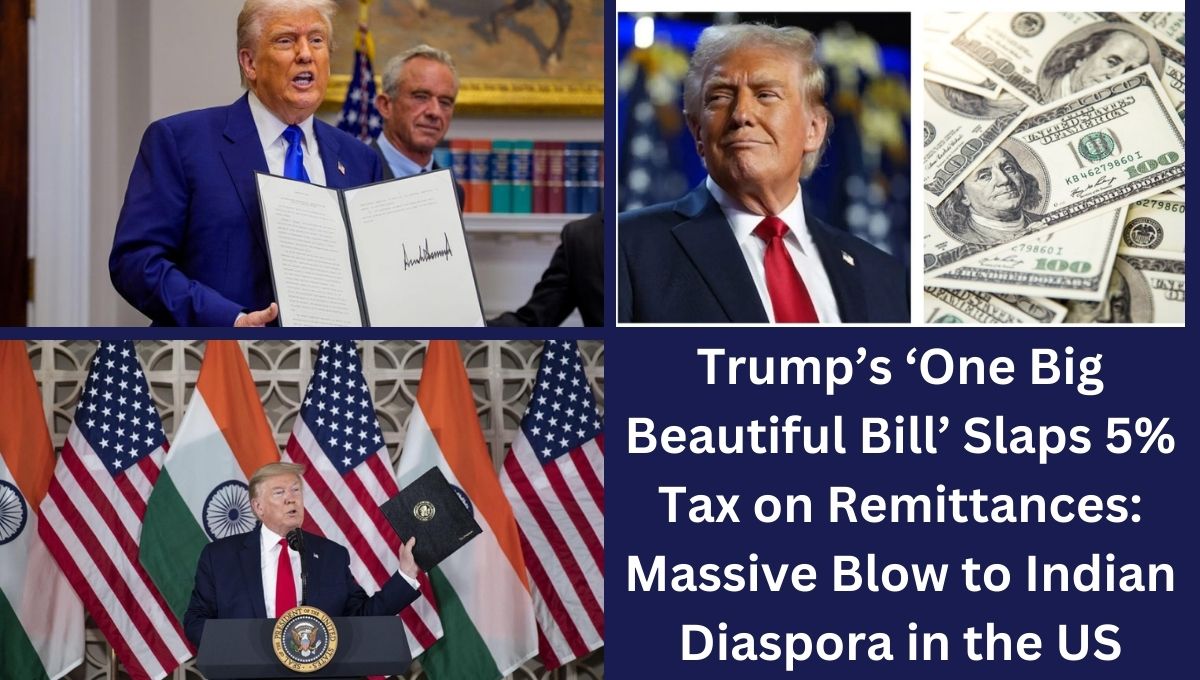
In a new legislative proposal, Trump’s ‘One Big Beautiful Bill’ Slaps 5% Tax on Remittances: Massive Blow to Indian Diaspora in the US. The Indian diaspora in the United States is staring down the barrel of a massive financial disruption as former President Donald Trump’s new legislative proposal, “The One Big Beautiful Bill”, moves closer to reality. This new bill passed narrowly by the US House Budget Committee in a 17-16 vote.
Trump’s ‘One Big Beautiful Bill’ Slaps 5% Tax on Remittances: Massive Blow to Indian Diaspora in the US
A Financial Storm Brews for Indians in the US
For millions of Indians sending money to support families back home, this Trump remittance tax could result in a direct, non-refundable financial hit compounding economic stress at a time of global uncertainty.
This 1,116-page behemoth includes a controversial clause: a 5% tax on all international money transfers made by non-US citizens, including H-1B visa holders, Green Card holders, and other non-residents.
5% Remittance Tax: What It Means for Indian Immigrants
At the heart of The One Big Beautiful Bill lies the proposed 5% levy on all outward remittances by individuals who are not US citizens. This includes everyone from H1B and F-1 visa holders to Green Card holders and other legal immigrants.
Unlike India’s remittance tax, which is refundable as an advance tax credit, this US tax offers no such relief.
With nearly 28% of India’s $120 billion in remittance inflows in 2023-24 originating from the United States, the impact could be substantial.
A 5% withholding on these funds means that Indian families may lose approximately $1.6 billion annually, even if remittance volumes remain constant.
Why the Tax Hurts: No Exemptions, No Refunds
The bill does not provide an exemption threshold, meaning even small transfers will be taxed. For example, if an Indian worker in the US sends $1,000 to India, they will now either have to send $1,050 (with $50 going to tax) or the recipient will get only $950.
This added burden is especially concerning for those who remit funds regularly to cover home loans (EMIs), family expenses, or support elderly parents in India.
Unlike US citizens who might offset the tax via their federal tax returns, non-citizens must absorb it as a direct cost.
NRIs Rethink Real Estate Investments Amid Rising Costs
The Trump remittance tax is also causing concern among NRIs planning to invest in Indian real estate. Traditionally, large chunks of savings sent back to India were directed toward property purchases, often as a long-term investment or a way to stay connected to their roots.
Consider this: An NRI planning to buy a property worth ₹80 lakh (approx. $100,000) would now need to remit ₹84 lakh, factoring in the 5% levy.
This significantly raises acquisition costs, and the situation is even more burdensome for those paying in monthly installments, as each remittance would attract the tax.
Tax experts recommend fast-tracking investments and transferring lump sums before the tax becomes law. This move could save thousands of dollars in otherwise non-recoverable taxes.
Impact on Indian Economy: Could the Rupee Take a Hit?
Economic think-tanks like Global Trade Research Initiative (GTRI) warn of broader macroeconomic consequences.
If the 5% remittance tax results in a 10–15% decline in remittance flows, India could see a shortfall of $12–18 billion annually.
Such a shock would tighten the supply of US dollars in India’s forex market, potentially weakening the rupee by ₹1–₹1.5 per USD.
The Reserve Bank of India may be forced to intervene frequently to stabilize the currency, especially in states like Kerala, Bihar, and Uttar Pradesh, which heavily rely on foreign remittances for household consumption.
More Than Just a Tax: Trump’s Broader Immigration Crackdown
The One Big Beautiful Bill is not just about remittances. It also allocates $46.5 billion to resume construction of Trump’s wall along the US-Mexico border, and $350 billion for immigration enforcement, including:
- $4 billion to hire 3,000 more Border Patrol agents
- $2.1 billion in signing and retention bonuses
- 10,000 new Immigration and Customs Enforcement (ICE) officers
- An unprecedented $1,000 fee on asylum seekers, making the US one of the few countries to do so
The plan envisions the removal of 1 million immigrants annually and the construction of facilities to detain 100,000 individuals.
This marks a massive escalation in anti-immigrant policy, directly affecting legal immigrants and exacerbating fears among the Indian community, many of whom have spent years on work visas and are still awaiting Green Cards.
What Should NRIs Do Now? Immediate Actions Recommended
Financial experts are advising urgent action for NRIs:
- Advance all planned remittances before the law is enacted
- Consider sending lump sums to cover future obligations like EMIs or tuition fees
- Consult a tax advisor about the implications for real estate purchases and long-term investments
- Track updates on the bill’s progress through Congress and prepare for a potential phase-in period
Given the non-refundable nature of the proposed tax, NRIs stand to lose thousands of dollars unless they act quickly.
Conclusion: A Crossroads for the Indian Diaspora
The proposed 5% tax on remittances under Trump’s One Big Beautiful Bill represents a serious financial obstacle for Indians living in the US.
From household support and real estate purchases to currency stability and family welfare, the implications are far-reaching.
While the bill has only just cleared the Budget Committee, the narrow margin of passage (17-16) shows how divisive and consequential this legislation is.
Whether it becomes law or not, the message is clear: immigrants, especially Indians, are in the crosshairs of a shifting US policy landscape.
Now is the time to plan, act, and protect your financial future.
Stay tuned to The News for real-time updates on Trump’s One Big Beautiful Bill and its impact on NRIs
Also Read: Elon Musk Breaks with Trump Over ‘Big Beautiful Bill’: Says It Increases Deficit and Undermines DOGE
Also Read: US Bill proposes 5% tax on foreign money transfers: Why NRIs are worried