
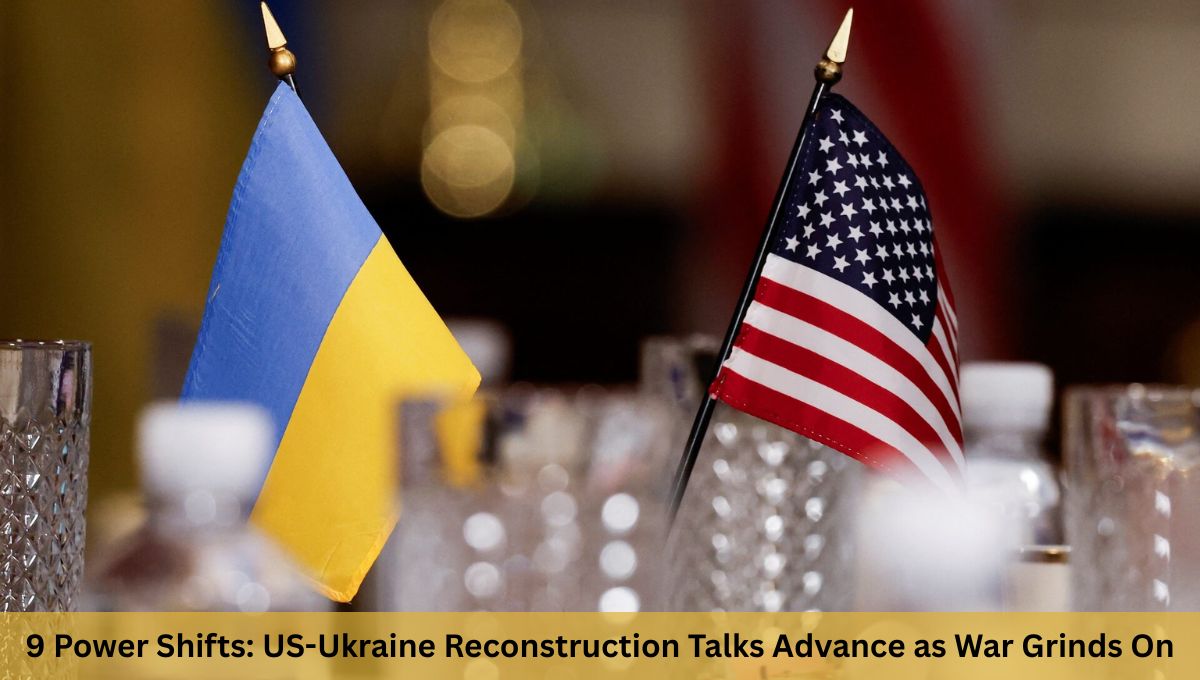
9 Power Shifts: US-Ukraine Reconstruction Talks Advance as War Grinds on under relentless Russian attacks. Senior officials from the United States and Ukraine met in Geneva this week to discuss post-war reconstruction and economic recovery — even as Russia’s invasion of Ukraine entered its fifth year with no sign of abating.
The talks, held against the backdrop of continued Russian missile and drone attacks, underscored a central paradox shaping the conflict:
planning for peace while war still rages.
Ukrainian officials described the meeting as a critical step toward shaping a future settlement, while U.S. envoys framed reconstruction as an essential pillar of any sustainable peace.
Yet deep divisions with Russia over territory, security guarantees, and political legitimacy continue to block a breakthrough.
9 Power Shifts: US-Ukraine Reconstruction Talks Advance as War Grinds On
Geneva Talks Focus on Life After War
The Geneva meeting brought together senior U.S. and Ukrainian negotiators for detailed discussions on how to rebuild Ukraine once hostilities end.
Leading Ukraine’s delegation was Rustem Umerov, who said the talks focused on economic recovery, security arrangements, and investment frameworks that could anchor a future peace.
“We worked out a document on the restoration of Ukraine in detail,” Umerov said, adding that agreed positions would “form the basis for further agreements.”
The U.S. delegation included President Donald Trump’s special envoy Steve Witkoff and adviser Jared Kushner.
While no formal agreements were announced, both sides portrayed the discussions as substantive and forward-looking.
Why Reconstruction Is Central to Peace Talks
Rebuilding Ukraine has become a core bargaining element in U.S.-brokered diplomacy aimed at ending Europe’s largest conflict since World War Two.
According to the World Bank, restoring Ukraine’s economy will cost an estimated $588 billion, based on damage recorded from February 24, 2022 through December 31, 2025.
Kyiv’s longer-term ambition is even larger:
- $800 billion in public and private investment over 10 years
- Modernisation of energy, transport, and housing
- Alignment with European Union standards
Ukrainian officials argue that credible reconstruction plans are essential not only for economic recovery but also for convincing citizens and investors that peace will endure.
Zelenskyy and Trump: Aligning the Political Track
Ukrainian President Volodymyr Zelenskyy said the Geneva meeting followed a phone call with President Trump, during which the two leaders discussed both reconstruction and the path toward peace talks with Russia.
Zelenskyy said the leaders agreed that negotiations should progress to a leaders-level meeting if upcoming trilateral talks show progress.
“This is the only way to resolve all the complex and sensitive issues and finally end the war,” Zelenskyy said.
Trump, who has repeatedly said he wants the war to end quickly, is pushing for tangible movement in talks — even as battlefield realities remain grim.
Early March Trilateral Talks in Abu Dhabi
Zelenskyy confirmed that the next round of trilateral talks involving Ukraine, the United States, and Russia would likely take place in Abu Dhabi in early March.
The aim, Ukrainian officials say, is to:
- Finalise economic and security frameworks
- Narrow gaps on key political issues
- Prepare the ground for a potential leaders’ summit
“This format can resolve a great deal,” Zelenskyy said, stressing that only national leaders can decide the most contentious issues.
Russia’s Parallel Engagement With the US
While Ukrainian and U.S. officials met together, Russia pursued separate contacts with Washington.
Russian President Vladimir Putin’s special envoy Kirill Dmitriev held talks with U.S. officials in Geneva, according to Russia’s state media.
Dmitriev declined to comment publicly on the outcome, reinforcing the opacity surrounding Moscow’s negotiating strategy.
The Kremlin has said it is too early to set deadlines for a deal, emphasizing that Russia has “tasks” it intends to complete.
Negotiations Still Deadlocked on Territory
Despite the diplomatic activity, talks remain stalled over the war’s most intractable issue: territory.
Russia is demanding that Ukraine cede:
- The remaining 20% of Donetsk region still under Kyiv’s control
- Recognition of Moscow’s hold over occupied areas
Ukraine has categorically rejected these demands, citing:
- Its constitution, which forbids territorial concessions
- The sacrifice of thousands of soldiers and civilians
- The need for security guarantees to prevent future invasions
Zelenskyy has said the problem is no longer military capacity, but political will.
Kremlin Casts Doubt on Leaders’ Summit
The Kremlin has responded coolly to suggestions of a Zelenskyy-Putin meeting.
Spokesman Dmitry Peskov said any summit between Putin, Zelenskyy, and Trump should occur only to finalise a deal, not to negotiate from scratch.
Russia has also questioned Zelenskyy’s legitimacy, a claim Kyiv rejects as a political tactic.
Russia Intensifies Attacks as Talks Continue
Even as diplomacy unfolds, Russia has continued to strike Ukraine with relentless force.
Hours before the Geneva meeting, Russia launched:
- 420 drones
- 39 missiles
targeting energy and critical infrastructure across at least eight regions, Zelenskyy said.
Cities affected included:
- Kharkiv
- Zaporizhzhia
- Kyiv
- Kryvyi Rih
Dozens were injured, and residential buildings, power facilities, and transport infrastructure were damaged.
Energy Infrastructure Under Siege
In recent months, Russia has increasingly focused on Ukraine’s energy system, destroying power plants and substations.
The result:
- Prolonged blackouts
- Winter heating shortages
- Economic disruption
Ukraine has also targeted Russia’s energy facilities, including oil refineries and depots, in retaliation.
Moscow denies targeting civilians, despite mounting evidence and civilian casualties.
Life Under Air Raids: Civilian Voices
For ordinary Ukrainians, the war remains a daily ordeal.
In Kyiv, art teacher Larysa Fuzik, 62, described the fear triggered by air raid sirens.
“Every time the alarm sounds, I feel such fear, such coldness in my soul,” she said. “I immediately get dressed and run to the metro.”
Such testimonies underscore why Kyiv insists on security guarantees as a precondition for peace.
Front Lines Slowly Shift
On the battlefield, Russian forces are making incremental gains along parts of the 1,200-kilometre front line.
They are:
- Pressuring “fortress cities” in eastern Donetsk
- Advancing within 20 km of Zaporizhzhia
Ukraine continues to resist, but the slow grind has reinforced fears of a prolonged war of attrition.
Prisoner Exchanges and Humanitarian Steps
One of the few areas of limited cooperation has been humanitarian exchanges.
Russia recently transferred the bodies of 1,000 Ukrainian soldiers in exchange for 35 Russian bodies, according to Kremlin aide Vladimir Medinsky.
Both sides say prisoner swaps and humanitarian measures will be discussed in upcoming talks.
The ‘Prosperity Package’
A key feature of the Geneva talks was Ukraine’s proposed “prosperity package.”
According to Umerov, it includes:
- Economic support mechanisms
- Investment guarantees
- Long-term cooperation frameworks
- Security arrangements linked to recovery
Ukraine is pitching itself as:
- A future European Union member
- A reconstruction opportunity for global investors
But officials acknowledge that funding depends on a ceasefire and peace deal.
Trump’s Push for Speed
Trump has repeatedly said the war has gone on “far too long” and told Zelenskyy he would like to see it end within 30 days.
Behind the scenes, Ukrainian officials describe Trump’s tone as friendly and engaged, with a strong focus on results.
Yet analysts caution that the gaps between Kyiv and Moscow remain wide.
Why Peace Remains Elusive
Despite intensive diplomacy, several obstacles persist:
- Disagreement over territory
- Russian demands for political concessions
- Ukrainian insistence on security guarantees
- Mutual distrust after years of war
Hundreds of thousands are believed to have been killed on both sides, and millions displaced.
Reconstruction Before Peace: A Risky Bet?
Some analysts warn that planning reconstruction before a ceasefire carries risks.
However, U.S. and Ukrainian officials argue that:
- Economic incentives can encourage compromise
- A credible recovery plan reassures Ukrainians
- Reconstruction commitments raise the cost of renewed war
For Washington, rebuilding Ukraine is also about European stability and deterrence.
Global Stakes of the Ukraine War
The outcome of the conflict affects:
- European security architecture
- Global energy markets
- International law and sovereignty norms
- US-Russia relations
That is why the Geneva talks, though technical, carry strategic weight far beyond Ukraine.
What to Watch Next
Key developments to monitor:
- Early March trilateral talks in Abu Dhabi
- Whether leaders agree to meet
- Any shift in Russian territorial demands
- Changes in battlefield dynamics
Diplomats say the coming weeks could determine whether talks move forward — or collapse.
Conclusion: Planning for Peace Amid War
The Geneva talks highlighted a stark reality:
Ukraine and its allies are planning for rebuilding while bombs still fall.
For Kyiv, reconstruction is inseparable from security. For Washington, it is leverage in diplomacy.
For Moscow, it remains secondary to territorial goals. Whether these competing visions can converge will shape not only Ukraine’s future — but Europe’s — for decades to come.
Also Read: 7 Explosive Developments as Ukraine City Hit During High-Stakes US Peace Talks
Also Read: Zelenskiy, after speaking with Trump, says talks should lead to leaders’ meeting
Related Posts:
- 3 Explosive Conditions Iran Sets to End War with US…

- 5 Major Takeaways from the US Supreme Court's…

- Trump’s 20-Point Gaza Peace Plan Gains Urgent Global…

- 7 Powerful Measures: Trump Sanctions Russian Oil…

- 7 Heartbreaking Facts About Venezuela's Earthquake Disaster
- Afghanistan–Pakistan War 2025: Inside the 48-Hour Ceasefire
