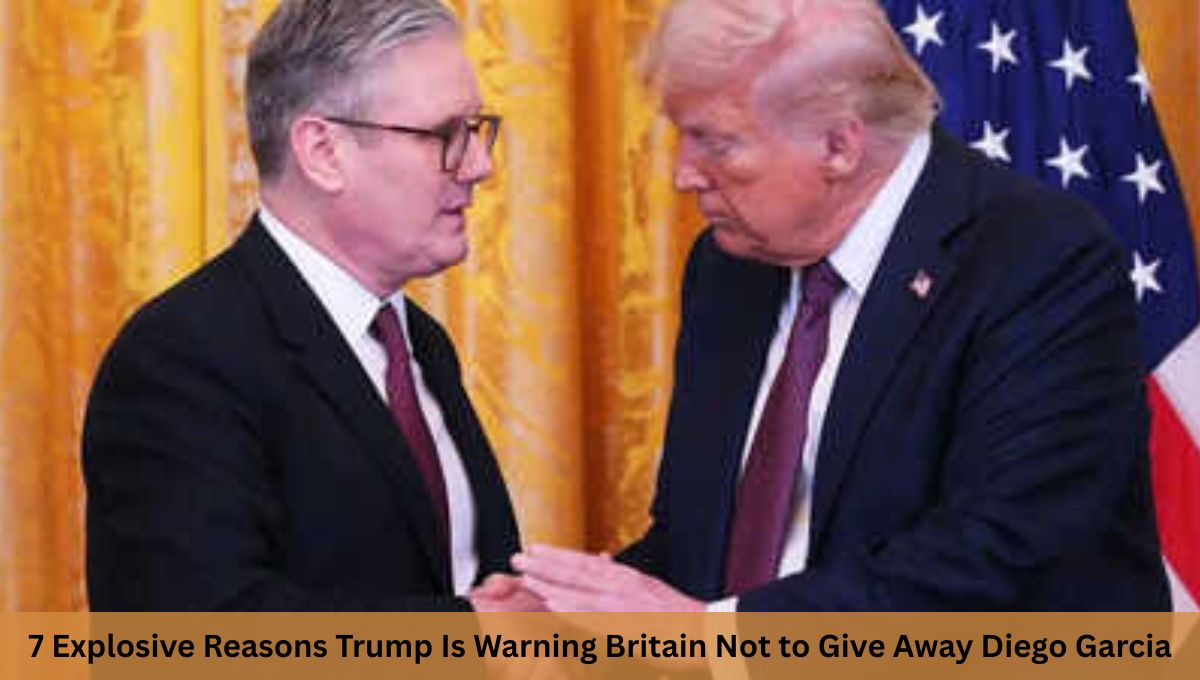
7 Explosive Reasons Trump Is Warning Britain Not to Give Away Diego Garcia, calling the plan a “Big Mistake.” The Chagos Islands were meant to be a settled issue. Legal rulings had been issued. Diplomatic agreements had been signed. Washington had given its approval.
Thank you for reading this post, don't forget to subscribe!Then the President of the United States intervened.
In a late-night Truth Social post that stunned diplomats in London and Washington alike, Donald Trump publicly rebuked Britain’s plan to hand sovereignty of the Chagos Islands to Mauritius, warning Prime Minister Keir Starmer that he was “making a big mistake”.
“DO NOT GIVE AWAY DIEGO GARCIA!” Trump wrote, directly contradicting the official position of his own State Department, which had backed the deal only a day earlier.
The outburst has reopened one of the most sensitive geopolitical disputes in the Indian Ocean, exposing fractures in UK-US relations, conflicting American foreign-policy signals, unresolved colonial legacies, and the growing shadow of confrontation with Iran.
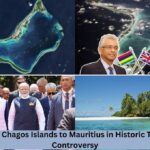
At the heart of it all lies Diego Garcia—a remote coral atoll that has quietly become one of the most strategically important military bases on Earth.
7 Explosive Reasons Trump Is Warning Britain Not to Give Away Diego Garcia
1. What Is the Chagos Islands Deal — and Why It Matters
Under an agreement reached in 2024 and finalized in 2025, the United Kingdom has agreed to transfer sovereignty of the Chagos Archipelago to Mauritius, while leasing back Diego Garcia for 99 years, with an option to extend.
The territory, formally known as the British Indian Ocean Territory (BIOT), has been under British control since 1965, when London detached it from Mauritius ahead of Mauritian independence.
Britain argues that the deal is the only viable way to protect the future of the joint UK-US military base on Diego Garcia in light of international legal rulings.
Mauritius, for its part, has long maintained that the separation of the islands violated international law and the principles of decolonisation.
The agreement was designed to:
- End decades of legal uncertainty
- Comply with international court rulings
- Preserve uninterrupted US-UK military access
- Remove a major diplomatic liability for Britain
Until Trump’s intervention, the arrangement appeared politically difficult but diplomatically settled.
2. Why Trump Calls the Deal a “Big Mistake”
Trump’s opposition is rooted less in legal nuance and more in sovereignty, leverage, and military instinct.
In his Truth Social posts, Trump repeatedly argued that:
- Long-term leases are “no good when it comes to countries”
- Sovereignty matters more than contractual guarantees
- Britain risks “losing control” of a vital security asset
From Trump’s perspective, a lease — even one lasting nearly a century — is inherently unstable.
This worldview reflects his background as a property developer, where ownership conveys power and leases invite renegotiation, litigation, or leverage by the landlord.
To Trump, ceding sovereignty is weakness, regardless of the legal safeguards attached.
3. Diego Garcia: Why This Tiny Island Is Strategically Critical
Diego Garcia is not symbolic real estate. It is one of the most important military hubs in the world.
Located in the central Indian Ocean, the atoll allows the United States and the United Kingdom to project power across:
- The Middle East
- East Africa
- South Asia
- Southeast Asia
Military Capabilities of Diego Garcia
- A runway capable of handling heavy bombers, including B-52s
- Pre-positioned weapons, fuel, and logistics
- Naval support facilities
- Intelligence and surveillance infrastructure
From Diego Garcia, the US has launched:
- Strikes against al-Qaeda and the Taliban in 2001
- Long-range bombing missions in Afghanistan
- Operations linked to the Iraq War
- Recent attacks on Houthi targets in Yemen
Trump’s warning is blunt:
if tensions with Iran escalate, Diego Garcia could again become a frontline asset.
4. Iran Looms Over Trump’s Calculations
Trump’s comments explicitly linked the Chagos deal to the possibility of military action against Iran.
“Should Iran decide not to make a Deal,” Trump wrote, “it may be necessary for the United States to use Diego Garcia… to eradicate a potential attack.”
This reflects:
- Ongoing US-Iran nuclear negotiations
- Trump’s long-standing skepticism of diplomacy with Tehran
- Heightened regional volatility after Gaza and Red Sea conflicts
Trump sees Diego Garcia not as a legacy base, but as a future launchpad.
In that context, any perceived dilution of British control — even symbolic — is treated as a strategic risk.
5. The State Department vs the President: US Policy Whiplash
Trump’s intervention is remarkable not just for what it says — but for when it was said.
Just one day earlier, the US Department of State issued a formal statement supporting the UK-Mauritius agreement, describing it as compatible with US security interests.
This contradiction has reignited a familiar Trump-era question:
Is US foreign policy made by institutions — or by presidential posts?
White House Press Secretary Karoline Leavitt resolved the ambiguity bluntly, telling reporters that Trump’s post should be treated as official policy.
The episode has left allies wondering:
- Which US position will prevail?
- Can agreements endorsed today be undone tomorrow?
- How reliable are American assurances under Trump?
6. Britain’s Dilemma: Law, Security, and Alliance Politics
For Britain, the Chagos deal was less about generosity and more about necessity.
In 2019, the International Court of Justice issued an advisory opinion stating that Britain’s continued administration of the Chagos Islands was unlawful and should end “as rapidly as possible”.
That ruling was followed by:
- A UN General Assembly resolution
- Growing diplomatic isolation for the UK
- Legal uncertainty over the base’s future
British officials concluded that without a negotiated settlement, the long-term operation of Diego Garcia itself could be jeopardized.
Starmer’s government insists that the leaseback arrangement is:
- Legally robust
- Militarily secure
- The only way to guarantee continuity
Trump’s attack has therefore landed as both a diplomatic rebuke and a strategic complication.
7. The Human Cost: Chagossians Still in Limbo
Lost amid the strategic arguments is the fate of the Chagossians.
Between the 1960s and 1970s, up to 2,000 islanders were forcibly removed from the archipelago to make way for the base. Many were resettled in Mauritius, the Seychelles, and later the UK.
Decades on, many Chagossians:
- Want the right to return
- Oppose the deal as negotiated
- Feel excluded from sovereignty decisions
Recent protests, including landings on remote atolls, underscore that the dispute is not only geopolitical but deeply human.
Even as sovereignty shifts, the original inhabitants remain largely dispossessed.
Why Trump’s Attack Resonates Politically in the UK
Trump’s remarks have energized Britain’s political right.
Figures such as Nigel Farage have labeled the handover an “act of treachery”, framing it as surrender to international pressure.
Opposition voices argue that:
- Britain looks weak
- The alliance with Washington is strained
- Starmer misjudged Trump’s instincts
For Starmer, the challenge is balancing:
- International law
- Alliance management
- Domestic political optics
Trump has turned a legal settlement into a culture-war flashpoint.
Is Trump Right? Or Is This Strategic Theatre?
Critics of Trump’s stance argue that:
- Mauritius has no intention of closing the base
- The lease guarantees access in practice
- Sovereignty transfer reduces anti-colonial criticism
Supporters counter that:
- Leases can be renegotiated
- Political shifts in Mauritius could alter terms
- Full sovereignty offers maximum control
What is clear is that Trump views geopolitics through control, not consensus.
What Happens Next
Several developments will shape the outcome:
- Upcoming US-Mauritius talks
- Parliamentary scrutiny in the UK
- Trump’s evolving stance on Iran
- Continued Chagossian protests
The deal is not yet undone — but it is no longer settled.
Conclusion: A Tiny Island, a Massive Test
Diego Garcia is small, remote, and uninhabited.
Yet it now sits at the crossroads of:
- US-UK relations
- Great-power competition
- Iran tensions
- Post-colonial justice
Trump’s warning has transformed a technical agreement into a global geopolitical test.
Whether Britain presses ahead — or pauses under pressure — will reveal how much power still lies in a single presidential post. One thing is certain:
Diego Garcia may be tiny, but the stakes could not be bigger.
Also Read: 12 Explosive Days That Left Keir Starmer Fighting to Survive as UK Prime Minister
Also Read: Why has Trump warned UK not to ‘give away’ the tiny island of Diego Garcia to Mauritius?