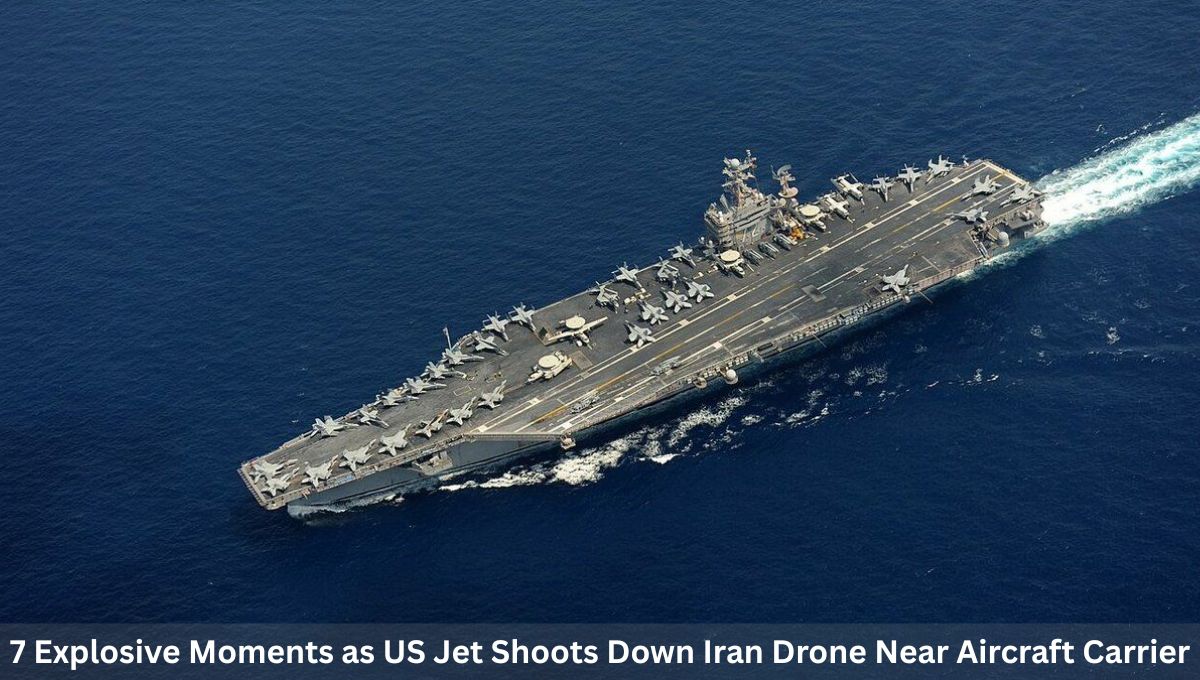
7 Explosive Moments as US Jet Shoots Down Iran Drone Near Aircraft Carrier just days ahead of planned US–Iran nuclear talks. A dramatic mid-air confrontation between the United States and Iran has sharply escalated tensions in the Middle East, after a US fighter jet shot down an Iranian drone that “aggressively approached” an American aircraft carrier in international waters of the Arabian Sea.
The incident unfolded just days before Washington and Tehran are expected to hold high-stakes diplomatic talks aimed at easing tensions over Iran’s nuclear programme — talks that are now overshadowed by renewed military brinkmanship, maritime confrontations in the Strait of Hormuz, and rising global oil prices.
US officials described the drone shoot-down as an act of self-defence. Iranian media, meanwhile, acknowledged the loss of contact with a drone but stopped short of confirming it was shot down, highlighting the deep mistrust and competing narratives that continue to define relations between the two adversaries.
What follows is a comprehensive breakdown of what happened, why it matters, and how this latest flashpoint could reshape diplomacy, security, and energy markets worldwide.
7 Explosive Moments as US Jet Shoots Down Iran Drone Near Aircraft Carrier
What Happened: US Shoots Down Iranian Drone
Drone ‘Aggressively Approached’ US Aircraft Carrier
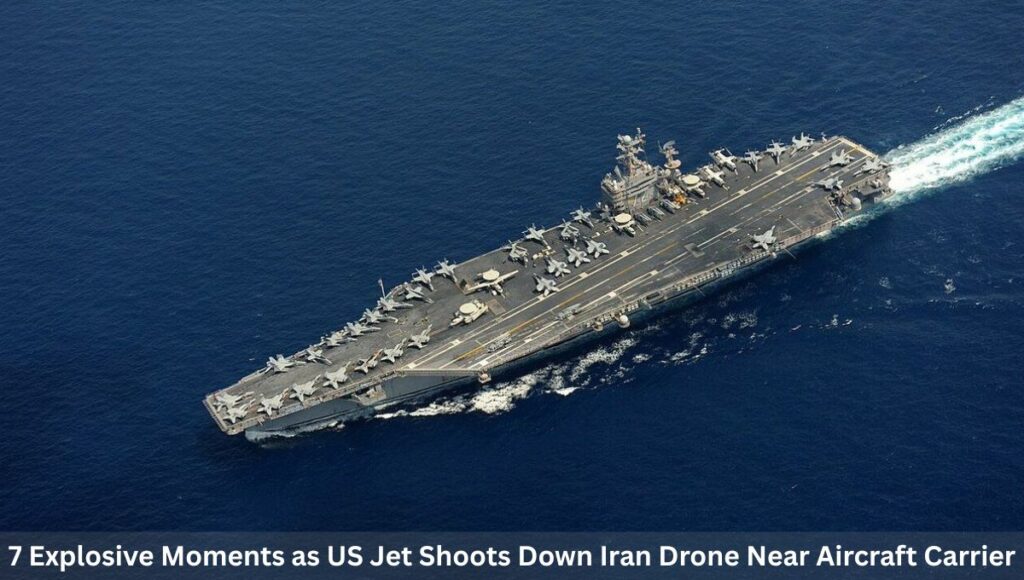
According to US Central Command (CENTCOM), an Iranian Shahed-139 drone flew toward the USS Abraham Lincoln aircraft carrier while it was transiting the Arabian Sea, roughly 800 kilometres (500 miles) from Iran’s southern coast.
Captain Tim Hawkins, a CENTCOM spokesperson, said the unmanned aircraft approached with “unclear intent” and continued toward the carrier despite US forces taking what he described as “de-escalatory measures” while operating in international waters.
In response, an F-35C fighter jet launched from the USS Abraham Lincoln shot down the drone.
“An F-35C fighter jet from Abraham Lincoln shot down the Iranian drone in self-defense and to protect the aircraft carrier and personnel on board,” Hawkins said.
No US service members were injured, and no American equipment was damaged during the incident.
Iran’s Response: Silence and Signals
Iran Acknowledges Drone Incident Without Confirming Shoot-Down
Iranian authorities did not immediately confirm the US account of events.
However, Iran’s state-affiliated Tasnim News Agency reported that communication had been lost with an Islamic Revolutionary Guard Corps (IRGC) drone operating in international waters of the Arabian Sea.
According to Tasnim, the drone had successfully transmitted reconnaissance and surveillance data back to IRGC command centres before contact was lost.
An investigation was reportedly under way to determine the cause of the disconnection.
Iran’s UN mission declined to comment, underscoring Tehran’s cautious approach as it seeks to balance military posture with diplomatic engagement ahead of planned talks.
Second Flashpoint: Iranian Boats Threaten US-Flagged Tanker
Strait of Hormuz Incident Raises Stakes
Just hours after the drone shoot-down, US Central Command reported a second confrontation — this time in the Strait of Hormuz, one of the world’s most critical maritime chokepoints.
According to US officials:
- Two Iranian IRGC gunboats
- And an Iranian Mohajer drone
approached the M/V Stena Imperative, a US-flagged and US-crewed chemical tanker transiting the strait in international waters.
Captain Hawkins said the Iranian vessels approached at high speeds and threatened to board and seize the tanker.
A US Navy destroyer, the USS McFaul, intervened with air support, escorting the tanker away from the area. The situation eventually de-escalated, and the vessel continued safely on its journey.
Competing Narratives Over Maritime Encounter
Iran Claims Vessel Entered Its Waters
Iranian news agency Fars offered a different version of events, claiming that a vessel — whose nationality it did not specify — had entered Iranian territorial waters without proper authorization.
According to Fars, Iranian forces issued a warning, after which the vessel left the area “without any special security event taking place.”
This clash of narratives mirrors previous confrontations in the Strait of Hormuz, where overlapping claims, disputed maritime boundaries, and high military presence have created a persistent risk of miscalculation.
Why the USS Abraham Lincoln Matters
Symbol of US Military Power
The USS Abraham Lincoln is the most visible component of a renewed US military buildup in the Middle East.
The carrier strike group includes:
- Around 5,700 additional US troops
- Squadrons of F/A-18E Super Hornets
- F-35C Lightning II stealth fighters
- EA-18G Growler electronic warfare aircraft
- Multiple guided-missile destroyers
The carrier was dispatched to the region amid heightened tensions following Iran’s deadly crackdown on nationwide anti-government protests and renewed US pressure on Tehran’s nuclear programme.
Diplomacy Under Fire: Nuclear Talks Still Planned
US Says Talks Are Still On Track
Despite the twin incidents at sea, the White House insists that diplomatic efforts are continuing.
White House Press Secretary Karoline Leavitt told Fox News that US special envoy Steve Witkoff is still expected to hold discussions with Iranian officials later this week.
“Those are still scheduled as of right now,” Leavitt said, while noting that President Donald Trump “always has a range of options on the table, including the use of military force.”
Trump’s Mixed Signals: Diplomacy and Threats
President Donald Trump struck a familiar dual tone — emphasizing negotiations while refusing to rule out military action.
Speaking to reporters at the White House, Trump said:
“We’re negotiating with them right now… They’d like to do something, and we’ll see if something is going to be done.”
But he also issued a pointed warning:
“If we can’t work something out, probably bad things would happen.”
Trump referenced “Midnight Hammer,” last summer’s US military operation that struck three Iranian nuclear facilities — a reminder that diplomacy is unfolding under the shadow of force.
Iran’s Conditions for Talks
‘Free From Threats and Unreasonable Expectations’
Iranian President Masoud Pezeshkian confirmed that he had instructed the country’s foreign minister to pursue negotiations with the United States — but only under specific conditions.
In a post on X, Pezeshkian wrote:
“Provided that a suitable environment exists — one free from threats and unreasonable expectations — [the foreign minister should] pursue fair and equitable negotiations.”
Iran has repeatedly stressed that:
- Talks must focus only on the nuclear issue
- Missile programmes and defence capabilities are off-limits
- Regional proxy activities should not be on the agenda
Where Will the Talks Take Place? Venue Dispute Emerges
Turkey, Oman, or Elsewhere?
While initial reports suggested talks would be held in Turkey, Iranian officials later indicated a preference for Oman, which has historically played a discreet mediating role between Washington and Tehran.
Countries including:
- Turkey
- Oman
- Qatar
- Saudi Arabia
- Pakistan
- United Arab Emirates
have all expressed willingness to host or support the talks.
However, Reuters reported that Iran is demanding:
- Oman as the venue
- A narrower agenda limited strictly to nuclear issues
These demands have cast uncertainty over whether the meeting will proceed as planned.
Israel Weighs In: ‘Iran Cannot Be Trusted’
Israeli Prime Minister Benjamin Netanyahu reportedly warned US envoy Steve Witkoff during talks in Jerusalem that Iran “cannot be trusted.”
Israel has long opposed any agreement it believes would allow Iran to retain nuclear capabilities and continues to press Washington to maintain maximum pressure on Tehran.
Oil Markets React: Prices Jump on Tensions
Crude Prices Climb 2%
Global energy markets reacted swiftly to the developments.
On Tuesday:
- Brent crude rose about 1.6%, settling at $67.33 per barrel
- West Texas Intermediate (WTI) climbed 1.7%, closing at $63.21 per barrel
Prices later rose further in post-settlement trading before paring gains after Trump reiterated that negotiations were ongoing.
Analysts warned that any disruption in the Strait of Hormuz — through which much of the world’s oil supply passes — could have immediate and far-reaching consequences.
Why the Strait of Hormuz Is Critical
A Global Energy Lifeline
The Strait of Hormuz connects the Persian Gulf to the Gulf of Oman and the Arabian Sea. It is one of the world’s most important energy corridors.
Major oil exporters that rely on the strait include:
- Saudi Arabia
- Iran
- Iraq
- Kuwait
- United Arab Emirates
Any escalation involving military vessels or commercial shipping in this narrow waterway raises fears of supply disruptions and price shocks affecting consumers worldwide.
US-Iran Tensions Rooted in Domestic Unrest
Iran’s Deadly Crackdown
The current crisis is unfolding against the backdrop of Iran’s deadliest domestic unrest since the 1979 Islamic Revolution.
Protests that began in December over rising living costs evolved into nationwide anti-government demonstrations.
According to Iranian officials:
- More than 3,000 people were killed
- Authorities claim many deaths involved security forces and bystanders
However, human rights groups paint a far grimmer picture.
The US-based Human Rights Activists News Agency says it has documented:
- 6,872 deaths, mostly protesters
- At least 50,553 arrests
Iranian authorities blame the unrest on foreign interference, accusing the United States and Israel of inflaming the protests.
Military Buildup and Strategic Calculations
Flexing Muscle or Preparing for Conflict?
Analysts say the US military buildup — including the deployment of the USS Abraham Lincoln — serves multiple purposes.
Alex Vatanka of the Middle East Institute noted:
- Washington may be trying to pressure Iran into concessions
- Or it could be preparing for a prolonged confrontation
“The question is whether this is about getting Iranian attention for a deal — or laying the groundwork for something much bigger,” Vatanka said.
Can Diplomacy Succeed Under Fire?
Despite repeated statements from both sides expressing openness to talks, many analysts remain sceptical.
Key obstacles include:
- Deep mistrust after past negotiations collapsed
- US demands extending beyond nuclear issues
- Iran’s insistence on limiting the scope of talks
With military incidents unfolding even as diplomats prepare to meet, the risk of miscalculation remains high.
Global Implications Beyond the Middle East
The shoot-down of an Iranian drone near a US aircraft carrier is not just a regional story.
It has implications for:
- Global energy prices
- International shipping security
- Nuclear non-proliferation efforts
- Stability across the Middle East
For global audiences, the incident underscores how quickly diplomatic openings can be overshadowed by military confrontation.
Conclusion: A Fragile Moment for Peace
The US decision to shoot down an Iranian drone approaching the USS Abraham Lincoln marks a sharp escalation at a critical diplomatic moment.
While Washington and Tehran insist they remain committed to talks, events at sea reveal how thin the margin for error has become.
As fighter jets, warships, and armed boats operate in close proximity across vital waterways, even a single incident has the potential to derail diplomacy — and send shockwaves through global markets.
Whether the planned nuclear talks can survive this latest flare-up remains uncertain.
What is clear is that the path to de-escalation is narrowing, and the stakes — for the region and the world — could hardly be higher.
Also Read: 7 Explosive Choices Facing Trump as Iran Standoff Nears Breaking Point
Also read: Trump says talks with Iran continuing as US shoots down an Iranian drone
Related Posts:
- 3 Explosive Conditions Iran Sets to End War with US…

- 7 Powerful Facts About Ayatollah Ali Khamenei’s…

- 11 Explosive Warnings as Trump Vows to ‘Knock the…

- 10 Explosive Warnings as Donald Trump Calls Iran…
- 9 Explosive Claims as Trump Says US Winning Iran War

- Insights from Pakistan Navy’s $1 Billion Arabian Sea…