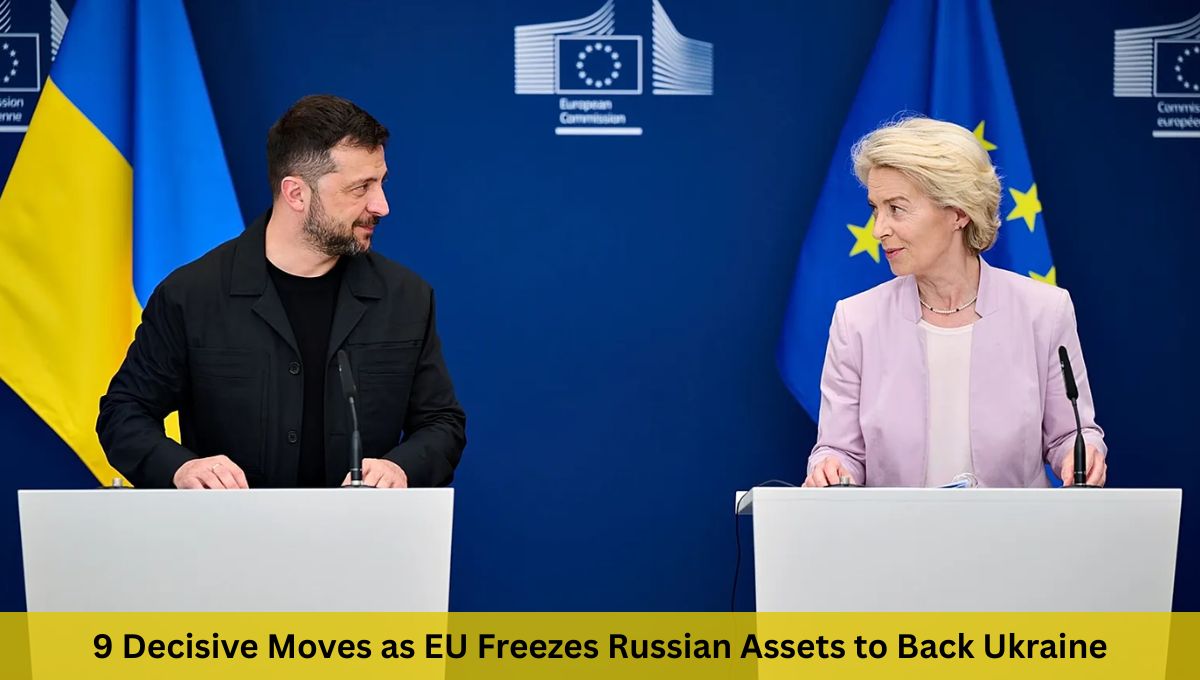
9 Decisive Moves as EU Freezes Russian Assets to Back Ukraine long term. The European Union has taken one of its most consequential financial and political decisions since the start of Russia’s invasion of Ukraine, agreeing to indefinitely freeze hundreds of billions of euros in Russian sovereign assets held in Europe.
The move is designed to ensure that EU support for Ukraine cannot be blocked by dissenting member states and to unlock long-term funding for Kyiv as the war approaches its fourth year. By invoking emergency treaty provisions, EU governments have effectively removed the requirement for unanimous six-monthly renewals of sanctions freezing Russian assets.
This closes a loophole that could have allowed Hungary or Slovakia — both governed by leaders with relatively friendly ties to Moscow — to veto the continuation of the freeze and potentially force the release of the funds back to Russia.
9 Decisive Moves as EU Freezes Russian Assets to Back Ukraine
What the EU Decided
On Friday, EU member states agreed to “indefinitely immobilise” approximately €210 billion ($246 billion) in Russian central bank assets held within the bloc. The assets will remain frozen until Russia ends what the EU describes as its war of aggression against Ukraine and provides compensation for the damage caused.
European Council President António Costa said the decision fulfilled a commitment made by EU leaders in October.
“In October, European leaders committed to keep Russian assets immobilised until Russia ends its war of aggression against Ukraine and compensates for the damage caused. Today we delivered on that commitment,” Costa said.
Under the new mechanism, the European Commission will review the situation annually, but the funds will remain locked on EU soil unless the commission determines that the exceptional circumstances justifying the freeze no longer exist.
Why Hungary and Slovakia Matter
Until now, EU sanctions freezing Russian assets had to be renewed every six months by unanimous agreement of all 27 member states. This gave individual countries effective veto power.
Hungary and Slovakia have repeatedly opposed deeper EU military and financial support for Ukraine. Hungarian Prime Minister Viktor Orbán, in particular, has positioned himself as the Kremlin’s closest ally within the EU, regularly criticising sanctions and questioning Ukraine aid.
EU officials feared that a future veto by either country could force the bloc to release the frozen assets, undermining Ukraine support and weakening Europe’s negotiating position in any peace talks. By shifting to an emergency procedure that relies on qualified majority voting, the EU has neutralised that risk.
The Scale of the Frozen Assets
The frozen assets are among the largest pools of sovereign wealth ever immobilised under international sanctions. Of the €210 billion total, around €193 billion is held at Euroclear, a Belgium-based financial clearing house that processes global securities transactions.
The funds were frozen in 2022 after Russia launched its full-scale invasion of Ukraine on February 24 of that year. Since then, they have remained largely untouched, generating interest income but unable to be accessed by Moscow.
The EU’s decision ensures that these assets cannot be used as bargaining chips in negotiations to end the war without European approval.
Unlocking Long-Term Support for Ukraine
The indefinite freeze is a crucial step toward enabling the EU to use Russian assets to underpin a massive loan package for Ukraine.
EU leaders are expected to finalise plans at a European Council summit on December 18 to use the immobilised assets to guarantee loans of up to €165 billion to Ukraine.
The funds would cover Kyiv’s military and civilian budget needs in 2026 and 2027.
“Next step: securing Ukraine’s financial needs for 2026–27,” Costa said, confirming that the decision clears a major obstacle ahead of the summit.
The European Commission argues that such funding is essential as Ukraine faces sustained military pressure and mounting reconstruction costs.
Belgium’s Legal Concerns
Belgium, where Euroclear is based, has been among the most cautious EU members regarding the use of frozen Russian funds.
The Belgian government has warned that using the assets as collateral for loans or reparations could expose the country and Euroclear to significant legal and financial risks, including potential lawsuits from Russia.
Officials fear that if courts eventually rule in Moscow’s favour, Belgium could be left liable for billions of euros. To address these concerns, EU leaders are expected to offer guarantees to Belgium, sharing the legal and financial risks across the bloc.
Russia’s Legal Response
Russia has reacted angrily to the EU’s move. On Friday, Russia’s Central Bank said it had filed a lawsuit in Moscow against Euroclear, seeking damages for what it claims were losses caused by being barred from managing its assets.
In a separate statement, the bank described EU plans to use the frozen assets as “illegal” and contrary to international law, arguing that they violate the principle of sovereign immunity.
Moscow has warned of a broader campaign of legal and economic retaliation if the EU proceeds with tapping the funds.
Euroclear has declined to comment publicly on the lawsuit.
Orbán’s Fierce Criticism
Hungarian Prime Minister Viktor Orbán launched a scathing attack on the European Commission and EU leaders following the decision.
Writing on social media, Orbán accused the commission of “systematically raping European law” and claimed that the move marked the end of the rule of law within the EU.
“It is doing this in order to continue the war in Ukraine, a war that clearly isn’t winnable,” Orbán wrote, adding that Hungary would “do everything in its power to restore a lawful order.”
The Hungarian government has argued that removing unanimity sets a dangerous precedent and undermines the treaty-based legal order of the EU.
Slovakia Signals Resistance
Slovakia has also voiced strong reservations. In a letter to António Costa, Slovak Prime Minister Robert Fico said he would refuse to support any measures that include covering Ukraine’s military expenses in coming years.
Fico warned that using frozen Russian assets could jeopardise US-led peace efforts, which he said envisioned the funds being used for Ukraine’s reconstruction rather than military purposes.
Despite these objections, Slovakia lacks the numbers to block the decision under the new voting mechanism.
The EU’s Economic Argument
The European Commission has defended the move by pointing to the heavy economic toll the war has imposed on the EU itself.
Higher energy prices, inflationary pressures and reduced economic growth have cost EU economies billions of euros since 2022. The bloc has already provided nearly €200 billion in financial, military and humanitarian support to Ukraine.
Commission officials argue that immobilising Russian assets is a proportionate response to Russia’s actions and a necessary step to ensure that the aggressor, rather than European taxpayers alone, bears the cost of the war.
A Blow to Backroom Peace Deals
Another consequence of the decision is that it prevents the frozen assets from being used in any peace negotiations without EU consent.
A controversial 28-point plan reportedly drafted by US and Russian envoys last month included provisions that would have released the frozen assets for use by Ukraine, Russia and the United States. The plan was rejected by Kyiv and by European allies, who saw it as undermining Ukraine’s position.
French Foreign Minister Jean-Noël Barrot said the EU decision ensured that “no one will decide in place of the Europeans the use of these funds.”
Diplomatic Efforts Continue
The asset freeze comes amid intensified diplomatic efforts led by the United States to explore a ceasefire framework between Moscow and Kyiv.
Ukraine has pushed back against elements of an initial US-drafted proposal that it viewed as favouring Russia, particularly provisions related to territorial concessions in eastern Ukraine.
President Volodymyr Zelenskyy has insisted that any peace deal must include credible security guarantees to prevent future Russian aggression.
Fighting Still Rages
Despite diplomatic manoeuvring, the war on the ground shows no sign of slowing. Ukrainian forces have reported gains around the northeastern city of Kupiansk in the Kharkiv region, claiming to have retaken several districts and encircled Russian troops.
Zelenskyy visited the front-line area this week, saying battlefield successes were strengthening Ukraine’s diplomatic hand. Russia, meanwhile, continues missile and drone strikes across Ukraine, while Kyiv has claimed to have hit Russian targets as far away as the Caspian Sea.
Why This Decision Matters
By indefinitely freezing Russian assets, the EU has crossed a strategic threshold.
The move locks in long-term financial leverage over Moscow, reassures Ukraine of sustained European backing, and signals that internal dissent will not derail collective action on one of the bloc’s core foreign policy challenges.
At the same time, it raises complex legal questions about sovereign immunity and sets a precedent that could reshape how international sanctions are used in future conflicts.
What Happens Next
EU leaders meeting in Brussels on December 18 are expected to finalise the structure of the Ukraine loan package backed by the frozen assets.
Negotiators will also continue working to reassure Belgium and other cautious member states that legal risks will be fairly shared.
As the war grinds on, the EU’s decision ensures that Russian funds will remain a central pillar of Europe’s strategy — both to support Ukraine and to pressure Moscow toward a settlement on terms acceptable to Kyiv and its allies.
Also Read: What is the EU’s ‘reparation loan’ plan for Ukraine using Russian funds?
Related Posts:
- H-1B Visa Renewals Face Costly New Fees: 5 Shocking…

- 5 Major Takeaways from the US Supreme Court's…

- 7 Heartbreaking Facts About Venezuela's Earthquake Disaster
- In 8 Moves, EU Targets China-Linked Refineries and…

- 7 Critical Reasons the Donbas Is the Most Explosive…
- 3 Explosive Conditions Iran Sets to End War with US…