7 Explosive Facts as Thailand–Cambodia Airstrikes Threaten Trump’s Peace Deal, pushing it to the brink of collapse. Tensions along the long-disputed Thailand–Cambodia border escalated dramatically on Monday after Thailand launched airstrikes against Cambodian military positions, marking one of the most serious flare-ups between the two Southeast Asian neighbours in years.
The renewed violence has cast serious doubt over a peace agreement brokered by US President Donald Trump just two months ago — an accord once touted by Trump as a major diplomatic win. At least one Thai soldier was killed and several others injured, according to Thai military officials, while thousands of civilians on both sides of the border were forced to flee.
Both governments accused the other of violating the fragile ceasefire, exposing deep mistrust and unresolved historical grievances.
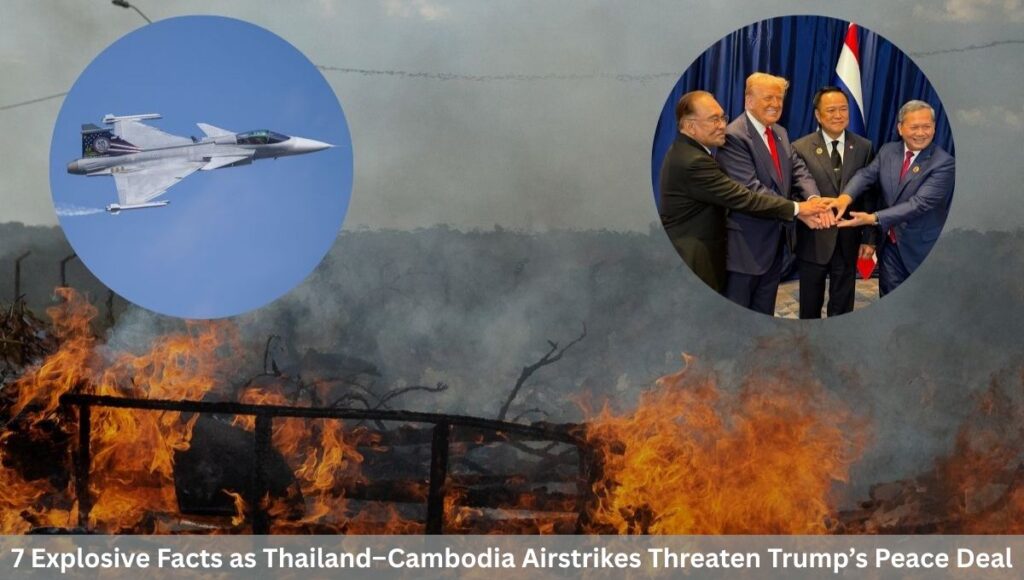
7 Explosive Facts as Thailand–Cambodia Airstrikes Threaten Trump’s Peace Deal
Airstrikes Signal Dangerous Escalation
Thailand’s military confirmed it deployed fighter aircraft to strike Cambodian targets early Monday morning after what it described as a deadly attack on Thai forces.
Thailand’s account of the clashes
Thai army spokesman Major General Winthai Suvaree said Cambodian troops initiated the violence by firing artillery and mortars at Thai positions near the Chong An Ma Pass and Anupong Base in Ubon Ratchathani province.
“Thai soldiers were attacked with supporting fire weapons, resulting in one soldier killed and four wounded,” Suvaree said.
The Royal Thai Air Force (RTAF) stated that the airstrikes targeted Cambodian military infrastructure, including logistics hubs and fire-support positions, and were intended to suppress further attacks and prevent escalation.
Thai officials also alleged that Cambodian forces had mobilised heavy weapons, repositioned combat units, and prepared rocket-launch systems — actions Bangkok interpreted as preparations for a broader offensive.
Cambodia Denies Retaliation, Condemns Strikes
Cambodia categorically rejected Thailand’s claims and accused Thai forces of initiating the attacks. In a statement released by the Cambodian Ministry of National Defense, Phnom Penh said Thai troops launched assaults on Cambodian positions at around 5:04 a.m. local time in Preah Vihear province.
“Cambodia did not retaliate and continues to monitor the situation vigilantly and with utmost caution,” the ministry said.
Calling the strikes a “grave violation” of the October joint declaration, Cambodia accused Thailand of undermining peace efforts witnessed by US President Donald Trump and Malaysian Prime Minister Anwar Ibrahim, ASEAN’s rotating chair.
Cambodia’s former Prime Minister Hun Sen urged restraint, accusing Thai forces of deliberately provoking clashes to sabotage the ceasefire.
Civilians Bear the Brunt of Renewed Fighting
While both militaries traded accusations, civilians once again paid a heavy price.
Mass evacuations on both sides
- Thai authorities confirmed that around 35,000 people were evacuated from border communities.
- Cambodia’s Oddar Meanchey province reported villagers fleeing their homes and schools being suspended.
- Gunfire was reported near historic sites, including the Tamone Thom and Ta Krabei temples, raising alarm over potential damage to culturally significant areas.
The renewed displacement echoes July’s violence, when more than 300,000 people were temporarily forced from their homes.
A Fragile Ceasefire Unravels
The latest clashes have exposed how fragile the peace agreement between Thailand and Cambodia had become.
Timeline of the failed peace
- July: Five days of intense fighting kill at least 43 people.
- July 28: Initial ceasefire agreed after mediation by Trump and Malaysia.
- October: Expanded ceasefire signed in Kuala Lumpur, witnessed by Trump and Anwar Ibrahim.
- November: Thailand halts implementation after a landmine blast injures Thai soldiers.
- December: Airstrikes resume, effectively collapsing the truce.
Thailand blamed Cambodia for the landmine explosion, while Phnom Penh said it was a leftover device from past conflicts.
Trump’s Diplomatic Victory Under Threat
US President Donald Trump had publicly celebrated the Thailand–Cambodia agreement as proof of his ability to end international conflicts — a central theme of his foreign policy messaging.
The October declaration was promoted by Trump as evidence of successful American diplomacy in Southeast Asia, alongside other disputed claims of ending wars elsewhere.
However, the rapid collapse of the ceasefire has raised questions about the durability of Trump-led mediation and the limits of external pressure when deep-rooted disputes remain unresolved.
Malaysia and ASEAN Urge Restraint
Malaysia’s Prime Minister Anwar Ibrahim, who co-brokered the ceasefire in his role as ASEAN chair, expressed deep concern over the renewed violence.
“The renewed fighting risks unravelling the careful work that has gone into stabilising relations between the two neighbours,” he said.
ASEAN, a bloc built on consensus and non-interference, now faces renewed pressure to prevent conflict between two of its members — a challenge that threatens regional credibility.
Why the Thailand–Cambodia Border Is So Volatile
At the heart of the conflict lies a century-old border dispute dating back to French colonial maps from 1907.
Key sources of tension
- The 817-kilometre border remains partially undemarcated.
- Both countries claim sovereignty over several ancient temples.
- Nationalist sentiment flares quickly when troops clash near culturally sacred sites.
- Past efforts at arbitration, including UN and international court rulings, have failed to fully resolve overlapping claims.
Despite decades of negotiations, military skirmishes have erupted repeatedly — most notably in 2011, when artillery exchanges lasted a week.
Military Claims and Counterclaims
Both sides have released sharply conflicting versions of events.
Thailand’s position
- Cambodia fired first using mortars, artillery, and rockets.
- Airstrikes were defensive and proportionate.
- Targets were strictly military and chosen under international law.
Cambodia’s position
- Thai forces initiated the attacks.
- Cambodia did not retaliate.
- Thai strikes violated sovereignty and international agreements.
The lack of independent verification has made it difficult to determine responsibility, though the scale of Thailand’s air operations represents a significant escalation.
Risk of a Wider Conflict
Analysts warn that continued skirmishes could spiral into prolonged conflict, especially if nationalist pressure builds on either government.
Potential risks include:
- Accidental civilian casualties
- Damage to cultural heritage sites
- Breakdown of ASEAN conflict-management mechanisms
- Increased involvement by external powers
The presence of high-profile mediators, including the United States and Malaysia, raises the stakes for diplomacy — and failure.
What Happens Next?
Despite the violence, officials on both sides have signalled — at least rhetorically — a desire to avoid all-out war. Cambodia reiterated its commitment to peaceful resolution, while Thailand framed its strikes as limited and defensive.
Whether dialogue resumes or fighting intensifies may depend on:
- ASEAN-led mediation efforts
- Pressure from Washington
- Domestic political calculations in Bangkok and Phnom Penh
For now, the ceasefire that once symbolised a diplomatic breakthrough appears dangerously close to collapse.
Conclusion: A Peace Deal Hanging by a Thread
The Thailand–Cambodia border airstrikes mark a sobering reminder that diplomatic agreements, no matter how high-profile, cannot erase longstanding disputes overnight.
As civilians flee, soldiers die, and accusations fly, the fate of Trump’s much-vaunted peace deal now hangs in the balance. Without swift and credible mediation, Southeast Asia risks seeing another frozen conflict thaw into something far more destructive.
For a region built on the promise of cooperation and stability, the cost of failure could be enormous.
Also Read: Thailand-Cambodia Border Ceasefire Holds Amid Tensions and Global Pressure
Also Read: From ceasefire to airstrikes: Timeline of Thailand-Cambodia border dispute
Related Posts:
- Thai F-16 Jet Bombs Cambodian Targets as Deadly…

- 7 Powerful Takeaways from Trump’s Thai-Cambodia Peace Deal
- 7 Explosive Developments as Cambodia Accuses…

- 11 Dangerous Signals as Thailand–Cambodia Airstrikes…

- 5 Powerful Highlights as Trump Lands Second Nobel…

- Deadly Border Clashes Between Thailand and Cambodia…