7 Alarming Facts: Rare Senyar & Ditwah Cyclones Devastate Southeast Asia, triggering floods, landslides, mass displacement and overwhelmed rescue operations. A catastrophic sequence of weather events has battered Southeast Asia and parts of South Asia, leaving more than 1,000 people dead, millions displaced, and entire regions submerged.
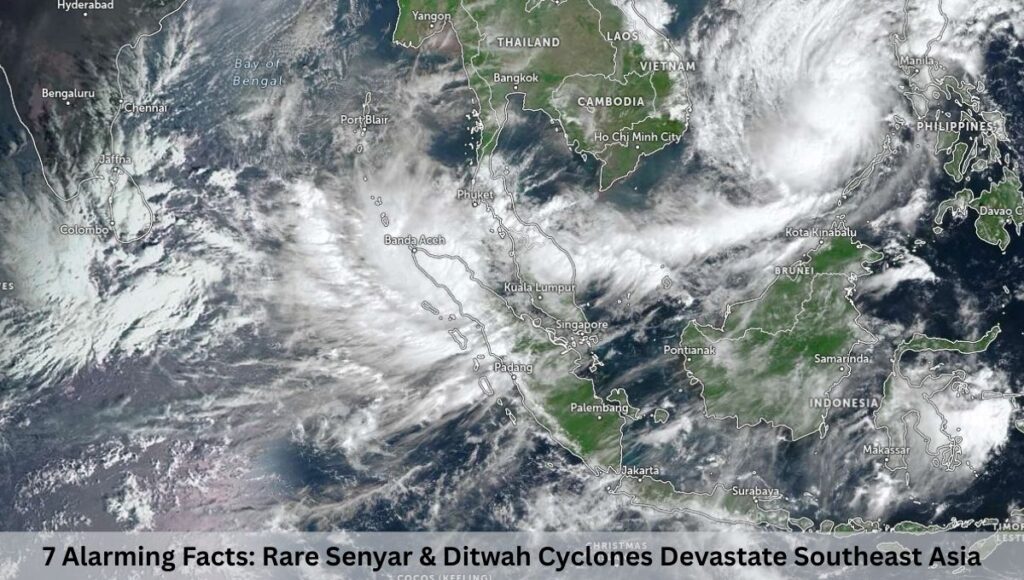
A rare combination of tropical systems—Cyclone Senyar, Cyclone Ditwah, and Typhoon Koto—produced one of the most destructive multi-country natural disasters in decades, striking Indonesia, Thailand, Sri Lanka, Malaysia and brushing the southern coast of India.
The disaster has shocked meteorologists and governments alike, not only because of its scale, but also because of its rarity: Cyclone Senyar was the first tropical cyclone to form in the Strait of Malacca since Typhoon Vamei in 2001. The unusual combination of storms created a relentless chain of floods, landslides and infrastructure collapses that crippled entire provinces.
Below is a full breakdown of what happened, how it unfolded, and why climate experts believe this may mark a turning point for the region’s vulnerability to extreme weather.
7 Alarming Facts: Rare Senyar & Ditwah Cyclones Devastate Southeast Asia
A Week of Catastrophe: How the Storm Sequence Unfolded
The sequence began with an innocuous deep depression over the Strait of Malacca that quickly intensified into Cyclone Senyar, fueled by unusually warm waters and atmospheric instability. As Senyar weakened and moved away from India, a second system—Cyclone Ditwah—rapidly developed over the southwest Bay of Bengal.
Just as relief teams were scrambling to respond to Senyar’s damage, Ditwah made landfall in Sri Lanka, unleashing torrential rain and triggering a humanitarian emergency. Meanwhile, Typhoon Koto churned east of Vietnam, adding additional rainfall to already saturated regions.
The combined influence of these storms created widespread flooding, landslides, power outages, collapsed roads, blocked hospitals and widespread displacement across Southeast Asia.
Cyclone Senyar — A Rare Storm in the Malacca Strait
First Cyclone in the Strait Since 2001
Cyclone Senyar’s formation stunned meteorologists because the Strait of Malacca rarely generates cyclones. Tropical systems seldom form near the equator due to the weak Coriolis effect. The last major storm to form here was Typhoon Vamei nearly 25 years ago.
According to the Hong Kong Observatory, Senyar formed because of:
- Exceptionally warm sea-surface temperatures
- Favorable wind shear patterns
- Enhanced atmospheric convection
- A rare alignment of monsoonal winds
The unusual alignment created a spinning low-pressure vortex strong enough to intensify into a named cyclone.
Indonesia Hit Hardest — 500+ Dead and Hundreds Missing
Indonesia’s Sumatra Island bore the worst of Senyar’s fury. Torrential rains over a full week triggered massive landslides and flooding across West Sumatra, North Sumatra and Aceh provinces.
Authorities reported:
- At least 502 deaths
- 508 missing persons
- More than 200,000 displaced
- Entire villages buried or cut off
Roads were wiped out, leaving many communities accessible only by helicopter or naval vessels. Power lines and communication networks collapsed, complicating rescue operations.
Residents described the flooding as “the worst in our lifetime.” Many homes were submerged up to their rooftops.
Infrastructure in Ruins
Cyclone Senyar caused:
- Washed-out bridges
- Collapsed roads
- Destroyed farmland
- Submerged homes
- Crippled hospitals
Petron Malaysia Refining & Marketing Bhd even halted operations at a major crude oil refinery after storm damage—an extremely rare occurrence highlighting the storm’s intensity.
To reduce further rainfall, Indonesia deployed aerial cloud seeding aircraft—an emergency measure typically reserved for extreme weather.
Thailand’s Worst Flooding in Decades
176 Deaths and Nearly 3 Million Affected
Southern Thailand faced the brunt of Cyclone Senyar’s rain bands. Extreme rainfall triggered massive flooding across 12 southern provinces, killing at least 176 people.
Nearly 2.8 million residents were affected.
Hat Yai Hit With Once-in-300-Years Rainfall
Hat Yai—the region’s largest city—recorded:
- 335 mm rainfall in a single day
- Floodwaters reaching eight feet
- Hospitals cut off
- 30 newborn babies trapped in a maternity ward
Rescue teams airlifted patients, distributed oxygen tanks, and delivered food supplies to submerged neighborhoods.
Rising Criticism Over Government Response
Despite rolling out relief measures, Thailand’s government faced criticism. Two local officers were suspended for alleged failure to respond adequately as entire communities waited hours—or days—for evacuation.
Videos showed:
- Cars overturned or stacked on top of each other
- Homes buried in mud and debris
- Power poles snapped
- Appliances floating along streets
The destruction is already considered one of the worst floods Thailand has faced in a decade.
Cyclone Ditwah — Sri Lanka’s “Most Challenging Disaster Ever”
Death Toll Surges to 355 With Hundreds Missing
Cyclone Ditwah struck Sri Lanka with unprecedented ferocity. Within hours:
- 355 people died
- 366 went missing
- 147,000 were forced into temporary shelters
- Over 25,000 homes were destroyed
President Anura Kumara Dissanayake declared it the most challenging natural disaster Sri Lanka has ever faced, surpassing even the tsunami in terms of geographic scale.
Entire towns in the central hill country were buried under landslides. Many families were stranded for days without power, communication or access to food.
Communities Cut Off, Families Rescued by Boats
Boats became the only reliable means of transport in some regions. Rescuers navigated flooded streets to reach families trapped on rooftops or floating debris.
At a mosque in Dalugala Thakiya, volunteers prepared rice meals with chicken and dhal curry to feed victims who lost everything.
Humanitarian groups described the situation as “starting over from zero.”
India’s Southern Coast Avoids Direct Hit but Sees Heavy Rainfall
Cyclone Ditwah was initially forecast to strike Tamil Nadu, Puducherry and south Andhra Pradesh around November 30. Though it eventually curved away from the coast, it still produced:
- Heavy rainfall
- Urban flooding
- Three deaths from rain-related incidents in Tamil Nadu
Authorities maintained red alerts for extreme rainfall but later lifted major warnings as the storm weakened.
Malaysia Faces Flooding and Evacuations
Malaysia experienced relatively weaker direct impacts but still suffered:
- 2 deaths
- 34,000+ people evacuated
- Widespread flooding across Perlis and Kedah
Some residents described fleeing waist-deep waters only to spend nights stranded in open fields. Many reached relief centers only hours before floodwaters surged again.
“The water looked like the ocean,” one elderly survivor recounted.
Typhoon Koto Adds to Regional Crisis
To the east, Typhoon Koto hovered offshore Vietnam. While it did not make landfall, its outer bands delivered:
- Additional heavy rainfall
- Renewed landslide risks
- Saturated river basins
Vietnam was already dealing with devastating floods earlier in the month, with billions of dollars in damages.
Meteorologists warn that the overlapping of these three storms—Senyar, Ditwah and Koto—created a rare and destructive weather synergy across Southeast Asia.
Search and Rescue Efforts Continue Across the Region
Indonesia: Thousands Still Missing
Indonesian President Prabowo Subianto visited multiple disaster zones, acknowledging massive shortages in:
- Fuel
- Medical supplies
- Rescue equipment
Entire regions remain unreachable due to collapsed terrain and blocked roads.
Sri Lanka: The Hardest Rescue Operation in its History
With families stranded for up to four days, rescuers continue:
- Searching collapsed homes
- Navigating treacherous mudslides
- Evacuating villages at risk of secondary landslides
Humanitarian agencies fear the death toll will rise.
Thailand: Water Receding but Devastation Remains
Water levels in many areas have begun receding, but:
- Homes are destroyed
- Schools remain closed
- Hospitals are damaged
- Roads are impassable
More than 3.8 million people were affected.
Climate Change and the Future of Southeast Asia’s Weather Extremes
Scientists have long warned that Southeast Asia is one of the most climate-vulnerable regions on Earth. This disaster highlights the danger of:
- Warmer ocean temperatures
- Unpredictable monsoon cycles
- Increasingly frequent extreme rainfall events
- Stronger and more erratic cyclones
Meteorologists say the interaction of Typhoon Koto, Cyclone Senyar, and Cyclone Ditwah is a clear example of how climate systems can collide to create catastrophic outcomes.
A climatologist cited by CNN noted that the region recently experienced some of the highest temperatures in recorded history, stressing ecosystems and intensifying storm development.
Governments across Southeast Asia face increasing pressure to:
- Strengthen early warning systems
- Improve urban drainage
- Tighten land-use policies in landslide-prone regions
- Invest in climate-resilient infrastructure
- Enhance cross-border disaster coordination
Human Stories From the Ground — Loss, Survival and Hope
Beyond the numbers, the human toll is overwhelming.
Indonesia: “We fled with only the clothes we were wearing.”
Many families from North Aceh and West Sumatra described waking up to roaring floodwaters:
- Homes collapsed
- Belongings buried
- Fields destroyed
Helicopter footage captured residents waving frantically from rooftops.
Thailand: Surviving 48 Hours on a Washing Machine
One family in Hat Yai spent two days perched on furniture, lifting their legs to avoid deep water, surviving only on determination and hope until rescuers arrived.
Sri Lanka: Families stranded on rooftops with no food
Volunteers recounted calls from families trapped on roofs. A police special taskforce arranged a lorry to transport a boat for a rescue—an improvised solution that saved multiple lives.
Relief Efforts and What Happens Next
Governments across the region have mobilized:
- Military personnel
- Naval ships
- Helicopters
- Disaster response teams
- Health workers
- International aid partners
Forecasts suggest weather conditions may improve by midweek, with drier patterns expected for Malaysia, Sumatra and parts of southern India.
But experts warn recovery will take months, if not years.
Conclusion: A Wake-Up Call for Southeast Asia
The devastating impacts of Cyclone Senyar, Cyclone Ditwah and Typhoon Koto underscore a powerful reality: climate change is reshaping the region’s weather patterns faster than expected.
With more than 1,000 lives lost, millions displaced, and entire regions submerged, this disaster is a sobering reminder of the urgent need for climate adaptation, early warning infrastructure and resilient urban planning.
As rescue operations continue, Southeast Asia faces an enormous humanitarian challenge—and an even larger task of preparing for a future where rare storms may no longer be rare at all.
Also Read: Air India Cancels Flights as Super Typhoon Ragasa Batters Asia