
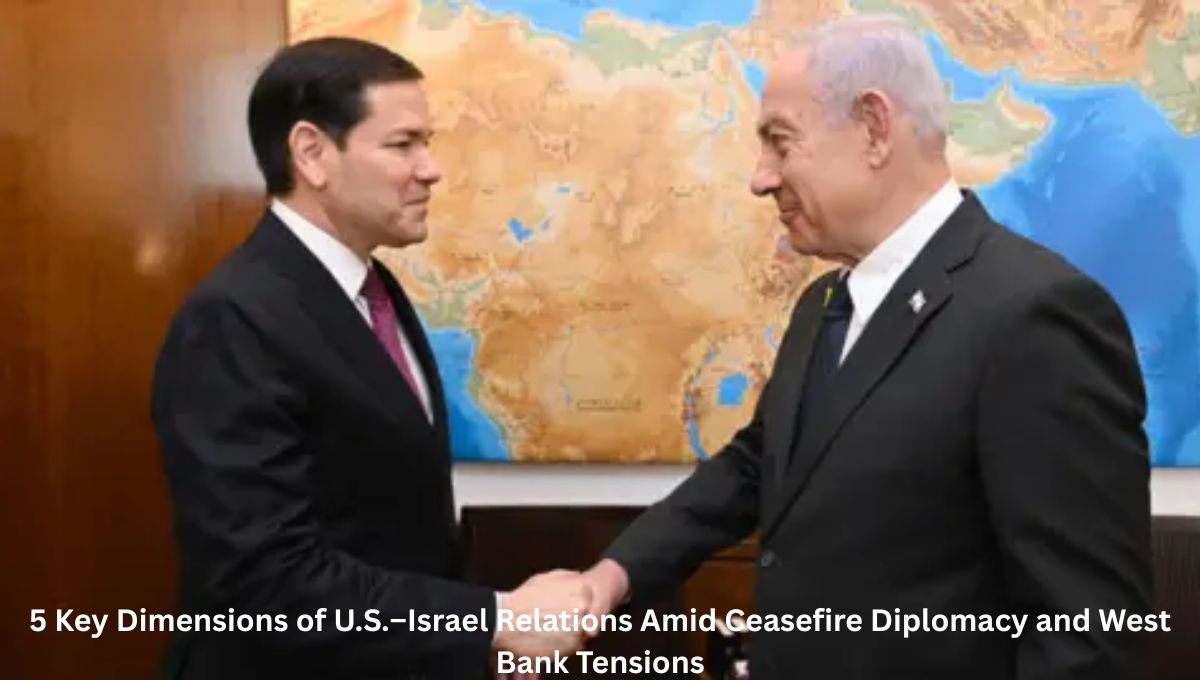
5 Key Dimensions of U.S.–Israel Relations Amid Ceasefire Diplomacy and West Bank Tensions — deepening strains in their alliance. The relationship between the United States and Israel is facing renewed tension as Israeli lawmakers move forward with bills that would apply Israeli law to occupied parts of the West Bank, and as the U.S. administration pushes to stabilise a fragile ceasefire in Gaza. The initiatives by the Israeli parliament, the responses from Washington, and the underlying strategic imperatives offer a window into how alliance dynamics, regional diplomacy and legislation interact.
5 Key Dimensions of U.S.–Israel Relations Amid Ceasefire Diplomacy and West Bank Tensions
Background: Israeli Bills and West Bank Annexation Moves
Late October 2025 saw the Israeli parliament (the Knesset) advance two bills in preliminary votes that signal a push toward the formal annexation of parts of the occupied West Bank — territory captured by Israel in 1967 and claimed by Palestinians for a future state.
- One bill would annex the settlement of Ma’ale Adumim (in the West Bank) and apply Israeli sovereignty there.
- A second, broader bill would apply Israeli law to all illegal settlements in the West Bank — effectively reversing the current status of military occupation.
On 22 October, these votes passed preliminary readings: the Ma’ale Adumim bill by 32–9, the broader sovereignty bill narrowly by 25–24. The bills were sponsored by far-right MKs outside the governing coalition; most of the ruling Likud Party members abstained or boycotted.
While the motions remain far from becoming law (three further readings are required), they represent a major political signal.
U.S. Response: “The West Bank Will Not Be Annexed”
In Washington, the U.S. reaction was immediate and strongly worded. President Trump said:
“Don’t worry about the West Bank. Israel’s not going to do anything with the West Bank.”
Earlier, on 25 September, he had told reporters:
“I will not allow Israel to annex the West Bank. I will not allow it. It’s not going to happen.”
Vice-President Vance, speaking from Israel during a two-day visit, was even more pointed. On 23 October he told reporters:
“If it was a political stunt, it was a very stupid political stunt, and I personally take some insult to it.”
“The West Bank is not going to be annexed by Israel. The policy of the Trump administration is that the West Bank will not be annexed.”
Secretary of State Rubio added that the annexation moves “could endanger” the U.S.-brokered Gaza ceasefire plan.
In short: the U.S. is signalling that annexation is off-limits and is linking it to broader regional diplomacy, including normalization with Arab states.
Also Read: Trump Says He Will Not Allow Israel to Annex West Bank Amid Global Pressure
Why the U.S. Opposes Annexation — Strategic and Diplomatic Stakes
Arab-Israeli Normalisation At Risk
One key reason for U.S. opposition is the impact on the so-called Abraham Accords and potential normalization with Saudi Arabia and other Gulf states.
French President Emmanuel Macron warned that Israeli annexation would be a “red line” for the U.S. and would threaten Arab-Israeli deals.
By publicly linking the annexation risk to the breakdown of normalization, Washington is signalling to Israel that the strategic benefits of Arab ties might be jeopardised by unilateral territorial moves.
Gaza Ceasefire Fragility
A second driver is the delicate ceasefire in Gaza. The U.S., via Vance and envoys, is seeking to stabilise the region after the 2023 war and advance into reconstruction and interim governance plans.
Annexation of the West Bank could jeopardise that by undermining Palestinian political legitimacy and inflaming tensions.
Vance noted that Israel and Hamas were largely abiding by the ceasefire while he was in Israel, but warned of the risk posed by unilateral steps.
Legal and International-Law Considerations
Although Israel disputes that annexation would breach international law, much of the world regards Israeli settlements and annexation of occupied territory as illegal under the Fourth Geneva Convention and the advisory opinion of the International Court of Justice.
By publicly positioning itself against annexation, the U.S. is aligning (at least in rhetoric) with broader international norms — and signalling that changing norms may carry costs.
Israel’s Domestic Politics: Motives and Constraints
Driving Forces Behind Annexation Bills
Within Israel’s political spectrum, annexation has long been a goal of the nationalist-religious right. For many, the West Bank (referred to as Judea and Samaria) is considered part of the historic Land of Israel. MK Avi Maoz, sponsor of the broader bill, explicitly invoked biblical language:
“The Holy One, blessed be He, gave the people of Israel the Land of Israel … settlement in the Land of Israel is the redemption and national revival … after two thousand years of exile.”
Additionally, annexation is seen by its proponents as a way to block the emergence of a viable Palestinian state, permanently fix large settlement blocs under Israeli sovereignty, and consolidate strategic depth on Israel’s eastern flank.
Constraints: Coalition and U.S. Pressure
Despite the bills’ passage in first readings, major constraints remain. Prime Minister Benjamin Netanyahu’s Likud party opposed the votes — the party statement described them as “a deliberate political provocation by the opposition aimed at damaging our relations with the United States.” Without Likud backing, the bills are unlikely to advance.
Moreover, coalition partners such as Finance Minister Bezalel Smotrich and National Security Minister Itamar Ben‑Gvir support annexation.
Their activism reflects internal pressure to move further right. But the risk of alienating the U.S. and Arab states creates a check on immediate action.
Timing and Symbolism
Observers note that the votes were timed during the U.S. delegation’s visit and may have been more symbolic than a serious legislative push. Israeli and U.S. officials alike described them as political manoeuvres rather than concrete policy changes. The narrow margin (25-24) also signals limited support.
The Ceasefire in Gaza and U.S. Mediation Role
In parallel with the West Bank discussions, the U.S. has been intensely engaged in implementing its peace plan for Gaza, which includes phases of cease-fire, reconstruction, disarmament of Hamas, and creation of an international stabilisation force.
Vice-President Vance, during his Israel visit, said:
“For all of the difficulties and problems, right now I think we can say with confidence that Israel is respecting the cease-fire. Hamas is respecting the cease-fire.”
He also announced that a U.S.-led coordination centre had opened in southern Israel where around 200 U.S. troops will train alongside Israeli forces and other allied delegations to manage the Gaza transition.
Given the interconnectedness of Gaza and West Bank diplomacy, the U.S. argues that unilateral annexation could undermine the Gaza process by weakening the Palestinian leadership, fracturing regional support and provoking renewed conflict.
Also Read: Gaza ceasefire: How Qatar gambled on truce deal and won
What Happens Next — Legislative Prospects and Diplomatic Pressures
Likelihood of Bills Becoming Law
The annexation bills must pass three more readings in the Knesset. Without support from the governing coalition, their passage is widely regarded as unlikely.
The Israeli government must also choose when and whether to bring the bills forward. Analysts see the current status as more of a political signal than a genuine impending transformation.
U.S. Leverage and Possible Consequences
From the U.S. side, potential responses to Israeli annexation include:
- Threatening to withdraw military aid or freeze strategic cooperation.
- Undermining further Arab-Israeli normalisation deals.
- Imposing diplomatic or economic consequences (though no specific sanctions have been announced).
Trump’s statement that “Israel would lose all of its support from the United States if that happened” underscores the potential cost.
Regional and Global Implications
Should annexation go ahead, it could:
- End the two-state solution as currently envisioned.
- Prompt Arab states to halt normalisation or re-open conflict lines with Israel.
- Trigger increased UN or international legal pressure — though enforcement remains uncertain.
- Shift the strategic balance in the Middle East, with implications for Iran, Syria, Jordan and the broader coalition against Tehran.
Analysis — Why the U.S. Pushback Matters
From a neutral perspective, the U.S. opposition to West Bank annexation—even when its ally Israel supports large settlement expansion—demonstrates several key points:
- Strategic leverage: The U.S. still retains bargaining power through aid, diplomacy and regional frameworks.
- Multilateral diplomacy: Washington is linking Israel’s actions not just to bilateral ties, but to broader regional architecture — Arab states, Gulf normalisation, and global legitimacy.
- Domestic politics: U.S. officials are mindful of both pro-Israel constituencies and Arab-American voters, adding layers to the policy stance.
- Alliance dynamics: The episode highlights that alliances do not equal automatic consent; diverging national interests can surface even among close partners.
Key Data & Facts at a Glance
- The Knesset preliminary vote on the West Bank sovereignty bill: 25-24 in favour.
- The Ma’ale Adumim annexation bill: 32-9 passed first reading.
- Some 700,000 Israeli settlers live in the West Bank and East Jerusalem combined; about 500,000 in the West Bank.
- The U.S.–brokered Gaza ceasefire followed two years of war that resulted in 68,000+ Palestinian deaths (per Gaza authorities) and around 1,200 Israeli deaths in the October 7 2023 Hamas attack.
Conclusion — A Test for the U.S.–Israel Alliance
The current moment puts the U.S.–Israel alliance under unusual strain. Israel’s parliamentary steps toward annexation test the limits of U.S influence and the coherence of broader Middle East strategy.
At the same time, Washington’s insistence that annexation not proceed underscores how the alliance is shaped as much by shared interests as by strict alignment.
For now, the bills remain in limbo — symbolic but pregnant with potential consequences. The U.S. publicly lays down a line, the Israeli internal debate presses ahead, and the wider region watches.
How this plays out will shape not only the future of the West Bank and Gaza, but the durability of U.S. alliance strategy in an increasingly complex Middle East.
Related Posts:
- 5 Major Takeaways from the US Supreme Court's…

- 7 Heartbreaking Facts About Venezuela's Earthquake Disaster

- Trump’s 20-Point Gaza Peace Plan Gains Urgent Global…

- In 8 Moves, EU Targets China-Linked Refineries and…

- Israel–Hamas Ceasefire Under Strain: 4 More Hostage…

- Afghanistan–Pakistan War 2025: Inside the 48-Hour Ceasefire
