
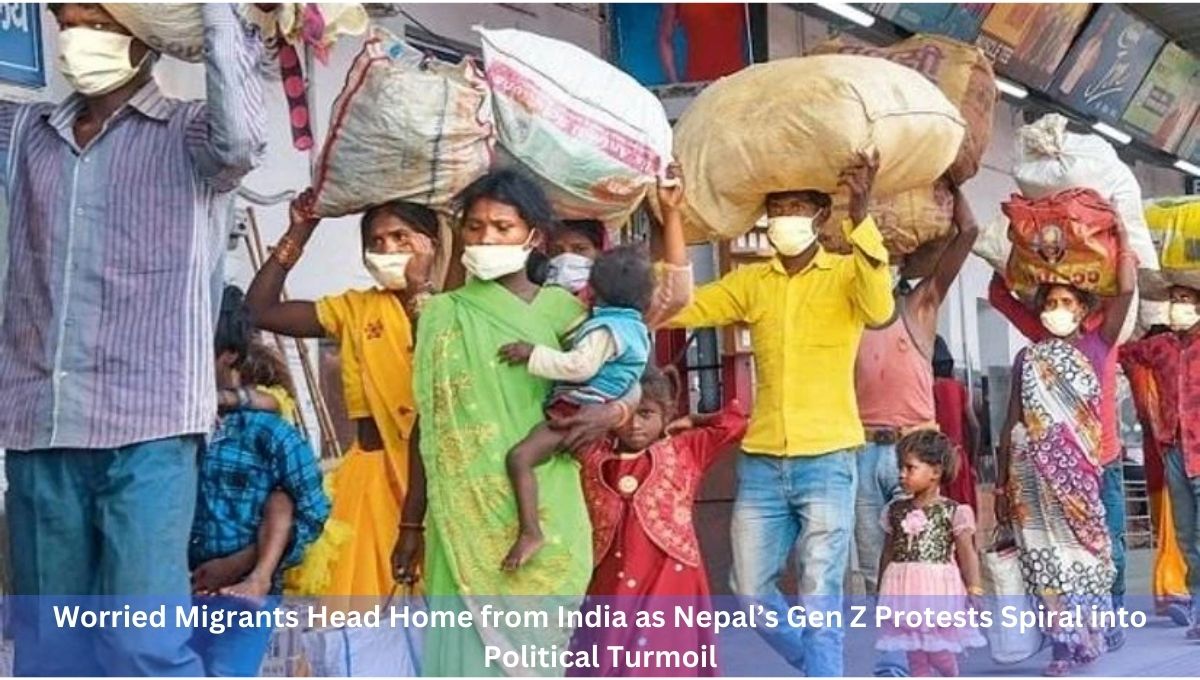
Amid Nepal’s worst crisis, Worried Migrants Head Home from India as Nepal’s Gen Z Protests Spiral into Political Turmoil. At a bus stand in the northern Indian city of Lucknow, anxious faces reveal the ripple effects of Nepal’s worst political crisis in decades. Nepalis who once came to India in search of work are now hurrying back across the border.
“We are returning home to our motherland,” says one man. “We are confused. People are asking us to come back.” Earlier this week, Nepal’s Prime Minister KP Sharma Oli resigned after violent clashes left at least 31 people dead and more than 1,000 injured. The unrest was triggered by a controversial social media ban that was later revoked, but the protests had already escalated into a nationwide youth-led movement.
With Oli gone, Nepal has no government in place. Soldiers now patrol the streets, curfews are enforced, and protesters have torched parliament, politicians’ homes, and even Kathmandu’s tallest hotel. For Nepali migrants in India, the turmoil back home has forced difficult choices.
Voices of Migrants
For migrants like Saroj Nevarbani, the decision is personal:
“There’s trouble back home, so I must return. My parents are there—the situation is grave.”
Others, like Pesal and Lakshman Bhatt, express uncertainty:
“We know nothing, but people at home have asked us to come back.” For many, the journey is not just about jobs or wages—it is about family, security, and identity.
Worried Migrants Head Home from India as Nepal’s Gen Z Protests Spiral into Political Turmoil
Who Are Nepal’s Migrants in India?
The flow of people between India and Nepal has deep historical roots, shaped by geography, politics, and survival. Nepalis in India broadly fall into three groups:
- Seasonal migrant workers – They leave families behind to work as cooks, domestic help, guards, or laborers. They lack Aadhaar, remain Nepali citizens, and move back and forth.
- Settled families – They relocate with families, often obtain Aadhaar, but keep Nepali citizenship and ties, even returning to vote.
- Indian citizens of Nepali ethnicity – Descendants of older waves of migration (18th–20th centuries), rooted in India but culturally linked to Nepal.
Nepal also tops the list of foreign students in India, with 13,000 out of 47,000 total foreign students. The 1,750 km open border—enabled by the 1950 Peace and Friendship Treaty—makes this movement easy, whether for jobs, studies, or family visits.
The Economic Lifeline: Remittances
Migration is not just about people—it is about Nepal’s economy.
- Remittances account for 27–30% of Nepal’s GDP (2024).
- Over 70% of households receive remittances.
- India contributes about one-fifth of all remittances.
This makes Nepal the world’s fourth most remittance-dependent country.
“Without remittances from India, Nepal’s poorest households would suffer immensely,” says Prof Jeevan Sharma of the University of Edinburgh.
Yet the migrants sending these lifelines often live in precarious conditions—cramped rooms, low wages, discrimination, and no healthcare.
Stories from the Ground
Take Dhanraj Kathayat, a security guard in Mumbai.
He first came to India in 1988, working in Nagpur, Goa, and Nasik before settling in Mumbai. For the last 16 years, he has worked as a security guard.
“I haven’t thought much about what’s happening back home,” he admits. “There’s so much joblessness in Nepal. Even those with education can’t find work. That’s why people like me left.”
Dhanraj’s family remains in Nepal. He earns just enough to survive and send money for his children’s education, visiting once a year.
“After so many years, I haven’t had much development for myself. Some migrants who went to Korea, the US, or Malaysia prospered—not people like us.”
Political Influence of Migrants
Do Nepali migrants shape politics back home? The answer is mixed.
- Historically: Migrants supported exiled leaders during the royal takeover and the Maoist insurgency.
- Today: Some still cross the border to vote, but their political influence has waned.
Still, almost every major Nepali party maintains sister organizations in Indian cities to mobilize funds and narratives.
Nepali Students in India: A Different Voice
While workers struggle, Nepali students in India offer more articulate and hopeful perspectives.
- Anant Mahto (Delhi): “The constitution is supreme. This is the time to rebuild.”
- Tekraj Koirala: “I worry for my family, but I have hope for tomorrow.”
- Abha Parajuli: “If I were in Nepal, I’d join protests—but I don’t support destroying property.”
Their words reflect both solidarity with protesters and desire for change.
The Gen Z Uprising: Anger at “Nepo Kids”
The protests were fueled not just by unemployment and corruption but also by resentment toward political elites’ children—Nepal’s “nepo kids.”
Social Media Outrage
On TikTok, Instagram, and X, hashtags like #PoliticiansNepoBabyNepal trended, showing images of luxury cars, handbags, and foreign trips by politicians’ children alongside photos of struggling citizens.
- Shrinkhala Khatiwada (daughter of ex-health minister) was targeted for flaunting wealth. Her family home was torched.
- Shivana Shrestha (singer, daughter-in-law of ex-PM Deuba) posted about luxury homes and fashion, sparking fury.
- Smita Dahal (granddaughter of Prachanda) was criticized for flaunting designer handbags.
- Saugat Thapa (son of Law Minister) was mocked for his lavish lifestyle.
Across Kathmandu, homes of these families were set on fire. Protesters declared:
“While the general public dies in poverty, these nepo kids wear clothes worth lakhs.”
Corruption and Inequality: The Breaking Point
Nepal has long been plagued by corruption.
- A Pokhara airport project saw $71 million embezzled, according to probes.
- Politicians were implicated in selling refugee quotas meant for displaced Nepalese.
Despite frequent scandals, prosecutions remain rare—fueling public anger.
Collapse of Government
As violence spread, Prime Minister KP Sharma Oli resigned, leaving Nepal without leadership.
- Parliament was burned.
- Ministers stepped down.
- The army imposed curfews, patrolling streets under prohibitory orders.
President Ramchandra Paudel, 80, appealed for calm but admitted the nation faced a “difficult situation.”
Also Read: How Discord became control room for Nepal’s Gen Z protests
The Fall of Kathmandu’s Tallest Hotel: Hilton in Flames
Among the most dramatic symbols of the protests was the destruction of the Hilton Hotel in Kathmandu.
- Inaugurated in July 2024 with a ₹8 billion investment.
- 172 rooms, spa, rooftop bar, EV charging, and views of the Himalayas.
- Once the tallest building in Nepal, located in Naxal.
On Tuesday, protesters set it ablaze. The luxury hotel burned for two days straight, turning into a charred shell.
Drone footage showed smoke billowing over the city.
For many, the Hilton became a symbol of inequality—a shining tower of privilege destroyed in a Gen Z uprising.
What Next for Nepal?
Analysts warn that each cycle of unrest drives more youth into India’s informal labor market.
Prof Bashyal of Tribhuvan University observes:
“This type of political crisis deepens unemployment. Nepali migrants in India will increase, but finding proper jobs will remain difficult.”
For migrants, the border is not just a line—it is a lifeline. It allows survival in India while keeping them tied to Nepal’s politics, economy, and families.
Conclusion
The return of migrants from India, the anger against nepo kids, the collapse of governance, and the burning of symbols like the Hilton Hotel all capture a historic turning point in Nepal’s trajectory. Whether this Gen Z-led movement leads to meaningful reform or deeper instability remains uncertain. But one thing is clear: Nepal’s crisis is reshaping lives not only within its borders but also across India, where millions of Nepalis have long sought refuge, work, and opportunity.
Related Posts:
- 7 Shocking Developments in KP Sharma Oli Arrest Over…

- 9 Powerful Reasons Why Balen Shah’s Victory Could…

- 10 Explosive Shifts: Nepal Votes in First Election…

- Nepal Gen Z Protests Escalate: 112 Indian Tourists…

- Nepal’s Gen Z Protests Push Sushila Karki and Kulman…

- Sushila Karki Sworn In as Nepal’s First Woman Prime…
