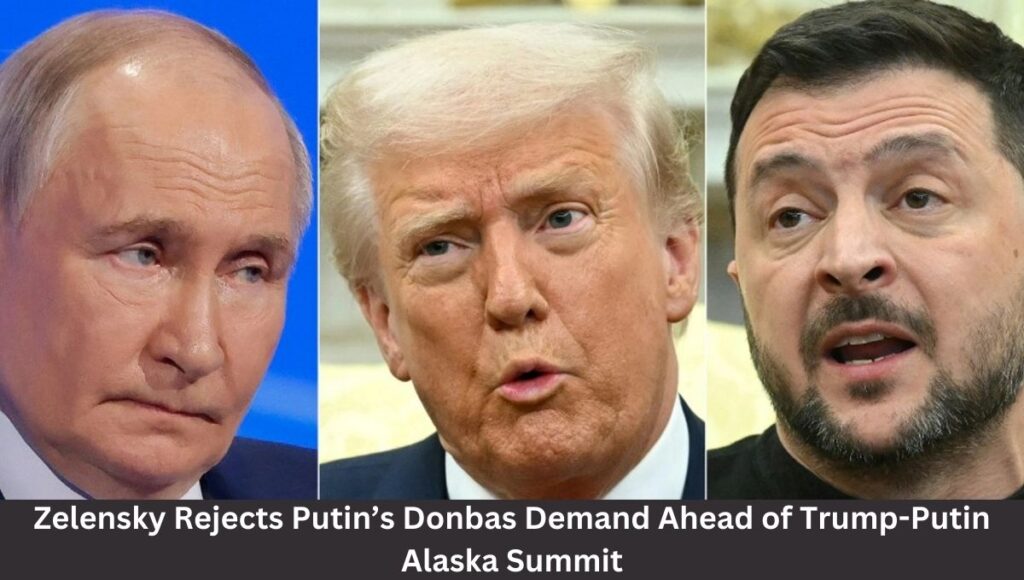
Vowing not to cede Donbas to Russia, Zelensky Rejects Putin’s Donbas Demand Ahead of Trump-Putin Alaska Summit. Ukrainian President Volodymyr Zelensky has firmly rejected Russian President Vladimir Putin’s reported demand for Ukraine to withdraw from its remaining territories in Donetsk, warning that such a move would give Moscow a “springboard” for future offensives.
Speaking to journalists in Kyiv on Tuesday, Zelensky said abandoning Donbas would risk triggering “a third war” in Ukraine. The statement comes just days before U.S. President Donald Trump and Putin are set to meet in Anchorage, Alaska, for a high-stakes summit expected to focus heavily on the war in Ukraine. According to reports, the Russian leader is likely to press for territorial concessions as part of a ceasefire deal.
Zelensky Rejects Putin’s Donbas Demand Ahead of Trump-Putin Alaska Summit
A Precarious Diplomatic Moment
Zelensky’s remarks underscore the tense diplomatic climate leading into the Alaska talks. While Trump has billed the meeting as a “listening exercise,” Moscow has signaled its intent to push for Ukrainian withdrawal from all parts of Donbas still under Kyiv’s control.
“For the Russians, Donbas is a springboard for a future new offensive,” Zelensky said. “If we leave Donbas of our own accord or under pressure, we will start a third war.”
The Ukrainian leader pointed to Russia’s illegal annexation of Crimea in 2014 and the full-scale invasion launched in 2022 as proof that concessions only embolden Moscow.
The Ceasefire Proposal and U.S. Mediation
The reported proposal emerged after U.S. special envoy Steve Witkoff met with Putin in Moscow. Witkoff allegedly conveyed that Putin wants Ukraine to leave Donbas entirely.
Zelensky, however, emphasized that the U.S. had not formally endorsed the demand.
“I do not believe that Putin’s proposal is Trump’s proposal,” Zelensky said. “Trump acts as a mediator he is in the middle, not on Russia’s side.”
Trump has hinted that a peace deal might involve “some land swapping” between Russia and Ukraine, acknowledging that Russia currently controls “very prime territory.”
Yet, the U.S. president insists his goal is to get both leaders in the same room to negotiate directly.
Strategic and Symbolic Importance of Donbas
The Donbas region encompassing Donetsk and Luhansk has been a flashpoint since 2014, when Russian-backed separatists seized territory following the annexation of Crimea.
Rich in coal, steel, and industrial infrastructure, the region holds both economic and strategic value for Moscow.
For Kyiv, retaining control over remaining pockets in Donetsk is essential for both sovereignty and security.
Military analysts warn that relinquishing these areas would expose Ukraine’s heartland including Dnipro, Zaporizhzhia, and Kharkiv to future Russian advances.
Also Read: Trump Eyes Land Swap in High-Stakes Putin Summit to End Ukraine War
Lessons from Crimea and Minsk
Zelensky’s caution draws on recent history. In 2014, international efforts to halt the fighting in eastern Ukraine resulted in the Minsk agreements, which froze the front lines but failed to secure lasting peace.
Russia used the lull to arm separatist forces and strengthen its grip on occupied territories.
By 2022, Moscow was prepared for a full-scale assault. For Zelensky, any repeat of that sequence freezing the front without binding security guarantees would be unacceptable.
European Concerns Over Alaska Summit
Across European capitals, officials worry that Trump and Putin could strike a deal without Kyiv’s full participation.
Polish Prime Minister Donald Tusk voiced both “fears and hope,” stressing that borders cannot be changed by force.
French President Emmanuel Macron and German Chancellor Friedrich Merz joined other EU leaders in stating that any settlement must start from the current line of contact and include security guarantees for Ukraine.
In a joint declaration, leaders from the European Commission, France, Italy, the UK, Poland, and Finland reaffirmed that “international borders must not be changed by force.”
Military Situation: Escalation Near Pokrovsk
On the ground, fighting continues to escalate. Ukrainian forces are reinforcing defensive lines near Pokrovsk and Dobropillia as Russian troops attempt to push deeper into Donetsk.
The Finland-based Black Bird Group reports that Russian units have advanced up to 17 kilometers beyond Ukrainian lines in recent days, with Kostiantynivka increasingly isolated.
Military analysts suggest that Russia aims to secure additional gains before the Alaska summit to strengthen its negotiating position.
Ukraine’s DeepState military blog has described the situation as “chaotic,” warning that Russian forces are consolidating gains at speed.
Residents in Donbas Fear Being Left Behind
In Sloviansk a city in Donetsk still under Ukrainian control news of potential territorial concessions has sparked fear and uncertainty.
Locals remember the city’s capture by Moscow-backed separatists in 2014 and its later liberation by Ukrainian forces.
“My friends want to stay here, but we might all have to leave,” a local journalist told CNN. “We have trenches dug around the city for a reason.”
Freeze-the-Frontline Option
According to The Telegraph, a European-backed peace plan would involve freezing the frontline and allowing Russia to keep control over occupied territories, including Luhansk, Donetsk, Zaporizhzhia, Kherson, and Crimea.
While Zelensky has expressed openness to halting fighting at current positions, he has ruled out surrendering additional land beyond what Russia already occupies.
Security Guarantees and NATO Membership
Kyiv’s position remains clear: any peace deal must include robust security guarantees and a defined path to NATO membership.
Without such protections, Ukraine fears Moscow will use any ceasefire to regroup for future offensives.
“No one except Europe is giving us security guarantees,” Zelensky said, noting the EU’s central role in ensuring Ukraine’s sovereignty.
Russia’s Wider Strategy
Analysts at the Institute for the Study of War believe Moscow is attempting to present the U.S. with a “fait accompli” securing as much territory as possible before talks.
Although recent gains do not constitute a strategic breakthrough, they could limit Kyiv’s leverage in negotiations.
International Dimensions: North Korea’s Support for Russia
The Kremlin revealed that Putin spoke with North Korean leader Kim Jong Un ahead of the Alaska summit.
According to Ukrainian intelligence, Pyongyang has sent over 10,000 troops and weapons to assist Russia since the 2022 invasion.
In a separate development, Ukraine’s SBU intelligence agency struck a Russian facility in Tatarstan more than 1,300 kilometers from Ukrainian territory that was being used to house Shahed drones.
Geopolitical Stakes of the Alaska Meeting
The Trump-Putin summit represents a geopolitical crossroads. Europe fears being sidelined, while Ukraine is determined to avoid concessions that could undermine its sovereignty.
For Zelensky, the stakes are existential: “I am not going to surrender my country because I have no right to do so.”
Also Read: Trump Backing Putin’s Ukraine Land Plan – AFP Source, Reports